Order Total (1 Item Items):
Shipping Destination:

Herschu (12 results)
Author:
herschu
Refine with Advanced Search
Skip to main search results
Search filters
Product Type
- All Product Types
- Books (No further results match this refinement)
- Magazines & Periodicals (No further results match this refinement)
- Comics (No further results match this refinement)
- Sheet Music (No further results match this refinement)
- Art, Prints & Posters (12)
- Photographs (No further results match this refinement)
- Maps (No further results match this refinement)
- Manuscripts & Paper Collectibles (No further results match this refinement)
Condition Learn more
- New (No further results match this refinement)
- As New, Fine or Near Fine (No further results match this refinement)
- Very Good or Good (No further results match this refinement)
- Fair or Poor (No further results match this refinement)
- As Described (12)
Binding
- All Bindings
- Hardcover (No further results match this refinement)
- Softcover (No further results match this refinement)
Collectible Attributes
- First Edition (No further results match this refinement)
- Signed (No further results match this refinement)
- Dust Jacket (No further results match this refinement)
- Seller-Supplied Images (12)
- Not Print on Demand (12)
Language (1)
Price
- Any Price
- Under US$ 25 (No further results match this refinement)
- US$ 25 to US$ 50 (No further results match this refinement)
- Over US$ 50
Free Shipping
- Free Shipping to U.S.A. (No further results match this refinement)
Seller Location
Seller Rating
-
Automotive design for Alexis Kellner AG Berlin Sport Cabriolet coachwork design by Alexis Kellner AG for an Austro-Daimler.
Publication Date: 1930
Seller: Shapero Rare Books, London, United Kingdom
Association Member: ABA ILAB PBFA
Seller rating 5 out of 5 stars

Art / Print / Poster
US$ 2,072.50
US$ 20.12 shipping
Ships from United Kingdom to U.S.A.Quantity: 1 available
Add to basketGouache and watercolour heightened with gum-arabic on cream card, faintly annotated in pencil with body type below, numbered '69', in upper left corner, German copyright stamp on verso, 27 x 42 cm (10½ x 16½ in). Finished in black with contrasting dark grey roof, and green coachlines with matching wire wheels, presented against a watercolour rural landscape background, this elegant 2-door cabriolet epitomises the brief pinnacle in the mixed fortunes of Austro-Daimler. Starting off in 1890 as simply the Austrian sales outlet of the German motor manufacturer, Daimler Motoren Gesellschaft, or DMG, founder Eduard Bierenz was soon persuaded to start making his own cars in conjunction with engine-builder, Eduard Fischer. Still an offshoot of the German company, in 1902 Gottlieb Daimler's son, Paul, took over technical developments, before being replaced in that role by the legendary Ferdinand Porsche. He took the company in a variety of directions, including more aerodynamic sports cars, aswell as powering buses, armoured vehicles and even the Zeppelin airship. After WW1, and before the company's collapse in the early 1930s, following a series of disastrous mergers and takeovers, it had developed a reputation for producing attractive sporting and luxury cars, attracting the interest of such coachbuilders as Kellner. Founded by Alexis Kellner (1880-1953) in 1910, in Berlin, the eponymous Alexis Kellner AG coachbuilding company's stylish automobile bodywork designs were immediately successful. This was demonstrated by the number of orders he received at the International Motor Show, in Berlin, in 1911. Kellner was noted for his inventiveness of small details, such as a concealed handle behind the driver's seat for quickly and easily raising and lowering the car's roof, concealed bonnet hinges, for aesthetic as well as aerodynamic reasons, and a suitcase mounted on the running board. The company's success reached its zenith in the 1920s, when it was famed for the luxury bodies it designed for such prestigious manufacturers as Audi, Austro-Daimler, Bugatti, Cadillac, Horch, Maybach, Mercedes, and others. This popularity stemmed from both the highly stylish external lines and the sumptuously appointed interiors. This emphasis on sensuous indulgence was even reflected in the company's pioneering use of nude women in its advertising. But, as with so many manufacturers dependent on wealth and stability in the market, its fortunes crashed in 1929, and Alexis Kellner was declared bankrupt in 1930. The brand name and patents were sold to arch-rival, Drauz in Heilbronn, against whom Kellner had launched a plagiarism suit in 1920 over a particular body design, who shrewdly maintained the Kellner name for its sales company. The stylishness of Kellner's coachbuilding was perfectly captured and presented to the public by the artistry of Herbert Schultz. Unlike the flamboyant designs he portrayed so skilfully, Schultz was a modest man, despite being a creative all-rounder. In 1818, as a commercial artist and caricaturist working for the Berliner Tageblatt, he gained the admiration of fellow contributor, the artist George Grosz. Schultz had only recently come to Berlin, having graduated from the Royal Academy of Graphic Arts in Leipzig, followed by a spell at the Kunstakademie in Hamburg. Schultz's skills as a graphic artist lent themselves perfectly to illustrating promotional catalogues to appeal to Alexis Kellner AG's affluent clientele, which had included the royal household. Always signing his work as 'Herschu', he presented these imposing designs against subtle open country landscapes, glamourous night cityscapes, or floating in isolation against a solid ground. Following the demise of Alexis Kellner AG, Schultz's ongoing artistic career was finally blocked by the Nazi state when he refused to part with his half-Jewish wife. So the Herschu name faded, as did that of Kellner, only for both to be rekindled now in these recently rediscovered, breathtaking, design.
-
Automotive design for Alexis Kellner AG Berlin Cabriolet coachwork design by Alexis Kellner AG for the Packard Custom Eight.
Publication Date: 1930
Seller: Shapero Rare Books, London, United Kingdom
Association Member: ABA ILAB PBFA
Seller rating 5 out of 5 stars
Art / Print / Poster
US$ 2,072.50
US$ 20.12 shipping
Ships from United Kingdom to U.S.A.Quantity: 1 available
Add to basketGouache and watercolour heightened with gum-arabic on very dark green card, annotated in pale ink with body type below, numbered '76', in upper left corner, German copyright label on verso, 27 x 42 cm (10½ x 16½ in). Finished in green with contrasting light green roof and matching solid disc wheels, presented against a silhouette of a grand palace, this imposing 4-door cabriolet was one of the more luxurious variant designs around the underpinnings of the company's straight-8 engine and drive train. It evolved from the Single Eight, so-called as it replaced the earlier V-12 known as the Double Six. Founded in 1899 by brothers James and William Packard, the eponymous company was not only one of the pioneers of North American motor manufacturing, but soon gained a global reputation for luxury and smoothness. The marque had been selling more models abroad than its competitors in the 1920s, culminating with selling twice as many as its closest rival by 1930. It is little wonder its the Packard received the attention of such creative luxury coachbuilders as Kellner. Founded by Alexis Kellner (1880-1953) in 1910, in Berlin, the eponymous Alexis Kellner AG coachbuilding company's stylish automobile bodywork designs were immediately successful. This was demonstrated by the number of orders he received at the International Motor Show, in Berlin, in 1911. Kellner was noted for his inventiveness of small details, such as a concealed handle behind the driver's seat for quickly and easily raising and lowering the car's roof, concealed bonnet hinges, for aesthetic as well as aerodynamic reasons, and a suitcase mounted on the running board. The company's success reached its zenith in the 1920s, when it was famed for the luxury bodies it designed for such prestigious manufacturers as Audi, Austro-Daimler, Bugatti, Cadillac, Horch, Maybach, Mercedes, and others. This popularity stemmed from both the highly stylish external lines and the sumptuously appointed interiors. This emphasis on sensuous indulgence was even reflected in the company's pioneering use of nude women in its advertising. But, as with so many manufacturers dependent on wealth and stability in the market, its fortunes crashed in 1929, and Alexis Kellner was declared bankrupt in 1930. The brand name and patents were sold to arch-rival, Drauz in Heilbronn, against whom Kellner had launched a plagiarism suit in 1920 over a particular body design, who shrewdly maintained the Kellner name for its sales company. The stylishness of Kellner's coachbuilding was perfectly captured and presented to the public by the artistry of Herbert Schultz. Unlike the flamboyant designs he portrayed so skilfully, Schultz was a modest man, despite being a creative all-rounder. In 1818, as a commercial artist and caricaturist working for the Berliner Tageblatt, he gained the admiration of fellow contributor, the artist George Grosz. Schultz had only recently come to Berlin, having graduated from the Royal Academy of Graphic Arts in Leipzig, followed by a spell at the Kunstakademie in Hamburg. Schultz's skills as a graphic artist lent themselves perfectly to illustrating promotional catalogues to appeal to Alexis Kellner AG's affluent clientele, which had included the royal household. Always signing his work as 'Herschu', he presented these imposing designs against subtle open country landscapes, glamourous night cityscapes, or floating in isolation against a solid ground. Following the demise of Alexis Kellner AG, Schultz's ongoing artistic career was finally blocked by the Nazi state when he refused to part with his half-Jewish wife. So the Herschu name faded, as did that of Kellner, only for both to be rekindled now in these recently rediscovered, breathtaking, design.
-
Automotive design for Alexis Kellner AG Berlin Landauline coachwork design by Alexis Kellner AG for the Packard Custom Eight.
Publication Date: 1930
Seller: Shapero Rare Books, London, United Kingdom
Association Member: ABA ILAB PBFA
Seller rating 5 out of 5 stars
Art / Print / Poster
US$ 2,072.50
US$ 20.12 shipping
Ships from United Kingdom to U.S.A.Quantity: 1 available
Add to basketGouache and watercolour heightened with gum-arabic on very dark green card, annotated in pale ink with body type below, numbered '75', in upper left corner, German copyright label on verso, 27 x 42 cm (10½ x 16½ in). Finished in dark brown with contrasting light brown coachlines and matching solid disc wheels, presented against a silhouetted skyline of a town with a twin-spired church, this grand 4-door landauline was one of the more luxurious variant designs around the underpinnings of the company's straight-8 engine and drive train. It evolved from the Single Eight, so-called as it replaced the earlier V-12 known as the Double Six. Founded in 1899 by brothers James and William Packard, the eponymous company was not only one of the pioneers of North American motor manufacturing, but soon gained a global reputation for luxury and smoothness. The marque had been selling more models abroad than its competitors in the 1920s, culminating with selling twice as many as its closest rival by 1930. It is little wonder its the Packard received the attention of such creative luxury coachbuilders as Kellner. Founded by Alexis Kellner (1880-1953) in 1910, in Berlin, the eponymous Alexis Kellner AG coachbuilding company's stylish automobile bodywork designs were immediately successful. This was demonstrated by the number of orders he received at the International Motor Show, in Berlin, in 1911. Kellner was noted for his inventiveness of small details, such as a concealed handle behind the driver's seat for quickly and easily raising and lowering the car's roof, concealed bonnet hinges, for aesthetic as well as aerodynamic reasons, and a suitcase mounted on the running board. The company's success reached its zenith in the 1920s, when it was famed for the luxury bodies it designed for such prestigious manufacturers as Audi, Austro-Daimler, Bugatti, Cadillac, Horch, Maybach, Mercedes, and others. This popularity stemmed from both the highly stylish external lines and the sumptuously appointed interiors. This emphasis on sensuous indulgence was even reflected in the company's pioneering use of nude women in its advertising. But, as with so many manufacturers dependent on wealth and stability in the market, its fortunes crashed in 1929, and Alexis Kellner was declared bankrupt in 1930. The brand name and patents were sold to arch-rival, Drauz in Heilbronn, against whom Kellner had launched a plagiarism suit in 1920 over a particular body design, who shrewdly maintained the Kellner name for its sales company. The stylishness of Kellner's coachbuilding was perfectly captured and presented to the public by the artistry of Herbert Schultz. Unlike the flamboyant designs he portrayed so skilfully, Schultz was a modest man, despite being a creative all-rounder. In 1818, as a commercial artist and caricaturist working for the Berliner Tageblatt, he gained the admiration of fellow contributor, the artist George Grosz. Schultz had only recently come to Berlin, having graduated from the Royal Academy of Graphic Arts in Leipzig, followed by a spell at the Kunstakademie in Hamburg. Schultz's skills as a graphic artist lent themselves perfectly to illustrating promotional catalogues to appeal to Alexis Kellner AG's affluent clientele, which had included the royal household. Always signing his work as 'Herschu', he presented these imposing designs against subtle open country landscapes, glamourous night cityscapes, or floating in isolation against a solid ground. Following the demise of Alexis Kellner AG, Schultz's ongoing artistic career was finally blocked by the Nazi state when he refused to part with his half-Jewish wife. So the Herschu name faded, as did that of Kellner, only for both to be rekindled now in these recently rediscovered, breathtaking, design.
-
Automotive design for Alexis Kellner AG Berlin Cabriolet coachwork design by Alexis Kellner AG for the Cadillac 341-A.
Publication Date: 1930
Seller: Shapero Rare Books, London, United Kingdom
Association Member: ABA ILAB PBFA
Seller rating 5 out of 5 stars
Art / Print / Poster
US$ 2,072.50
US$ 20.12 shipping
Ships from United Kingdom to U.S.A.Quantity: 1 available
Add to basketGouache and watercolour heightened with gum-arabic on very dark green card, annotated in pale ink with body type below, numbered '77', in upper left corner, German copyright label on verso, 27 x 42 cm (10½ x 16½ in). Finished in dark green with contrasting grey roof and matching solid disc wheels, presented against a silhouetted rural landscape with windmill, this imposing 4-door cabriolet was powered by Cadillac's famous V8 engine. Founded in 1902 from the remnants of Henry Ford's first manufacturing venture, the company was rebranded as Cadillac after the founder of the city of Detroit at the beginning of the 18th century, Antoine de la Mothe Cadillac. The firm was acquired by General Motors as early as 1909, to be their flagship brand, as by which time it had already made its mark as a maker of luxurious and technically innovative cars. The V8 engine was first introduced in 1915. The longer chassis of the 341-A of 1928 allowed for a sleeker, lower-slung, body that suited such a sporty design treatment by such creative coachbuilders as Kellner. Founded by Alexis Kellner (1880-1953) in 1910, in Berlin, the eponymous Alexis Kellner AG coachbuilding company's stylish automobile bodywork designs were immediately successful. This was demonstrated by the number of orders he received at the International Motor Show, in Berlin, in 1911. Kellner was noted for his inventiveness of small details, such as a concealed handle behind the driver's seat for quickly and easily raising and lowering the car's roof, concealed bonnet hinges, for aesthetic as well as aerodynamic reasons, and a suitcase mounted on the running board. The company's success reached its zenith in the 1920s, when it was famed for the luxury bodies it designed for such prestigious manufacturers as Audi, Austro-Daimler, Bugatti, Cadillac, Horch, Maybach, Mercedes, and others. This popularity stemmed from both the highly stylish external lines and the sumptuously appointed interiors. This emphasis on sensuous indulgence was even reflected in the company's pioneering use of nude women in its advertising. But, as with so many manufacturers dependent on wealth and stability in the market, its fortunes crashed in 1929, and Alexis Kellner was declared bankrupt in 1930. The brand name and patents were sold to arch-rival, Drauz in Heilbronn, against whom Kellner had launched a plagiarism suit in 1920 over a particular body design, who shrewdly maintained the Kellner name for its sales company. The stylishness of Kellner's coachbuilding was perfectly captured and presented to the public by the artistry of Herbert Schultz. Unlike the flamboyant designs he portrayed so skilfully, Schultz was a modest man, despite being a creative all-rounder. In 1818, as a commercial artist and caricaturist working for the Berliner Tageblatt, he gained the admiration of fellow contributor, the artist George Grosz. Schultz had only recently come to Berlin, having graduated from the Royal Academy of Graphic Arts in Leipzig, followed by a spell at the Kunstakademie in Hamburg. Schultz's skills as a graphic artist lent themselves perfectly to illustrating promotional catalogues to appeal to Alexis Kellner AG's affluent clientele, which had included the royal household. Always signing his work as 'Herschu', he presented these imposing designs against subtle open country landscapes, glamourous night cityscapes, or floating in isolation against a solid ground. Following the demise of Alexis Kellner AG, Schultz's ongoing artistic career was finally blocked by the Nazi state when he refused to part with his half-Jewish wife. So the Herschu name faded, as did that of Kellner, only for both to be rekindled now in these recently rediscovered, breathtaking, design.
-
Automotive design for Alexis Kellner AG Berlin Pullman Cabriolet coachwork design by Alexis Kellner AG for the Packard Custom Eight.
Publication Date: 1930
Seller: Shapero Rare Books, London, United Kingdom
Association Member: ABA ILAB PBFA
Seller rating 5 out of 5 stars
Art / Print / Poster
US$ 2,072.50
US$ 20.12 shipping
Ships from United Kingdom to U.S.A.Quantity: 1 available
Add to basketGouache and watercolour heightened with gum-arabic on very dark green card, annotated in pale ink with body type below, numbered '73', in upper left corner, German copyright label on verso, 27 x 42 cm (10½ x 16½ in). Finished in warm grey with matching solid disc wheels, presented against a silhouette of the Packard factory, this grand 4-door cabriolet was one of the more luxurious variant designs around the underpinnings of the company's straight-8 engine and drive train. It evolved from the Single Eight, so-called as it replaced the earlier V-12 known as the Double Six. Founded in 1899 by brothers James and William Packard, the eponymous company was not only one of the pioneers of North American motor manufacturing, but soon gained a global reputation for luxury and smoothness. The marque had been selling more models abroad than its competitors in the 1920s, culminating with selling twice as many as its closest rival by 1930. It is little wonder its the Packard received the attention of such creative luxury coachbuilders as Kellner. Founded by Alexis Kellner (1880-1953) in 1910, in Berlin, the eponymous Alexis Kellner AG coachbuilding company's stylish automobile bodywork designs were immediately successful. This was demonstrated by the number of orders he received at the International Motor Show, in Berlin, in 1911. Kellner was noted for his inventiveness of small details, such as a concealed handle behind the driver's seat for quickly and easily raising and lowering the car's roof, concealed bonnet hinges, for aesthetic as well as aerodynamic reasons, and a suitcase mounted on the running board. The company's success reached its zenith in the 1920s, when it was famed for the luxury bodies it designed for such prestigious manufacturers as Audi, Austro-Daimler, Bugatti, Cadillac, Horch, Maybach, Mercedes, and others. This popularity stemmed from both the highly stylish external lines and the sumptuously appointed interiors. This emphasis on sensuous indulgence was even reflected in the company's pioneering use of nude women in its advertising. But, as with so many manufacturers dependent on wealth and stability in the market, its fortunes crashed in 1929, and Alexis Kellner was declared bankrupt in 1930. The brand name and patents were sold to arch-rival, Drauz in Heilbronn, against whom Kellner had launched a plagiarism suit in 1920 over a particular body design, who shrewdly maintained the Kellner name for its sales company. The stylishness of Kellner's coachbuilding was perfectly captured and presented to the public by the artistry of Herbert Schultz. Unlike the flamboyant designs he portrayed so skilfully, Schultz was a modest man, despite being a creative all-rounder. In 1818, as a commercial artist and caricaturist working for the Berliner Tageblatt, he gained the admiration of fellow contributor, the artist George Grosz. Schultz had only recently come to Berlin, having graduated from the Royal Academy of Graphic Arts in Leipzig, followed by a spell at the Kunstakademie in Hamburg. Schultz's skills as a graphic artist lent themselves perfectly to illustrating promotional catalogues to appeal to Alexis Kellner AG's affluent clientele, which had included the royal household. Always signing his work as 'Herschu', he presented these imposing designs against subtle open country landscapes, glamourous night cityscapes, or floating in isolation against a solid ground. Following the demise of Alexis Kellner AG, Schultz's ongoing artistic career was finally blocked by the Nazi state when he refused to part with his half-Jewish wife. So the Herschu name faded, as did that of Kellner, only for both to be rekindled now in these recently rediscovered, breathtaking, design.
-
Automotive design for Alexis Kellner AG Berlin Pullman Limousine coachwork design by Alexis Kellner AG for the Adler Standard 8.
Publication Date: 1930
Seller: Shapero Rare Books, London, United Kingdom
Association Member: ABA ILAB PBFA
Seller rating 5 out of 5 stars
Art / Print / Poster
US$ 2,072.50
US$ 20.12 shipping
Ships from United Kingdom to U.S.A.Quantity: 1 available
Add to basketGouache and watercolour heightened with gum-arabic on very dark green card, annotated in pale ink with body type below, numbered '93', in upper left corner, German copyright stamp on verso, 27 x 42cm (10½ x 16½ in). Finished in two-tone dark and light brown, with matching solid disc wheels, picked out against a silhouetted trees, this handsome 4-door limousine would have represented the pinnacle of Frankfurt motor manufacturer, Adler's aspirations of entering the luxury car market. Better known for more modest vehicles, this was to be powered by an 8-cylinder engine, a development from their existing 6-cylinder model, itself an evolution of their staple 4-cylinder workhorse. Introduced in 1928, the Standard 8 fell foul of the global stock market crash a year later, and by the early 1930s, Adler had withdrawn from what had been the more affluent end of the market, to concentrate on its more utilitarian base. Although larger in scale than the rest of Adler's range, the Standard 8 had always fallen short of the true luxury offered by the likes of Mercedes, although this was clearly reflected in its far more modest price. Founded by Alexis Kellner (1880-1953) in 1910, in Berlin, the eponymous Alexis Kellner AG coachbuilding company's stylish automobile bodywork designs were immediately successful. This was demonstrated by the number of orders he received at the International Motor Show, in Berlin, in 1911. Kellner was noted for his inventiveness of small details, such as a concealed handle behind the driver's seat for quickly and easily raising and lowering the car's roof, concealed bonnet hinges, for aesthetic as well as aerodynamic reasons, and a suitcase mounted on the running board. The company's success reached its zenith in the 1920s, when it was famed for the luxury bodies it designed for such prestigious manufacturers as Audi, Austro-Daimler, Bugatti, Cadillac, Horch, Maybach, Mercedes, and others. This popularity stemmed from both the highly stylish external lines and the sumptuously appointed interiors. This emphasis on sensuous indulgence was even reflected in the company's pioneering use of nude women in its advertising. But, as with so many manufacturers dependent on wealth and stability in the market, its fortunes crashed in 1929, and Alexis Kellner was declared bankrupt in 1930. The brand name and patents were sold to arch-rival, Drauz in Heilbronn, against whom Kellner had launched a plagiarism suit in 1920 over a particular body design, who shrewdly maintained the Kellner name for its sales company. The stylishness of Kellner's coachbuilding was perfectly captured and presented to the public by the artistry of Herbert Schultz. Unlike the flamboyant designs he portrayed so skilfully, Schultz was a modest man, despite being a creative all-rounder. In 1818, as a commercial artist and caricaturist working for the Berliner Tageblatt, he gained the admiration of fellow contributor, the artist George Grosz. Schultz had only recently come to Berlin, having graduated from the Royal Academy of Graphic Arts in Leipzig, followed by a spell at the Kunstakademie in Hamburg. Schultz's skills as a graphic artist lent themselves perfectly to illustrating promotional catalogues to appeal to Alexis Kellner AG's affluent clientele, which had included the royal household. Always signing his work as 'Herschu', he presented these imposing designs against subtle open country landscapes, glamourous night cityscapes, or floating in isolation against a solid ground. Following the demise of Alexis Kellner AG, Schultz's ongoing artistic career was finally blocked by the Nazi state when he refused to part with his half-Jewish wife. So the Herschu name faded, as did that of Kellner, only for both to be rekindled now in these recently rediscovered, breathtaking, design.
-
Automotive design for Alexis Kellner AG Berlin Sportcabriolet coachwork design by Alexis Kellner AG for the Cadillac 341-A.
Publication Date: 1930
Seller: Shapero Rare Books, London, United Kingdom
Association Member: ABA ILAB PBFA
Seller rating 5 out of 5 stars
Art / Print / Poster
US$ 2,072.50
US$ 20.12 shipping
Ships from United Kingdom to U.S.A.Quantity: 1 available
Add to basketGouache and watercolour heightened with gum-arabic on very dark green card, annotated in pale ink with body type below, numbered '78', in upper left corner, German copyright label on verso, 27 x 42 cm (10½ x 16½ in). Finished in red with contrasting dark grey roof and trunk, with matching solid disc wheels, presented against a tree-lined rural roadside in silhouette, this graceful 2-door cabriolet was powered by Cadillac's famous V8 engine. Founded in 1902 from the remnants of Henry Ford's first manufacturing venture, the company was rebranded as Cadillac after the founder of the city of Detroit at the beginning of the 18th century, Antoine de la Mothe Cadillac. The firm was acquired by General Motors as early as 1909, to be their flagship brand, as by which time it had already made its mark as a maker of luxurious and technically innovative cars. The V8 engine was first introduced in 1915. The longer chassis of the 341-A of 1928 allowed for a sleeker, lower-slung, body that suited such a sporty design treatment by such creative coachbuilders as Kellner. Founded by Alexis Kellner (1880-1953) in 1910, in Berlin, the eponymous Alexis Kellner AG coachbuilding company's stylish automobile bodywork designs were immediately successful. This was demonstrated by the number of orders he received at the International Motor Show, in Berlin, in 1911. Kellner was noted for his inventiveness of small details, such as a concealed handle behind the driver's seat for quickly and easily raising and lowering the car's roof, concealed bonnet hinges, for aesthetic as well as aerodynamic reasons, and a suitcase mounted on the running board. The company's success reached its zenith in the 1920s, when it was famed for the luxury bodies it designed for such prestigious manufacturers as Audi, Austro-Daimler, Bugatti, Cadillac, Horch, Maybach, Mercedes, and others. This popularity stemmed from both the highly stylish external lines and the sumptuously appointed interiors. This emphasis on sensuous indulgence was even reflected in the company's pioneering use of nude women in its advertising. But, as with so many manufacturers dependent on wealth and stability in the market, its fortunes crashed in 1929, and Alexis Kellner was declared bankrupt in 1930. The brand name and patents were sold to arch-rival, Drauz in Heilbronn, against whom Kellner had launched a plagiarism suit in 1920 over a particular body design, who shrewdly maintained the Kellner name for its sales company. The stylishness of Kellner's coachbuilding was perfectly captured and presented to the public by the artistry of Herbert Schultz. Unlike the flamboyant designs he portrayed so skilfully, Schultz was a modest man, despite being a creative all-rounder. In 1818, as a commercial artist and caricaturist working for the Berliner Tageblatt, he gained the admiration of fellow contributor, the artist George Grosz. Schultz had only recently come to Berlin, having graduated from the Royal Academy of Graphic Arts in Leipzig, followed by a spell at the Kunstakademie in Hamburg. Schultz's skills as a graphic artist lent themselves perfectly to illustrating promotional catalogues to appeal to Alexis Kellner AG's affluent clientele, which had included the royal household. Always signing his work as 'Herschu', he presented these imposing designs against subtle open country landscapes, glamourous night cityscapes, or floating in isolation against a solid ground. Following the demise of Alexis Kellner AG, Schultz's ongoing artistic career was finally blocked by the Nazi state when he refused to part with his half-Jewish wife. So the Herschu name faded, as did that of Kellner, only for both to be rekindled now in these recently rediscovered, breathtaking, design.
-
Automotive design for Alexis Kellner AG Berlin Pullman Cabriolet coachwork design by Alexis Kellner AG for the Mercedes Typ Mannheim (W10).
Publication Date: 1930
Seller: Shapero Rare Books, London, United Kingdom
Association Member: ABA ILAB PBFA
Seller rating 5 out of 5 stars
Art / Print / Poster
US$ 2,072.50
US$ 20.12 shipping
Ships from United Kingdom to U.S.A.Quantity: 1 available
Add to basketGouache and watercolour heightened with gum-arabic on very dark green card, annotated in pale ink with body type below, numbered '74', in upper left corner, German copyright stamp on verso, 27 x 42 cm (10½ x 16½ in). Finished in pale blue with contrasting mid-blue roof and coachlines, and corresponding pale blue spoked wheels, presented against a landscape background silhouetted trees, this grand 4-door cabriolet was one of many variant designs around the underpinnings of the Mercedes Typ Mannheim, which ran from 1929 to 1934, and was designed by Mercedes' then chief engineer, the legendary Ferdinand Porsche. It was based on a 6-cylinder 3.4 litre engine that established the reputation for reliability and longevity enjoyed by Mercedes engines to this day. Founded by Alexis Kellner (1880-1953) in 1910, in Berlin, the eponymous Alexis Kellner AG coachbuilding company's stylish automobile bodywork designs were immediately successful. This was demonstrated by the number of orders he received at the International Motor Show, in Berlin, in 1911. Kellner was noted for his inventiveness of small details, such as a concealed handle behind the driver's seat for quickly and easily raising and lowering the car's roof, concealed bonnet hinges, for aesthetic as well as aerodynamic reasons, and a suitcase mounted on the running board. The company's success reached its zenith in the 1920s, when it was famed for the luxury bodies it designed for such prestigious manufacturers as Audi, Austro-Daimler, Bugatti, Cadillac, Horch, Maybach, Mercedes, and others. This popularity stemmed from both the highly stylish external lines and the sumptuously appointed interiors. This emphasis on sensuous indulgence was even reflected in the company's pioneering use of nude women in its advertising. But, as with so many manufacturers dependent on wealth and stability in the market, its fortunes crashed in 1929, and Alexis Kellner was declared bankrupt in 1930. The brand name and patents were sold to arch-rival, Drauz in Heilbronn, against whom Kellner had launched a plagiarism suit in 1920 over a particular body design, who shrewdly maintained the Kellner name for its sales company. The stylishness of Kellner's coachbuilding was perfectly captured and presented to the public by the artistry of Herbert Schultz. Unlike the flamboyant designs he portrayed so skilfully, Schultz was a modest man, despite being a creative all-rounder. In 1818, as a commercial artist and caricaturist working for the Berliner Tageblatt, he gained the admiration of fellow contributor, the artist George Grosz. Schultz had only recently come to Berlin, having graduated from the Royal Academy of Graphic Arts in Leipzig, followed by a spell at the Kunstakademie in Hamburg. Schultz's skills as a graphic artist lent themselves perfectly to illustrating promotional catalogues to appeal to Alexis Kellner AG's affluent clientele, which had included the royal household. Always signing his work as 'Herschu', he presented these imposing designs against subtle open country landscapes, glamourous night cityscapes, or floating in isolation against a solid ground. Following the demise of Alexis Kellner AG, Schultz's ongoing artistic career was finally blocked by the Nazi state when he refused to part with his half-Jewish wife. So the Herschu name faded, as did that of Kellner, only for both to be rekindled now in these recently rediscovered, breathtaking, design.
-
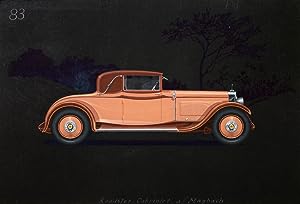
Automotive design for Alexis Kellner AG Berlin. Roadster Cabriolet coachwork design by Alexis Kellner AG for the Maybach Type 12.
Publication Date: 1930
Seller: Shapero Rare Books, London, United Kingdom
Association Member: ABA ILAB PBFA
Seller rating 5 out of 5 stars
Art / Print / Poster
US$ 2,072.50
US$ 20.12 shipping
Ships from United Kingdom to U.S.A.Quantity: 1 available
Add to basketGouache and watercolour heightened with gum-arabic on very dark green card, annotated in pale ink with body type below, numbered '83', in upper left corner, German copyright stamp on verso, 270 x 420 mm. Finished in light brown with dark brown hood and wings, with matching solid disc wheels picked out against silhouetted trees, this deceptively large 2-door roadster was one of many variant designs around the underpinnings of Maybach's awesome V-12 engine and running gear, introduced in 1929. It was actually achieved by marrying two 6-cylinder units at a 60 degree angle. The company was founded in 1909 by Wilhelm Maybach and his son Karl, as Luftfahrzeug-Motorenbau GmbH, producing engines for the burgeoning aeroplane and airship industries, including for the famous Zeppelin. It was rebranded Maybach-Motorenbau GmbH in 1912, as the scope of application widened to include rail locomotives and by 1919 the company was experimenting with its own motorcars. From 1921 to WWII, the name Maybach became synonymous with powerful and luxurious motoring, its engine and chassis designs readily lending themselves to the creative imaginations of such coachbuilders as Kellner. Founded by Alexis Kellner (1880-1953) in 1910, in Berlin, the eponymous Alexis Kellner AG coachbuilding company's stylish automobile bodywork designs were immediately successful. This was demonstrated by the number of orders he received at the International Motor Show, in Berlin, in 1911. Kellner was noted for his inventiveness of small details, such as a concealed handle behind the driver's seat for quickly and easily raising and lowering the car's roof, concealed bonnet hinges, for aesthetic as well as aerodynamic reasons, and a suitcase mounted on the running board. The company's success reached its zenith in the 1920s, when it was famed for the luxury bodies it designed for such prestigious manufacturers as Audi, Austro-Daimler, Bugatti, Cadillac, Horch, Maybach, Mercedes, and others. This popularity stemmed from both the highly stylish external lines and the sumptuously appointed interiors. This emphasis on sensuous indulgence was even reflected in the company's pioneering use of nude women in its advertising. But, as with so many manufacturers dependent on wealth and stability in the market, its fortunes crashed in 1929, and Alexis Kellner was declared bankrupt in 1930. The brand name and patents were sold to arch-rival, Drauz in Heilbronn, against whom Kellner had launched a plagiarism suit in 1920 over a particular body design, who shrewdly maintained the Kellner name for its sales company. The stylishness of Kellner's coachbuilding was perfectly captured and presented to the public by the artistry of Herbert Schultz. Unlike the flamboyant designs he portrayed so skilfully, Schultz was a modest man, despite being a creative all-rounder. In 1818, as a commercial artist and caricaturist working for the Berliner Tageblatt, he gained the admiration of fellow contributor, the artist George Grosz. Schultz had only recently come to Berlin, having graduated from the Royal Academy of Graphic Arts in Leipzig, followed by a spell at the Kunstakademie in Hamburg. Schultz's skills as a graphic artist lent themselves perfectly to illustrating promotional catalogues to appeal to Alexis Kellner AG's affluent clientele, which had included the royal household. Always signing his work as 'Herschu', he presented these imposing designs against subtle open country landscapes, glamourous night cityscapes, or floating in isolation against a solid ground. Following the demise of Alexis Kellner AG, Schultz's ongoing artistic career was finally blocked by the Nazi state when he refused to part with his half-Jewish wife. So the Herschu name faded, as did that of Kellner, only for both to be rekindled now in these recently rediscovered, breathtaking, design.
-
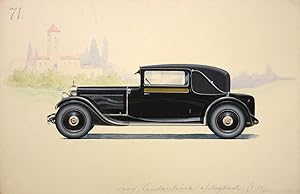
Automotive design for Alexis Kellner AG Berlin Sport Landauline coachwork design by Alexis Kellner AG for the Maybach Type 12.
Publication Date: 1930
Seller: Shapero Rare Books, London, United Kingdom
Association Member: ABA ILAB PBFA
Seller rating 5 out of 5 stars
Art / Print / Poster
US$ 2,072.50
US$ 20.12 shipping
Ships from United Kingdom to U.S.A.Quantity: 1 available
Add to basketGouache and watercolour heightened with gum-arabic on cream card, annotated in pencil with body type below, numbered '71', in upper left corner, German copyright stamp on verso, 27 x 42 cm (10½ x 16½ in). Finished in black with matching solid disc wheels, a contrasting textured panel inset to the doors, presented against a landscape background with a large complex of buildings to the left, this stylish 2-door landauline was one of many variant designs around the underpinnings of Maybach's awesome V-12 engine and running gear, introduced in 1929. It was actually achieved by marrying two 6-cylinder units at a 60 degree angle. The company was founded in 1909 by Wilhelm Maybach and his son Karl, as Luftfahrzeug-Motorenbau GmbH, producing engines for the burgeoning airplane and airship industries, including for the famous Zeppelin. It was rebranded Maybach-Motorenbau GmbH in 1912, as the scope of application widened to include rail locomotives, and by 1919 they experimenting with their own motorcars. From 1921 to WWII, the name Maybach became synonymous with powerful and luxurious motoring, its engine and chassis designs readily lending themselves to the creative imaginations of such coachbuilders as Kellner. Founded by Alexis Kellner (1880-1953) in 1910, in Berlin, the eponymous Alexis Kellner AG coachbuilding company's stylish automobile bodywork designs were immediately successful. This was demonstrated by the number of orders he received at the International Motor Show, in Berlin, in 1911. Kellner was noted for his inventiveness of small details, such as a concealed handle behind the driver's seat for quickly and easily raising and lowering the car's roof, concealed bonnet hinges, for aesthetic as well as aerodynamic reasons, and a suitcase mounted on the running board. The company's success reached its zenith in the 1920s, when it was famed for the luxury bodies it designed for such prestigious manufacturers as Audi, Austro-Daimler, Bugatti, Cadillac, Horch, Maybach, Mercedes, and others. This popularity stemmed from both the highly stylish external lines and the sumptuously appointed interiors. This emphasis on sensuous indulgence was even reflected in the company's pioneering use of nude women in its advertising. But, as with so many manufacturers dependent on wealth and stability in the market, its fortunes crashed in 1929, and Alexis Kellner was declared bankrupt in 1930. The brand name and patents were sold to arch-rival, Drauz in Heilbronn, against whom Kellner had launched a plagiarism suit in 1920 over a particular body design, who shrewdly maintained the Kellner name for its sales company. The stylishness of Kellner's coachbuilding was perfectly captured and presented to the public by the artistry of Herbert Schultz. Unlike the flamboyant designs he portrayed so skilfully, Schultz was a modest man, despite being a creative all-rounder. In 1818, as a commercial artist and caricaturist working for the Berliner Tageblatt, he gained the admiration of fellow contributor, the artist George Grosz. Schultz had only recently come to Berlin, having graduated from the Royal Academy of Graphic Arts in Leipzig, followed by a spell at the Kunstakademie in Hamburg. Schultz's skills as a graphic artist lent themselves perfectly to illustrating promotional catalogues to appeal to Alexis Kellner AG's affluent clientele, which had included the royal household. Always signing his work as 'Herschu', he presented these imposing designs against subtle open country landscapes, glamourous night cityscapes, or floating in isolation against a solid ground. Following the demise of Alexis Kellner AG, Schultz's ongoing artistic career was finally blocked by the Nazi state when he refused to part with his half-Jewish wife. So the Herschu name faded, as did that of Kellner, only for both to be rekindled now in these recently rediscovered, breathtaking, design.
-
Automotive design for Alexis Kellner AG Berlin Half-Limousine coachwork design by Alexis Kellner AG for an Austro-Daimler.
Publication Date: 1930
Seller: Shapero Rare Books, London, United Kingdom
Association Member: ABA ILAB PBFA
Seller rating 5 out of 5 stars
Art / Print / Poster
US$ 2,072.50
US$ 20.12 shipping
Ships from United Kingdom to U.S.A.Quantity: 1 available
Add to basketGouache and watercolour heightened with gum-arabic on very dark green card, annotated in pale ink with body type below, numbered '84', in upper left corner, German copyright label on verso, 27 x 42 cm (10½ x 16½ in), a tear at the left sheet edge into the background. Finished in pale blue with contrasting black roof and trunk, gold coachline and with wire wheels, presented against landscape background in silhouette, this stately 4-door 'Halb-Limousine' epitomises the brief pinnacle in the mixed fortunes of Austro-Daimler. Starting off in 1890 as simply the Austrian sales outlet of the German motor manufacturer, Daimler Motoren Gesellschaft, or DMG, founder Eduard Bierenz was soon persuaded to start making his own cars in conjunction with engine-builder, Eduard Fischer. Still an offshoot of the German company, in 1902 Gottlieb Daimler's son, Paul, took over technical developments, before being replaced in that role by the legendary Ferdinand Porsche. He took the company in a variety of directions, including more aerodynamic sports cars, aswell as powering buses, armoured vehicles and even the Zeppelin airship. After WW1, and before the company's collapse in the early 1930s, following a series of disastrous mergers and takeovers, it had developed a reputation for producing attractive sporting and luxury cars, attracting the interest of such coachbuilders as Kellner. Founded by Alexis Kellner (1880-1953) in 1910, in Berlin, the eponymous Alexis Kellner AG coachbuilding company's stylish automobile bodywork designs were immediately successful. This was demonstrated by the number of orders he received at the International Motor Show, in Berlin, in 1911. Kellner was noted for his inventiveness of small details, such as a concealed handle behind the driver's seat for quickly and easily raising and lowering the car's roof, concealed bonnet hinges, for aesthetic as well as aerodynamic reasons, and a suitcase mounted on the running board. The company's success reached its zenith in the 1920s, when it was famed for the luxury bodies it designed for such prestigious manufacturers as Audi, Austro-Daimler, Bugatti, Cadillac, Horch, Maybach, Mercedes, and others. This popularity stemmed from both the highly stylish external lines and the sumptuously appointed interiors. This emphasis on sensuous indulgence was even reflected in the company's pioneering use of nude women in its advertising. But, as with so many manufacturers dependent on wealth and stability in the market, its fortunes crashed in 1929, and Alexis Kellner was declared bankrupt in 1930. The brand name and patents were sold to arch-rival, Drauz in Heilbronn, against whom Kellner had launched a plagiarism suit in 1920 over a particular body design, who shrewdly maintained the Kellner name for its sales company. The stylishness of Kellner's coachbuilding was perfectly captured and presented to the public by the artistry of Herbert Schultz. Unlike the flamboyant designs he portrayed so skilfully, Schultz was a modest man, despite being a creative all-rounder. In 1818, as a commercial artist and caricaturist working for the Berliner Tageblatt, he gained the admiration of fellow contributor, the artist George Grosz. Schultz had only recently come to Berlin, having graduated from the Royal Academy of Graphic Arts in Leipzig, followed by a spell at the Kunstakademie in Hamburg. Schultz's skills as a graphic artist lent themselves perfectly to illustrating promotional catalogues to appeal to Alexis Kellner AG's affluent clientele, which had included the royal household. Always signing his work as 'Herschu', he presented these imposing designs against subtle open country landscapes, glamourous night cityscapes, or floating in isolation against a solid ground. Following the demise of Alexis Kellner AG, Schultz's ongoing artistic career was finally blocked by the Nazi state when he refused to part with his half-Jewish wife. So the Herschu name faded, as did that of Kellner, only for both to be rekindled now in these recently rediscovered, breathtaking, design.
-
Automotive design for Alexis Kellner AG Berlin Sportcabriolet coachwork design by Alexis Kellner AG for an Austro-Daimler.
Publication Date: 1930
Seller: Shapero Rare Books, London, United Kingdom
Association Member: ABA ILAB PBFA
Seller rating 5 out of 5 stars
Art / Print / Poster
US$ 2,072.50
US$ 20.12 shipping
Ships from United Kingdom to U.S.A.Quantity: 1 available
Add to basketGouache and watercolour heightened with gum-arabic on very dark green card, annotated in pale ink with body type below, numbered '79', in upper left corner, German copyright label on verso, 27 x 42 cm (10½ x 16½ in). Finished in pale blue with contrasting pale grey roof and trunk, with matching wire wheels, presented against landscape background with a hilltop town in silhouette, this spritely 2-door cabriolet epitomises the brief pinnacle in the mixed fortunes of Austro-Daimler. Starting off in 1890 as simply the Austrian sales outlet of the German motor manufacturer, Daimler Motoren Gesellschaft, or DMG, founder Eduard Bierenz was soon persuaded to start making his own cars in conjunction with engine-builder, Eduard Fischer. Still an offshoot of the German company, in 1902 Gottlieb Daimler's son, Paul, took over technical developments, before being replaced in that role by the legendary Ferdinand Porsche. He took the company in a variety of directions, including more aerodynamic sports cars, aswell as powering buses, armoured vehicles and even the Zeppelin airship. After WW1, and before the company's collapse in the early 1930s, following a series of disastrous mergers and takeovers, it had developed a reputation for producing attractive sporting and luxury cars, attracting the interest of such coachbuilders as Kellner. Founded by Alexis Kellner (1880-1953) in 1910, in Berlin, the eponymous Alexis Kellner AG coachbuilding company's stylish automobile bodywork designs were immediately successful. This was demonstrated by the number of orders he received at the International Motor Show, in Berlin, in 1911. Kellner was noted for his inventiveness of small details, such as a concealed handle behind the driver's seat for quickly and easily raising and lowering the car's roof, concealed bonnet hinges, for aesthetic as well as aerodynamic reasons, and a suitcase mounted on the running board. The company's success reached its zenith in the 1920s, when it was famed for the luxury bodies it designed for such prestigious manufacturers as Audi, Austro-Daimler, Bugatti, Cadillac, Horch, Maybach, Mercedes, and others. This popularity stemmed from both the highly stylish external lines and the sumptuously appointed interiors. This emphasis on sensuous indulgence was even reflected in the company's pioneering use of nude women in its advertising. But, as with so many manufacturers dependent on wealth and stability in the market, its fortunes crashed in 1929, and Alexis Kellner was declared bankrupt in 1930. The brand name and patents were sold to arch-rival, Drauz in Heilbronn, against whom Kellner had launched a plagiarism suit in 1920 over a particular body design, who shrewdly maintained the Kellner name for its sales company. The stylishness of Kellner's coachbuilding was perfectly captured and presented to the public by the artistry of Herbert Schultz. Unlike the flamboyant designs he portrayed so skilfully, Schultz was a modest man, despite being a creative all-rounder. In 1818, as a commercial artist and caricaturist working for the Berliner Tageblatt, he gained the admiration of fellow contributor, the artist George Grosz. Schultz had only recently come to Berlin, having graduated from the Royal Academy of Graphic Arts in Leipzig, followed by a spell at the Kunstakademie in Hamburg. Schultz's skills as a graphic artist lent themselves perfectly to illustrating promotional catalogues to appeal to Alexis Kellner AG's affluent clientele, which had included the royal household. Always signing his work as 'Herschu', he presented these imposing designs against subtle open country landscapes, glamourous night cityscapes, or floating in isolation against a solid ground. Following the demise of Alexis Kellner AG, Schultz's ongoing artistic career was finally blocked by the Nazi state when he refused to part with his half-Jewish wife. So the Herschu name faded, as did that of Kellner, only for both to be rekindled now in these recently rediscovered, breathtaking, design.