
Honshu (7 results)
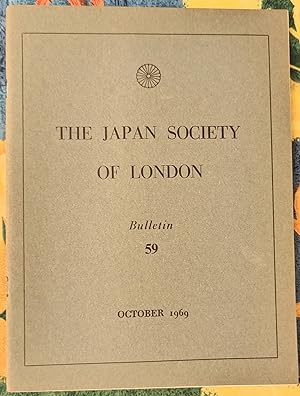
The Japan Society Of London Bulletin 59, October 1969
W P C de Trafford (Editor) / Sir Frank Bowden "The Japanese Sword in Legend, Story and Fact" / (BT#33)I H Burnett and D F Severs "Festivals and Colour of Western Honshu" / Japan's Student Life / U A Casal "Combs in Japan" / Japan Today (1969) / H W Gardner (Editor) "BONSAI KAI BULLETIN"
Published by The Japan Society 1969
- Softcover
- Periodical
Seller: Shore Books, London, United KingdomShore Books
Contact seller5-star sellerCondition: Used - Very good
US$ 10.28
US$ 14.63 shippingShips from United Kingdom to U.S.A.Quantity: 1 available
Soft cover. Condition: Very Good. 42 pages. Sir Frank Bowden "The Japanese Sword in Legend, Story and Fact" / (BT#33)I H Burnett and D F Severs "Festivals and Colour of Western Honshu" / Japan's Student Life / U A Casal "Combs in Japan" / Japan Today (1969) / H W Gardner (Editor) "BONSAI KAI BULLETIN".

Published by Not Available 1914
- Softcover
Seller: Sunny Day Bookstore, SINGAPORE, , SingaporeSunny Day Bookstore
Contact seller4-star sellerCondition: Used - Fine
US$ 60.00
US$ 15.00 shippingShips from Singapore to U.S.A.Quantity: 1 available
Condition: Fine. The book is in fine condition.

Published by University Academy Press inc Tokyo, Japan 1992
- Softcover
Seller: beaumont books, Beaumont-cum-Moze, ESSEX, United Kingdombeaumont books
Contact seller4-star sellerCondition: Used - As new
US$ 41.10
US$ 46.55 shippingShips from United Kingdom to U.S.A.Quantity: 1 available
Soft cover. Condition: As New. No Jacket. This copy was presented to the participants at the Japan society of civil engineers at the International Session of the 1988 Annual convention of the American society of civil engineers (ASCE).
 More images
Published by Sanyo Movie Co LTD, Toppan Printing Com LTD 1988
- Hardcover
- First Edition
Seller: beaumont books, Beaumont-cum-Moze, ESSEX, United Kingdombeaumont books
Contact seller4-star sellerCondition: Used - As new
US$ 109.59
US$ 46.55 shippingShips from United Kingdom to U.S.A.Quantity: 1 available
Hardcover. Condition: As New. Dust Jacket Condition: As New. 1st Edition. Book in slip cover, Japanese and English The Great Seto Bridge, or Seto-Ohashi Bridge, is a series of double deck bridges connecting Okayama and Kagawa prefectures in Japan across a series of five small islands in the Seto Inland Sea. Built over the period… 1978 1988, it is one of the three routes of the Honshū-Shikoku Bridge Project connecting Honshū and Shikoku islands. At 13.1 km long, it ranks as the world's longest two-tiered bridge system.Crossing the bridge takes about 20 minutes by car or train. The ferry crossing before the bridge was built took about an hour. The non-discounted toll from Kojima, Kurashiki (Okayama Prefecture on the Honshū side) to Sakaide (Kagawa Prefecture on the Shikoku side) is ¥3,500, and vice-versa.The bridges carry two lanes of highway traffic in each direction (Seto-Chūō Expressway) on the upper deck and one railway track in each direction (Seto-Ōhashi Line) on the lower deck. The lower deck was designed to accommodate an additional Shinkansen rail line in each direction.
 More images
6 Ansichtskarten Japan um 1910, Nihon Rhein (Fluss Kiso auf Honshu), Schaluppen, Boote
6 Ansichtskarten Japan um 1910, Nihon Rhein (Fluss Kiso auf Honshu), Schaluppen, Boote
Published by Japan um 1910 1910
- Photo
Seller: Antiquariat Thomas Mertens, Berlin, GermanyAntiquariat Thomas Mertens
Contact seller4-star sellerCondition: Used - Very good
US$ 94.81
US$ 63.29 shippingShips from Germany to U.S.A.Quantity: 1 available
Kein Einband. Condition: Gut. 6 Ansichtskarten Japan um 1910, Nihon Rhein (Fluss Kiso auf Honshu), Schaluppen, Boote Postkarten Japan --- Sechs schöne Ansichtskarten von den "Nihon Rhein" (japanischer Rhein) genannten Stromschnellen des Flusses Kiso zwischen Minokamo (Präfektur Gifu) und Inuyama (Präfektur Aichi) auf der japanis…chen Halbinsel Honshu. Vorhanden sind vier Motive aus der Serie "The fien landscape of Nihon Rhine Riv. Kiso" und zwei Motive aus der Serie "Famous Places in Nihonrain Kisocawa". Der Serientitel auf englisch; das genaue Motiv auf japanisch bezeichnet. Zu sehen sind kleine Segelboote (Schaluppen). Japan um 1910 Sechs s/w-Ansichtskarten (8,9 x 14,1 cm), ungelaufen, rückseitig blanko. --- Zustand: Rückseiten leicht fleckig, ansonsten sehr guter Zustand.

Language: German
- Art Print
Seller: Antiquariat Clemens Paulusch GmbH, Berlin, , GermanyAntiquariat Clemens Paulusch GmbH
Contact seller5-star sellerCondition: Used
US$ 71.11
US$ 30.95 shippingShips from Germany to U.S.A.Quantity: 1 available
Stahlstich aus Strahlheim, 1838, 9,3 x 13,2.
 More images
- First Edition
Seller: R & A Petrilla, Booksellers & Appraisers, Roosevelt, NJ, U.S.A.R & A Petrilla, Booksellers & Appraisers
Contact seller4-star sellerCondition: Used - Very good
US$ 672.00
US$ 5.00 shippingShips within U.S.A.Quantity: 1 available
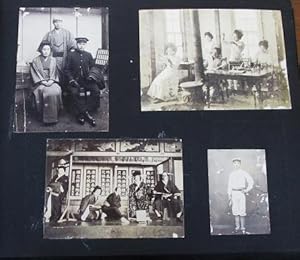
Condition: Very Good. Original photograph album. Oblong, string-tied album of black cardstock leaves, 11" x 13", photographs mounted on 35pp, blanks at the rear. Bound in black, flexible boards with an embossed sailing ship and gilt lettering (Photo-Album) on the cover. Pasted in are 116 albumen and silver gelatin prints, rangin…g from small candids to 8 ½" x 10 ½" group portraits, a few fading, overall sharp and clean. Laid into the album are a Japanese news article, a small head-shot of an older gentleman, and a watercolor portrait (10" x 8 ¼") of a man's face. Most of the photographs in this album. circa 1895-1925, were taken in Mie-Ken (or "Mie prefecture"), part of the Kansai region on the main island of Honshu. The group and individual portraits reflect new social and economic developments and cultural norms that emerged during this period. Subjects are shown in either traditional Japanese garments or in Western dress. Group shots often depict people wearing both styles within the same picture. There are many group shots of schoolchildren of both sexes, young people in uniforms posed before buildings with Japanese signs on them, as well as many formal group shots of families, some "nuclear"husband, wife, children others extended by relatives. Individual shots of young children show them almost invariably in western dress, one posed with his tricycle, young boys in uniform, a young girl in kimono showing a dance move while holding a fan, infants in traditional robes, and young men in business suits. Several birdseye views feature very large groups of rural people in traditional dress, posed outdoors. Among the most striking photographs are: one (8 ½" x 10 ½") showing 11 doctors/ medical students posed around two corpses (one smiling happily) being dissected on two tables; four women and one man posed around a table doing handwork (weaving, tatting?); men in western dress, "strap-holding" inside a streetcar; and 5 actors (2 male, 3 female) on stage in costume. ~~ The Meiji period (1868-1912) saw the restoration of the Emperor (this time with a centralized bureaucracy behind him) after years of shogun rule. Japan was under heavy influence from Western political, economic, and educational models, and the country became more capitalist, industrial, and progressively democratic, offering free education to youngsters of both genders. Transportation and communications systems were modernized, the feudal lords and samurai lost their power, and a powerful national army and navy were created. By the early 1870s, the government declared all classes of people to be equal. The Taishu period (1912-26) saw the continued influence of Western culture, and values such as efficiency and individualism continued to replace more traditional ones. Japanese participation on the world stage continued to grow as the nation co-founded the League of Nations and emerged on the winning side in WWI. By 1925, there was universal male suffrage in Japan. Corruption in government increased, however, and the West began to form negative views of this newly-powerful, non-white nation, exacerbated by Japan's poor treatment of China.


