Order Total (1 Item Items):
Shipping Destination:

Houdini Harry, Signed (20 results)
Skip to main search results
Search filters
Product Type
- All Product Types
- Books (19)
- Magazines & Periodicals (No further results match this refinement)
- Comics (No further results match this refinement)
- Sheet Music (No further results match this refinement)
- Art, Prints & Posters (No further results match this refinement)
- Photographs (No further results match this refinement)
- Maps (No further results match this refinement)
- Manuscripts & Paper Collectibles (1)
Condition Learn more
- New (No further results match this refinement)
- As New, Fine or Near Fine (2)
- Very Good or Good (4)
- Fair or Poor (No further results match this refinement)
- As Described (14)
Binding
Collectible Attributes
Language (2)
Price
- Any Price
- Under US$ 25 (No further results match this refinement)
- US$ 25 to US$ 50 (No further results match this refinement)
- Over US$ 50
Free Shipping
Seller Location
Seller Rating
-
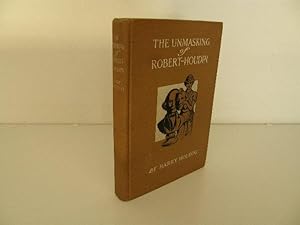
The Unmasking of Robert-Houdin
Language: English
Published by The Publishers Printing Company, New York, 1908
First Edition Signed
Hardcover. Condition: Fine. Dust Jacket Condition: Fine. 1st Edition. First Edition, First Printing SIGNED by Harry Houdini. A beautiful copy. This copy has a full page inscription by the author on the front free endpaper. "to .aboard the N.D.L. Kronprinz Wilhelm, mid-ocean, May 25, 1913. Houdini had suggested, during this voyage, that he would like to perform to raise funds for the seaman's charities by jumping overboard while handcuffed, but the captain decided that it was too risky in the shark-infested waters. The book is in great shape. The binding is tight with NO cocking or leaning and the boards are crisp with minor wear to the boards. The pages are clean with NO writing, marks or bookplates in the book. A beautiful copy in collector's condition authentically SIGNED by the author. We buy SIGNED Harry Houdini First Editions. Signed by Author(s).
-

Magic. Featuring the Manny Weltman Houdini Collection
Published by New York Swann Galleries 2002, 2002
Seller: James Pepper Rare Books, Inc., ABAA, Santa Barbara, CA, U.S.A.
Seller rating 5 out of 5 stars

First Edition Signed
First Edition. An illustrated auction catalogue for the sale of the impressive collection of Houdini material from Manny Weltman, a self-described Ômagic nutÕ, smitten at an early age by the mysterious world of magic and Harry Houdini in particular. Mr. Weltman published several books on Houdini: Houdini: A Definitive Bibliography (1991) and Houdini - Escape Into Legend - The Early Years (1993), which was intended to be the first in a series of volumes. Included in this catalogue are books by and about Harry Houdini (many signed and inscribed), manuscripts, a personal diary, magazines and newspapers, curiosities, letters, performance programs, photographs, film, ephemera, posters, etc. Illustrated throughout. With the prices realized sheet laid in, individually listing the prices for which each item sold. Essential reference for any Houdini collector. Paperbound. Fine in wrappers.
-

Houdini and Conan Doyle.
Published by Albert and Charles Boni, Inc, New York, 1932
First Edition Signed
First edition of this historical account on the friendship between writer Sir Arthur Conan Doyle and magician Harry Houdini. Octavo, original publisher's orange cloth, top stain green, frontispiece of Conan Doyle and Houdini. Association copy, inscribed by the author on the front free endpaper, "To Oscar S. Teale With every good wish from Bernard M.L. Ernst November 17, 1933." The recipient, Oscar Teale (1901â"1986), was an American magician, lecturer, and historian of magic whose work bridged performance, scholarship, and the preservation of conjuring as a serious cultural practice. He served as the private secretary to Harry Houdini during the final years of Houdiniâs life, a position that granted him direct access to the magicianâs professional correspondence, research, and anti-spiritualist investigations, and later informed Tealeâs influential role in preserving and interpreting Houdiniâs legacy. In very good condition with light rubbing and spotting to the spine and extremities. Accompanied by an original flyer for the book laid in. An exceptional association, rare and desirable signed. Bernard M. L. Ernst (1897â"1971) was an American writer and historian of magic best known for his rigorous documentation of stage magic, escapology, and anti-spiritualist performance in the early twentieth century. After taking a sustained interest in magic, he became Harry Houdiniâs personal attorney and later the legal representative of Houdiniâs estate, overseeing the magicianâs correspondence and private papers while also collecting magic memorabilia. He lectured on Houdini and magic at Columbia University and, in 1926, succeeded Houdini as President of the Society of American Magicians. 'Houdini and Conan Doyle' offers a concise historical account of the complex friendship and eventual estrangement between the magician Harry Houdini and the writer Arthur Conan Doyle. Drawing on correspondence, public statements, and contemporaneous accounts, Ernst traces how their relationshipâ"initially grounded in mutual admirationâ"became increasingly strained due to irreconcilable views on spiritualism. While Conan Doyle emerged as a committed believer in psychic phenomena, Houdini devoted considerable effort to exposing fraudulent mediums, a stance that directly challenged Doyleâs convictions.
-
Hardcover. Condition: Very Good. Hardcover. Bound in brown cloth with black and white decoration and lettering on the cover. Faded white lettering on the spine. Corners lightly bumped and crown of spine a bit curled, but overall quite good condition. Binding and text block both in good tight condition. Front free endpaper is signed Harry Houdini, and underlined. Houdini's signature is frustratingly variable -- The facsimile printed in this very volume has H's without any curls at all -- but examples on most of the authentication sites show pronounced loops and cramped overlaps. The version in this book is in blue ink, fluidly done and with H's very much in keeping with his most commonly seen autographs on letters and photographs. Title page dated 1908. Copyright page dated 1906, 1907 and 1908. Frontispiece portrait of Houdini, with reproduction of his signature beneath. Tissue guard complete, with a couple faint spots of foxing. 319 pages. Illustrated throughout. Inside back cover has a rough spot about 2.5 inches across where a sticker was removed (or something like that). Two similar spots on the rear endpaper, and a third on the back side of the final page of text. Houdini was at the height of his international fame when he published this book. It went through several editions and (whether it was accurate or not) increased his popularity and attracted more attention to his traveling show. Please email with questions or to request additional photos. Signed by Author(s).
-
A MAGICIAN AMONG THE SPIRITS [Inscribed to Richard Enright]
Published by Harper and Brothers, New York, 1924
Seller: Second Story Books, ABAA, Rockville, MD, U.S.A.
Seller rating 4 out of 5 stars

First Edition Signed
Hardcover. First Edition, First Printing. Octavo, xxi, 294 pages. In Very Good minus condition. Bound in blue cloth with gilt lettering and decoration to spine and front board. Mild shelf wear to boards, including sun fading to spine (lettering remains legible); bumping to head, tail, and corners; scuffing to boards; boards somewhat shaken, no shelf lean, binding sturdy; age-toning to text block, stain to top; mild age toning to interior pages, text remains clear and legible; contains several black-and-white photographs and illustrations. Signed flat by Houdini on the dedication page. Inscribed on the front free endpaper by Houdini to Police Commissioner Richard Enright. JD consignment. Shelved Case 3. Richard E. Enright, police commissioner of New York from 1918 to 1925, and Erik Weisz, more commonly known by his stage name Harry Houdini, were both friends and professional collaborators. The pair maintained a good relationship until Houdini's death in 1926, making the inscription in this book a personal glance into a historically noteworthy relationship. Enright was the first person to assume command of the NYPD through climbing the ranks on merit and was the longest serving commissioner at the time. While his policies attracted criticism during prohibition, during his eight year term he instituted many reforms that benefited the working conditions of police officers and improved the overall efficiency of the police force. Enright was responsible for the execution of all laws and regulations of the NYPD starting before prohibition and through the early 1920s. He was charged with preserving the public peace, preventing crimes, arresting offenders, suppressing riots, and suppressing houses of "ill fame," vice and gambling. Enright specifically targeted illegal gambling establishments formery run by the U.S. Congressman and underworld figure "Honest" John Kelly. Enright's continued harassment of Kelly's posthumous operations eventually forced them to sell the infamous Vendome Club building to a Republican political organization. While collaborating with the police in perfecting and performing many of his most famous acts, especially those involving handcuffs, Houdini kept company with lawmen and stayed in touch with their affairs outside of his escape acts. He frequently lectured at police academies and departments, including the NYPD, as part of his (rather ironic) lifelong commitment to serving the common good through education against escape and deception. By the end of his career, Houdini had an NYPD pass that authorized him to cross "all police lines" (Silverman, pg 44). In a letter written to psychic researcher Harry Price on July 4, 1925, Houdini affirms his police connection stating, "You know I am instructor here to the Police Academy to about hundred and fifty detectives." (The Harry Price Library, at The University of London) In an interview for the November 1925 issue of Popular Science Magazine, Houdini said "[In the summer of 1924,] Police Commissioner Enright, of New York, asked me to lecture at the New York Police Academy, to explain to the members of the police force just how to go about detecting fraudulent mediums. The best and most direct way that occurred to me of doing this was by staging a séance, performing myself the tricks that the mediums use." "It has been my good fortune," Houdini wrote later, "to meet personally and converse with the chiefs of police and the most famous detectives in all the great cities of the world." (Silverman, pg 43) Houdini bought tickets for the Policeman's Ball, kept a folder labeled "Police Cuttings," and owned a Directory of Police and Prisons, which named the chief of police in every sizable town in the country, and the wardens of state and federal prisons. In 1924, As President of the Society of American Magicians, he arranged a benefit dinner in New York for the families of fallen policemen, further cementing his positive reputation with the NYPD. Richard Enright, who was Commissioner of Police at the time, atte.
-
The Unmasking of Robert-Houdin
Published by New York Publishers Printing Co. 1908, 1908
Seller: James Pepper Rare Books, Inc., ABAA, Santa Barbara, CA, U.S.A.
Seller rating 5 out of 5 stars
First Edition Signed
First Edition. Signed presentation copy signed and inscribed by the author Harry Houdini on front free endpaper. Inscribed: ÒTo my very old young friend, S. Howard Swobe, with best wishes and regards of the author of this the First authentic History of magic and magicians ever published. Harry Houdini, Dec 16 - 1916 Be sure and (at least) read the introduction. HHÓ. Illustrated. Near fine copy with a little handling. HoudiniÕs study of magic. Enclosed in a custom red leather and cloth clamshell box.
-
The Unmasking Of Robert-Houdin
Published by The Publishers Printing Co, New York, 1908
Seller: Mystery Pier Books, Inc.,ABAA, ILAB, ABA, West Hollywood, CA, U.S.A.
Seller rating 4 out of 5 stars
First Edition Signed
Hardback. Condition: Fine. First Edition. First Edition of the author's landmark title inscribed by Houdini as follows. "To / F.L.C. Wehrenberg Jr / with compliments / of the author / Harry Houdini / 4/27/16 / Baltimore MD. Book comes with a variety of fascinating newspaper articles.
-
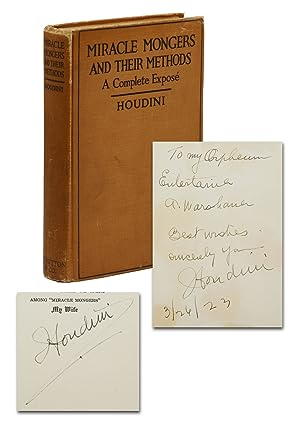
Miracle Mongers and their Methods: A Complete Expose of the Modus Operandi of Fire Eaters, Heat Resisters, Poison Eaters, Venomous Reptile Defiers, Sword Swallowers, Human Ostriches, Strong Men, etc.
Published by E.P. Dutton & Company, New York, 1920
Seller: Burnside Rare Books, ABAA, Portland, OR, U.S.A.
Association Member: ABAA CBA ILAB
Seller rating 5 out of 5 stars
First Edition Signed
Hardcover. First edition. First edition. Signed by Harry Houdini twice: inscribed to former owner, Allan Warshauer, manager of the Orpheum Theatre in Oakland, CA where Houdini did an escape stunt on 3/26/23, dated. Also flat-signed "Houdini" on the dedication page. xiv, 240pp. Bound in publisher's tan cloth with navy lettering. About Very Good with darkening to spine, light wear, small tape stain to front board, tidemark along bottom edge of terminals. Old bookseller's label to front paste down. Lacking jacket. An expose of spiritualists and flimflammers by the famous Hungarian-American magician.
-
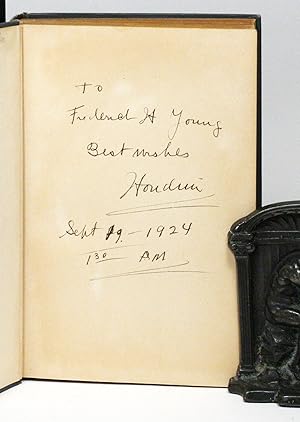
A Magician Among the Spirits
Published by Harper and Brothers, New York, 1924
Seller: Manhattan Rare Book Company, ABAA, ILAB, New York, NY, U.S.A.
Seller rating 5 out of 5 stars
First Edition Signed
Original cloth. Condition: Very Good. First edition. FIRST EDITION, INSCRIBED AND TWICE SIGNED BY HOUDINI: "To Frederick H Young / Best wishes / Houdini / Sept 19. - 1924 / 1:30 AM." Additionally signed "Houdini" on dedication page. Harry Houdini, the son of a rabbi and a doting mother, was born Erik Weisz in Budapest, Hungary in 1874. After moving to Wisconsin at age 4 then to New York City at 13, Erik Weisz eventually became the legendary Harry Houdini, a master mystifier now remembered for his sensational escapes but known in his time as an unmasker of frauds. When Houdini's mother died in 1913 he lamented, "it was a shock from which I do not think recovery is possible." Her death led to Harry's interest in Spiritualism, a religious movement based on the belief that the dead could interact with the living, and he dedicated his book, A Magician Among the Spirits, to her. Harry Houdini met Sir Arthur Conan Doyle in 1920 and they corresponded regularly about their mutual interest in Spiritualism. In 1922, while Houdini and his wife vacationed with the Doyle family, Houdini attended a séance with Lady Doyle, who claimed to be channeling Houdini's mother. Houdini was hopeful that this religious movement would lead to contact with his dead mother, but he became skeptical of Lady Doyle and others who claimed to communicate with those on the other side. In early 1923, Houdini joined a committee sponsored by Scientific American which was offering $2,500 to any medium who could successfully demonstrate supernatural abilities. Houdini believed that his training as a magician gave him insights that scientists and academics lacked. After observing more than a hundred mediums, Houdini announced that spiritualists were charlatans and no prize was ever awarded. As President of the Society of American Magicians, he sought to uphold professional standards and expose fraudulent artists. As his fame as a "ghostbuster" grew, Houdini chronicled his debunking exploits in A Magician Among the Spirits, which was published in May of 1924. In the dedication he refers to his mother as an "angel upon earth in human form." The book also features a large photo of Houdini and Doyle opposite the title page as well as a chapter dedicated to the discussion of their friendship and divergent opinions about Spiritualism. As Houdini wrote, "Spiritualism has claimed among its followers numbers of brilliant minds-scientists, philosophers, professionals and authors.Such a one is Sir Arthur Conan Doyle.I have no warfare with Sir Arthur [but] so far I have never on any occasion.seen.anything which has convinced me that it is possible to communicate with those who have passed out of this life. Therefore I do not agree with Sir Arthur." Doyle refused to believe any of Houdini's exposés and viewed him as a dangerous enemy. Doyle believed that the ungrateful and stubborn Houdini had insulted his wife's powers, while Houdini believed that the Doyles made a mockery of his deep feelings for his mother, the ruling passion of his life. A Magician Among the Spirits, like a good magician revealing a secret, invites us behind the scenes, educates us, and then allows us to find mystery in the countless questions that may develop. Houdini explains how mediums utilized props as well as the power of suggestion to convince people that the dead are among them. He does not ridicule Spiritualism but rather treats it with respect and sympathetically explains that it gained popularity after the unprecedented loss of life from World War I and the influenza pandemic. Houdini writes earnestly from the perspective of a professional magician, and, as he tells us in the Introduction, approaches his research scientifically, systematically, and with an open mind. This copy of A Magician Among the Spirits was inscribed by Houdini to Frederick H. Young on September 19, 1924 at 1:30AM, perhaps following a séance. Houdini also signed the dedication page. He inscribed this book after spending much of the summer exposing the trickery of the celebrated medium, Mina "Margery" Crandon, the wife of a wealthy surgeon. In July and August of 1924, Houdini and the Scientific American committee attended five séances with "Margery" at various locations in Boston. Ultimately Houdini deemed her a fake and published a 40-page pamphlet, Houdini Exposes the tricks used by the Boston Medium "Margery." As he told an interviewer from The Los Angeles Times, "It takes a flimflammer to catch a flimflammer." ("Margery Pamphlet"). In 1925 Houdini's one-man show on Broadway included as its final act "Do the Dead Come Back?" in which he named and shamed mediums whom he believed were fraudulent. In February and May of 1926, Houdini testified before Senate and House subcommittees for a bill aimed at prosecuting anyone "pretending to tell fortunes for reward or compensation." According to one of his biographers, "This [anti-Spiritualist crusade work] is what Houdini wanted to be remembered for. He did not want to go down in history as a magician or an escape artist." (David Jaher, The Witch of Lime Street) Despite their distrust of Spiritualism, Houdini and his wife Bess agreed to conduct an experiment: the first to die was to try to communicate with the survivor. While still in his prime, Houdini died on October 31, 1926, at the age of 52, from complications of appendicitis. Houdini's funeral was held on November 4, 1926 in New York City with over two thousand mourners in attendance. He was buried in Queens, in a coffin he'd made for one of his magic tricks, with his head lying on a stack of letters from his mother, instructions which he left behind in his will. Bess held a séance in an effort to contact her husband every Halloween for the next 10 years. In 1936, after 10 unsuccessful séances, she extinguished the candle that had been burning beside a photo of Houdini since his death and later said "ten years is long enough to wait for any man." A Magician Among the Spirits was the final book that Houdini published and the culmination of ove.
-
The Ummasking of Robert-Houdin
Published by The Publishers Printing Company, New York, 1908
Seller: John R. Sanderson, Bookseller, Stockbridge, MA, U.S.A.
Association Member: SNEAB
Seller rating 5 out of 5 stars
First Edition Signed
Original Cloth. Condition: Near Very Good. No Jacket. 1st Edition. Full page inscription, with signature. Slight wear to head and tail of spine cloth. Inscribed by Author(s).
-
Papyro-Plastics, or the Art of Modelling in Paper;; Being an Instructive Amusement for Young Persons of Both Sexes
Published by Boosey, London, 1825
Seller: Argosy Book Store, ABAA, ILAB, New York, NY, U.S.A.
Seller rating 5 out of 5 stars
Signed
hardcover. Condition: very good(+). Second. From the German by D. Boileau. Colored frontispiece & 22 folding b/w plates. Square 16mo, original salmon boards with circular paper title label. London: Boosey & Sons, 1825. Second Edition, greatly enlarged. Harry Houdini's copy, with his penciled ownership signature on the end-paper, and the notation "Bot Leeds England 1913". The initials "H H" are written on the fore-edge. A rare and unusual item.
-
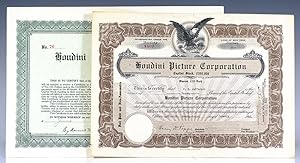
Harry Houdini Signed Houdini Picture Corporation Stock Certificate.
Published by The Brown-Green Co. January 23, 1922, New York, 1922
Signed
Rare stock certificate signed by the worldâs greatest escape artist, master illusionist Harry Houdini. One page, partially printed in brown and black ink with an embossed seal, the document is dated January 23, 1922 and certifies that W.E. Jefferson hereby owns twenty shares of the Capital Stock of Houdini Picture Corporation. Signed by Harry Houdini as President of the Corporation and countersigned by Harry H. Poppa as Assistant Treasurer. In near fine condition. With a Houdini Picture Corporation Voting Trust Certificate awarding 30 shares of common capital stock of Houdini Picture Corporation to Abel Shearer. In 1918, Houdini signed his first contract with film producer B. A. Rolfe to star in a 15-part serial, The Master Mystery (released in November 1918), and after Rolfe went our of business, he was signed by Famous Players-Lasky Corporation/Paramount Pictures, for whom he made two pictures, The Grim Game (1919) and Terror Island (1920). Following this successful Hollywood two-picture stint, Houdini returned to New York and founded his own film production company, Houdini Picture Corporation, in 1921 with a capitalization of $500,000. He produced and starred in two films: The Man from Beyond (1921) and Haldane of the Secret Service (1923). He also founded his own film laboratory business called The Film Development Corporation (FDC), gambling on a new process for developing motion picture film. Houdini's brother, Theodore Hardeen, left his own career as a magician and escape artist to run the company and Magician Harry Kellar was a major investor. Neither Houdini's acting career nor FDC found success, and he gave up on the movie business in 1923, complaining that "the profits are too meager".Â.
-
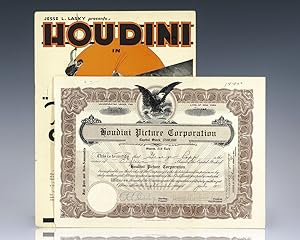
Harry Houdini Signed Houdini Picture Corporation Stock Certificate.
Published by The Brown-Green Co July 18, 1921, New York, 1921
First Edition Signed
Rare stock certificate signed by the worldâs greatest escape artist, master illusionist Harry Houdini. One page, partially printed in brown and black ink with an embossed seal, the document is dated July 18, 1921 and certifies that George Popp hereby owns fifteen shares of the Capital Stock of Houdini Picture Corporation. Signed by Harry Houdini as President of the Corporation and countersigned by R.G. Risley as Treasurer. In near fine condition. With a rare Famous-Players-Lasky Promotional brochure for The Grim Game, Houdini's first full-length movie which is widely regarded as his best. In 1918, Houdini signed his first contract with film producer B. A. Rolfe to star in a 15-part serial, The Master Mystery (released in November 1918), and after Rolfe went our of business, he was signed by Famous Players-Lasky Corporation/Paramount Pictures, for whom he made two pictures, The Grim Game (1919) and Terror Island (1920). Following this successful Hollywood two-picture stint, Houdini returned to New York and founded his own film production company, Houdini Picture Corporation, in 1921 with a capitalization of $500,000. He produced and starred in two films: The Man from Beyond (1921) and Haldane of the Secret Service (1923). He also founded his own film laboratory business called The Film Development Corporation (FDC), gambling on a new process for developing motion picture film. Houdini's brother, Theodore Hardeen, left his own career as a magician and escape artist to run the company and Magician Harry Kellar was a major investor. Neither Houdini's acting career nor FDC found success, and he gave up on the movie business in 1923, complaining that "the profits are too meager".Â.
-
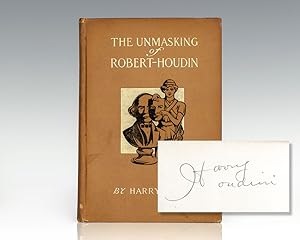
The Unmasking of Robert-Houdin.
Published by The Publishers Printing Co, New York, 1908
First Edition Signed
First edition of this work by Houdini regarding his one-time idol. Octavo, original cloth, frontispiece of Houdini, illustrated throughout. Boldly signed by Harry Houdini on the front free endpaper. Bookplate to the front pastedown, in near fine condition. Rare and desirable signed. âHarry Houdini was a unique figure in the history of entertainment⦠a hero of legend and folklore.â Following the death of his mother in 1913, Houdini began to investigate spiritualism and âsoon became an all-out crusader against it. Early in 1924 he began lecturing throughout the United States on fraudulent mediums. In city after city he attended sà ances in disguise, exposing frauds on the spot and sometimes securing their arrest, aided by his personal squad of detectives. The raids brought him huge publicity as well as a million dollars in lawsuits.â At his death in 1927, âhe was buried in a brass replica of the iron casket, his head pillowed on a bundle of his motherâs letters to himâ (ANB). The legendary magician and illusionist Harry Houdini turns a critical eye to the astonishing claims of those in his own profession in his work Miracle Mongers and Their Methods. Using personal research and observations, Houdini reveals the cunning techniques employed by fire-eaters, sword swallowers, and other masters of deception to mystify and amaze audiences around the world.
-
The Unmasking of Robert-Houdin. (Signed Presentation Copy!) Robert-Houdin is often credited as being "the father of modern magic. And in this work, Houdini exposes his namesake and one-time hero Robert-Houdin as a fraud
Published by The Publishers Printing Co, New York, 1908
Seller: Brainerd Phillipson Rare Books, Holliston, MA, U.S.A.
Association Member: SNEAB
Seller rating 5 out of 5 stars
First Edition Signed
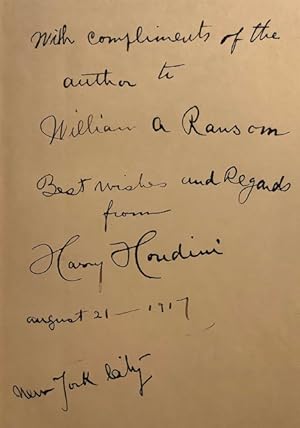
Condition: Very Good. Handsomely bound in beige cloth with a statue of magician Robert-Houdin having a mask removed from his face. Lettered in bright white type on the front boards and on the spine. With bumping to the bottom right hand corner of the front boards and the bottom of the spine. Touch of soiling to the front boards. Very clean and tight throughout. Printed on heavy stock with crisp lettering and numerous illustrations in fine register. With 6 pages of illustrations and the index bound in at the end of the book. A wonderful volume, and even more so as this copy is inscribed in ink by Harry Houdini: "With compliments of the author to *William A. Ransom. Best wishes and regards from Harry Houdini. / August21 1917. New Your City." *William A. Ransom (1860-1941), an Executive Secretary to railroad businessmen and later became head of a big department for one of the railways, was president of The Society of American Magicians in 1909.[1] Known as "Bill" to his friends, Ransom began his interest in magic when, as a small boy, he saw a performance by Signor Blitz. He never gave professional performances but did helped many professional magicians improve their apparatus mechanically. Ransom died at his home in New Jersey. (Magicpedia) Jean-Eugà ne Robert-Houdin (1805 1871) was a French watchmaker, magician and illusionist, widely recognized as the father of the modern style of conjuring.[1] He transformed magic from a pastime for the lower classes, seen at fairs, to an entertainment for the wealthy, which he offered in a theatre opened in Paris, a legacy preserved by the tradition of modern magicians performing in tails.In the mid-1820s, he saved up to buy a copy of a two-volume set of books on clockmaking called Traità de l'horlogerie ("Treatise on Clockmaking"), written by Ferdinand Berthoud.[3] He would go on to pursue the craft of clockmaking for the rest of his life, and is widely credited with inventing the mystery clock.When he got home and opened the wrapping, instead of the Berthoud books, what appeared before his eyes was a two-volume set on magic called Scientific Amusements. Instead of returning the books, his curiosity got the better of him. From those crude volumes, he learned the rudiments of magic. He practiced at all hours of the day.[3]From that point on, he became very interested in the art. He was upset that the books he got only revealed how the secrets were done but did not show how to do them.[2] He found that learning from the books available in those days was very difficult due to the lack of detailed explanations,[3] but the books piqued his interest in the art. So Robert-Houdin began taking lessons from a local amateur magician.[3] He paid ten francs for a series of lessons from a man named Maous from Blois who was a podiatrist but also entertained at fairs and parties doing magic. He was proficient at sleight of hand, and taught Robert-Houdin how to juggle to improve his hand-eye coordination.[2][3] He also taught him rudiments of the cups and balls. He told young Robert-Houdin that digital dexterity came with repetition, and as a direct result, Robert-Houdin practiced incessantly.[2]Magic was his pastime, and meanwhile, his studies in horology continued. When he felt he was ready, he moved to Tours and set up a watchmaking business, doing conjuring on the side.[3]Much of what we know about Robert-Houdin comes from his memoirs and his writings were meant more to entertain than to chronicle, rendering it difficult to separate fact from fiction. Robert-Houdin would have readers believe that a major turning point in his life came when he became apprenticed to the magician Edmund De Grisi, Count's son and better known as Torrini. What is known is that his early performing came from joining an amateur acting troupe. (Wikipedia) First Edition. With matching dates of 1908 on the right and copyright pages; and no subsequent printings listed. Hardcover in decorated, pictorial cloth First Edition.With matching dates of 1908 on the title and copyright pages.
-
The Unmasking of Robert-Houdin.
Published by New York: The Publishers Printing Co., 1908, 1908
Seller: Peter Harrington. ABA/ ILAB., London, United Kingdom
Association Member: ABA ILAB PBFA
Seller rating 5 out of 5 stars
First Edition Signed
US$ 6,600.99
US$ 29.68 shipping
Ships from United Kingdom to U.S.A.Quantity: 1 available
Add to basketFirst edition, signed and dated by the author on the front free endpaper, "Harry Houdini. Oct 29, 1910". In this work, Houdini attempted to expose his former hero and namesake, the great Robert-Houdin. Essentially a history of modern magic, the work denies Robert-Houdin any originality for his tricks and well-known use of technological effects. "In chapter after chapter [Houdini] traced their invention back to earlier magicians. By doing so he believed he had restored rightful credit to the originators, changed the outlines of the development of western conjuring, and uncloaked Robert-Houdin as 'a mere pretender, a man who waxed great on the brainwork of others'" (Silverman, p. 130). In contrast, Houdini lionized the originality of himself and his book: "As if The Unmasking were one of his inimitable escapes, he offered a challenge of $250 to anyone who could adduce its peer, 'a book which has taken so much time, energy, travel and money, with such authentic data regarding real magical inventions'" (Silverman, p. 132). The claims of The Unmasking were greatly contested by Houdini's contemporaries and by later scholars. Many argued that Robert-Houdin's great legacy stands rather than falls upon his contributions to improving previous techniques and to the psychology of deception, and in France some magicians perceived Houdini's work as a national insult. "While the book did not achieve its aim, it remains of considerable historical interest as the first sustained attempt to mine Houdini's large and growing collection for historical information" (Tigner, III, p. 1037). Kenneth Silverman, Houdini!!!: The Career of Ehrich Weiss, 1997; Steven S. Tigner, "Magic and Magicians", The Greenwood Guide to American Popular Culture, ed. by M. Thomas Inge & Dennis Hall, 2002. Octavo. Portrait frontispiece of Houdini with tissue guard. Contents printed on plate paper with further illustrations throughout. Original light brown diagonal-grain cloth, spine and front cover lettered in white, unmasking vignette on front cover in black, white, and brown. Endmatter bound out of sequence between rear endpapers. Spine lettering faded but legible, spine foot a little frayed, wear to corners, slight soiling to cloth, front inner hinge split but sound, foxing to outer leaves, else contents bright. A very good copy.
-
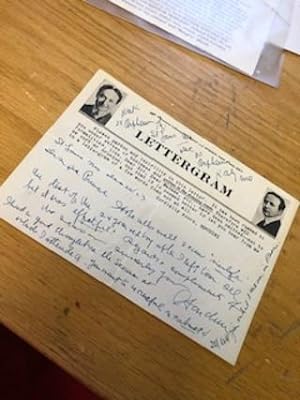
AUTOGRAPH NOTE SIGNED BY HARRY HOUDINI ON HIS "LETTERGRAM" LETTERHEAD `
Published by St. Louis, MO `, 1923
Seller: John K King Used & Rare Books, Detroit, MI, U.S.A.
Seller rating 5 out of 5 stars
Signed
Two printed photos and a printed explanation at top of one sheet, oblong 6 x 8.5", toned, folds, minor wear and soiling, but WRITTEN AND SIGNED BY HOUDINI. Houdini writes: "Dear Dr. Prince [?]. Hope alls well. I can "visualize" the test of the 24 year old boy after I left tour. All[?] but it was effectful. Regards and complements of the season. Sincerely yours Houdini. I had a good thought re the Séance at which I attended. You want to be careful re cabinet! I'll tell you what I mean in person." At top of the page, Houdini writes "Week 23 Orpheum St Louis MO / Dec 30 Orpheum K. City Mo." The "cabinet" and "séance" refer to Mina Crandon, who almost won a $2500 prize offered by Scientific American to prove telekinesis.until Houdini attended her séances in July and August 1924 (at which time Mina was locked in a wooden cabinet to keep her from ringing a bell). "Dr. Prince" was Walter Franklin Prince, a friend of Houdini, who was out to expose fake mediums (though, he himself believed some were genuine). The experience was related in the book HOUDINI EXPOSES THE TRICKS USED BY THE BOSTON MEDIUM "MARGERY" (Adams Press: NY nd), a copy of which is included here (worn, folded, torn, soiled), which includes both photos and illustrations of "the cabinet" and "Margery" (Mina). `.
-
AUTOGRAPH NOTE SIGNED BY HARRY HOUDINI ON HIS "LETTERGRAM" LETTERHEAD `
Published by St. Louis, MO ` 1923 `, 1923
Seller: John K King Used & Rare Books, Detroit, MI, U.S.A.
Seller rating 5 out of 5 stars
Signed
Two printed photos and a printed explanation at top of one sheet, oblong 6 x 8.5", toned, folds, minor wear and soiling, but WRITTEN AND SIGNED BY HOUDINI. Houdini writes: "Dear Dr. Prince [?]. Hope alls well. I can "visualize" the test of the 24 year old boy after I left tour. All[?] but it was effectful. Regards and complements of the season. Sincerely yours Houdini. I had a good thought re the Séance at which I attended. You want to be careful re cabinet! I'll tell you what I mean in person." At top of the page, Houdini writes "Week 23 Orpheum St Louis MO / Dec 30 Orpheum K. City Mo." The "cabinet" and "séance" refer to Mina Crandon, who almost won a $2500 prize offered by Scientific American to prove telekinesis.until Houdini attended her séances in July and August 1924 (at which time Mina was locked in a wooden cabinet to keep her from ringing a bell). "Dr. Prince" was Walter Franklin Prince, a friend of Houdini, who was out to expose fake mediums (though, he himself believed some were genuine). The experience was related in the book HOUDINI EXPOSES THE TRICKS USED BY THE BOSTON MEDIUM "MARGERY" (Adams Press: NY nd), a copy of which is included here (worn, folded, torn, soiled), which includes both photos and illustrations of "the cabinet" and "Margery" (Mina). `.
-

Harry Houdini Autograph
Seller: Markus Brandes Autographs GmbH, Kesswil, TG, Switzerland
Seller rating 3 out of 5 stars

Manuscript / Paper Collectible Signed
US$ 4,252.77
US$ 35.35 shipping
Ships from Switzerland to U.S.A.Quantity: 1 available
Add to basketTyped letter signed & autograph note, one page - with an affixed clipping (autograph note) to the lower edge, `Houdini` stationery, 8 x 10,5 inch, Portsmouth, 20.04.1920, to English poet Miss May Herschel-Clarke (1894-1955) - concerning a small book and an upcoming performance at the Hippodrome Theatre in Portsmouth, signed in dark ink "Houdini" - with an added autograph note "Miss Elisabeth [illegible] will be very pleased to see Miss Clarke on Saturday - at the Criterion at 5 o`clock", attractively mounted (removable) for fine display with a promotion picture Harry Houdini as magician (altogether 16,5 x 12,5 inch), with intersecting letter folds and, and mild signs of wear to the edges - in fine condition."Dear Miss Clarke, Please let me have Editors name of Picture Show, want to get permission to reproduce your article in a small book that I am giving away to the audience, and it `reads` just the way I like to read things myself. Or perhaps you can get permission for me, though I don`t mind writing for same. This shows you what I think of your interview. Best wishesand regards - sincerely yoursRemember me to your good mother.This week, Hippodrome Portsmouth Week April 26th. Hippodrome Newcastle on Tyne".
-
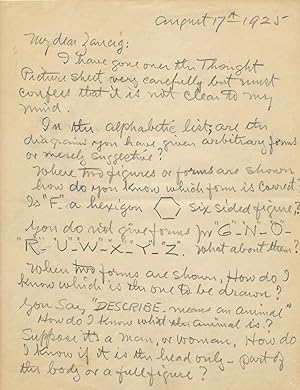
Correspondence about Mind Reading between Houdini and mentalist Julius Zancig with illustration, unsigned by Houdini: 1- Zancig Typed Letter unsigned, to Houdini on "Zancig Studio" stationery explaining the mind reading trick "How to Thought Picture"; with envelope addressed to Houdini, postmarked Asbury Park, NJ., August 8, 1925. Zancig wrote "Private" on verso of this letter. 2- A handwritten letter written for Houdini, possibly by his secretary Julie Sawyer, signed for him to mentalist Julius Zancig, in pencil, three separate 4to pages, August 17,1925; Julie Sawyer was the niece of Houdini's wife Bess. 3- Typed Letter unsigned, 2 pp, to Zancig with a hexagram diagram Houdini likely drew, in ink, Aug. 21, 1925
Seller: Schulson Autographs, Ltd., Millburn, NJ, U.S.A.
Seller rating 5 out of 5 stars
Signed
Houdini is known as one of the greatest escapologists and stunt performers, as well as a skeptic and investigator of spiritualists. He was also a film producer and actor. The illusion of mind reading intrigued Houdini. Both he and Zancig had little to do with each other though both belonged to the Society of American Magicians. Houdini doubted mentalist Julius Zancig's ability to self proclaimed ability. In this three piece correspondence Zancig reveals his trick. This correspondence began with Zancig's Aug. 8 TLS to Houdini on "How to Thought Picture. here is the secret Harry nd (sic) no one lese (sic) has it but you up to this timeyou promise not to Devulge (sic) it to any one here" Houdini replied first with a three page holograph letter including bold capital letters detailing what he did not understand about Zancig's trick. The letter is not in is hand but is most likely a draft of the typed letter he sent to Zancig. The typed letter included in this group varies from the hand written letter and is very likely a copy of the typed letter Houdini did send. This copy contains a hexagram drawing in ink appearing to be in Houdini's hand. He never believed the mind reading illusion had anything to do with a special mental ability. From the Aug. 17 holograph letter "I have gone over the Thought Picture sheet very carefully but must confess that it is not clear to my mind." The letter ends on the second page, with his name then crossed out and the letter continued onto a third page . "I really cannot put these things together and would appreciate your making it clearer--With best regards, yours, Houdini." This first closing and signature are struck out and followed on the last page with, "Do you really attempt to reproduce what is drawn by members of the audience, or confine your reproductions to your prepared list? If so what about identification by audience." At this point it is signed on his behalf, "With best regards, Houdini." The letter while not in Houdini's hand expresses his views about Zancig. It is possible the letter was dictated as a first draft then redrafted into the typed copy here. Sir Arthur Conan Doyle declared in 1923 that Julius Zancig and his wife were genuine telepathists, contradicting Houdini''s belief that the Zancigs' "mind-reading performances required no supernatural powers. Houdini purchased the explanation of the act from Julius Zancig in order to demonstrate the truth of his view to posterity." (Milbourne Christopher, Houdini, New York, 1969, p. 177)." Harry Houdini forever changed the world of magic and escapes.


![Seller image for The Unmasking of Robert-Houdin [signed] for sale by Riverby Books](https://pictures.abebooks.com/inventory/md/md32351184932.jpg)
![Seller image for A MAGICIAN AMONG THE SPIRITS [Inscribed to Richard Enright] for sale by Second Story Books, ABAA](https://pictures.abebooks.com/inventory/md/md32141341375.jpg)