

Order Total (1 Item Items):
Shipping Destination:

Italian Risorgimento (6 results)
Skip to main search results
Search filters
Product Type
- All Product Types
- Books (2)
- Magazines & Periodicals (No further results match this refinement)
- Comics (No further results match this refinement)
- Sheet Music (No further results match this refinement)
- Art, Prints & Posters (No further results match this refinement)
- Photographs (No further results match this refinement)
- Maps (No further results match this refinement)
- Manuscripts & Paper Collectibles (4)
Condition Learn more
- New (No further results match this refinement)
- As New, Fine or Near Fine (No further results match this refinement)
- Very Good or Good (No further results match this refinement)
- Fair or Poor (No further results match this refinement)
- As Described (6)
Binding
Collectible Attributes
- First Edition (No further results match this refinement)
- Signed (1)
- Dust Jacket (No further results match this refinement)
- Seller-Supplied Images (3)
- Not Print on Demand (6)
Language (2)
Price
- Any Price
- Under US$ 25 (No further results match this refinement)
- US$ 25 to US$ 50 (No further results match this refinement)
- Over US$ 50
Free Shipping
- Free Shipping to U.S.A. (No further results match this refinement)
Seller Location
Seller Rating
-
![Seller image for Immagini della vita e dei tempi di Alessandro Manzoni raccolte e illustrate da Marino Parenti [La Stampa di quest'opera fu personalmente curata dall'autore presso le officine della S. A. Grafitalia, già Pizzi e Pizio in Milano, fra il giugno e il novembre del Millenovecentoquarantadue XX-XXI. Centocinquanta copie, numerate in macchina, constituiscono l'edizione originale] Images of the life and times of Alessandro Manzoni collected and illustrated by Marino Parenti [The Print of this work was personally supervised by the author at the workshop of S. A. Grafitalia already Pizzi and Pizio in Milan, between June and November Millenovecentoquarantadue XX-XXI. One hundred and fifty copies, numbered in the car, constitute the original edition] for sale by Little Stour Books PBFA Member](https://pictures.abebooks.com/inventory/md/md1170963822.jpg)
Immagini della vita e dei tempi di Alessandro Manzoni raccolte e illustrate da Marino Parenti [La Stampa di quest'opera fu personalmente curata dall'autore presso le officine della S. A. Grafitalia, già Pizzi e Pizio in Milano, fra il giugno e il novembre del Millenovecentoquarantadue XX-XXI. Centocinquanta copie, numerate in macchina, constituiscono l'edizione originale] Images of the life and times of Alessandro Manzoni collected and illustrated by Marino Parenti [The Print of this work was personally supervised by the author at the workshop of S. A. Grafitalia already Pizzi and Pizio in Milan, between June and November Millenovecentoquarantadue XX-XXI. One hundred and fifty copies, numbered in the car, constitute the original edition]
Published by Published Milano. Ulrico Hoepli -1942. 1941., 1941
Seller: Little Stour Books PBFA Member, Canterbury, United Kingdom
Association Member: PBFA
Seller rating 5 out of 5 stars

US$ 130.14
US$ 39.90 shipping
Ships from United Kingdom to U.S.A.Quantity: 1 available
Add to basketHard back binding in publisher's original colour illustrated paper covered boards, pretty floral illustrations to the spine and both covers, to the front cover is a colour cameo illustration of Alessandro Manzoni, silk water marked end papers. Folio. 12½'' x 9¼''. Contains [x] 295 printed pages of Italian text with 6 colour plates on glossy art paper, other tinted colour and many monochrome illustrations and photographs throughout. Ownership marking dated 1944 to the front free end paper, 95 mm piece of card covering missing to the base of the spine, spine edges neatly repaired, rubbing of the paper across the spine top and corners, contents clean and tidy. Member of the P.B.F.A. ITALY (History & Culture).
-

[ Alessandro Gavazzi, chaplain in Garibaldi's army during the Risorgimento. ] Autograph Note Signed ('Alessandro Gavazzi') to 'John Ledgett Esq', in English, regarding a meeting.
Published by 88 Newman Street London 4 February s, 1850
Seller: Richard M. Ford Ltd, London, United Kingdom
Seller rating 5 out of 5 stars
Manuscript / Paper Collectible
US$ 123.29
US$ 5.98 shipping
Ships from United Kingdom to U.S.A.Quantity: 1 available
Add to basket1p., 12mo. In fair condition, on aged paper. Reads: 'Dear Sir | I returned yesterday only from a long journey. I hope to see you in he present week in the City.' In 1850 Gavazzi began a course of political and religious sermons in London; first at the Princess's Court Rooms, Great Castle Street, Oxford Street, and then from 1854 in an open chapel at King's Cross. In 1859 he returned to Italy to take up a post as chaplain for Giuseppe Garibaldi, serving in that role during the Expedition of the Thousand to Sicily in 1860.
-
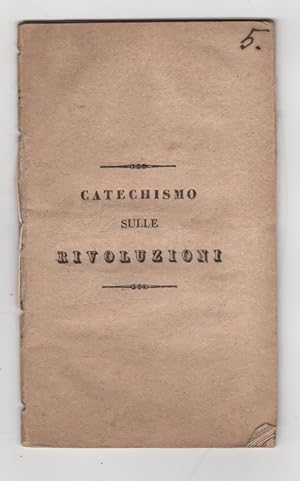
Catechismo Sulle Rivoluzioni
Language: Italian
Published by [n.a.], [n.a.], 1832
Seller: Kaaterskill Books, ABAA/ILAB, East Jewett, NY, U.S.A.
Association Member: ABAA ILAB IOBA
Seller rating 5 out of 5 stars
Stitched self wrappers. 40 pp. 16mo. "Q. Does God's holy law permit rebelliousness against one's temporal Sovereign? R. Never, indeed, condemns it highly; for the sacred writing which, as you know, is the very word of God, declares that the High Official (Podesta) does not come from God, but whoever resists him, resists precisely the ordination of God, and thus proceeds to damnation." Thus begins Count Monaldo Leopardi's (1776-1847) counter-revolutionary Catechism on Revolutions, arguing that Christianity and the French Revolution are incompatible, that the rebellion is an ignominious revolt against the metaphysical and social order established by God, and that tradition is more important that abstract concepts of liberalism. Meant for use in schools, it was one of two essays published by Leopardi in 1832. Two editions were published in 1832 both rather uncommon. This edition without date and publisher (but which Sorbelli's "Opuscoli stampe alla macchia e fogli volanti riflettenti il pensiero politico italiano: [1830-1835" dates as 1832) is held by only two libraries: Univ. Conn. and Biblioteca Casanatense. Very good, lightly browned, a few lower fore edge corners folded, tiny marginal chip at leaf 16, and one closed tear on rear leaf, numeral inked on title, original stitching but perhaps removed from a later volume.
-
[Giuseppe Garibaldi, hero of the Risorgimento.] Autograph Signature ('G. Garibaldi').
Published by Without date or place
Seller: Richard M. Ford Ltd, London, United Kingdom
Seller rating 5 out of 5 stars
Manuscript / Paper Collectible
US$ 164.39
US$ 5.98 shipping
Ships from United Kingdom to U.S.A.Quantity: 1 available
Add to basketOn irregular slip of thin paper, roughly 2 x 6 cm. Laid down on piece of paper cut from album. In fair condition, lightly aged. Bold signature ('G. Garibaldi') with wavy underlining, possibly cut from the valediction of a letter.
-
[Cavour, Italian statesman and leading figure in the Risorgimento.] Autograph Letter Signed ('C Cavour'), in Italian, enclosing a letter for the Marquess of Azeglio, and inviting the recipient to contribute writing in a powerful 'organ of publicity'.
Published by Without date or place
Seller: Richard M. Ford Ltd, London, United Kingdom
Seller rating 5 out of 5 stars
Manuscript / Paper Collectible Signed
US$ 479.46
US$ 5.98 shipping
Ships from United Kingdom to U.S.A.Quantity: 1 available
Add to basket1p, 12mo. On the recto of the first leaf of a bifolium, the rest being blank. In good condition, lightly aged, with a hole on a blank part of the paper at the foot of the first leaf. Neatly written and signed 'C. Cavour'. Cavour begins by taking up an offer by the unnamed recipient, by asking him to convey a letter to his rival Massimo Taparelli, Marquess of Azeglio (1798-1866), Prime Minister of Sardinia. He hopes that on the recipient's return from London he will employ his pen ' con quell'efficacia che le e propria' in the service of the cause of unification of Italy, by writing in the most powerful 'organo de' pubblicita' which has ever existed [The Times?]. He ends with good wishes for the journey. The letter reads: 'Preg. Sig. | Approfittando della gentile Sua profferta le mando que' compriegata una lettera pel Marchesa d'Azeglio. | Spero che al tuo ritorno da Londra [?] la penna per patrocinare con quell'efficacia che le e propria la causa dell'unificazione d'Italia nel piu potente organo de' pubblicita che abbia mai esistito | Le auguro bouon viaggio e le [?] gli atti della distinta mia Stima.'.
-
Collection of poems by Fusinato, together with letters by Mazzini, Cavour, Cesare Battisti, Bixio and others.
Seller: Kotte Autographs GmbH, Roßhaupten, Germany
Association Member: ILAB PADA VDA
Seller rating 5 out of 5 stars
Manuscript / Paper Collectible
Various formats. Fascinating collection of 15 items related to the Unification of Italy, containing handwritten letters, notes, and poems from notable Italian figures and patriots like Giuseppe Mazzini, Count of Cavour, Cesare Battisti, Nino Bixio, Arnaldo Fusinato, and others. Dated between 1838 and 1900, the collection is highlighted by three manuscript poems from Fusinato, which include 'L'ultima ora di libertà,' 'Le due Madri Ballata,' and an early copy of 'Brindisi.' Also included are letters and notes by Mazzini (one in French, dated June 17, 1852, regarding "manifeste Sicilien"), a handwritten letter from Cavour to the Chevalier De Bry, postmarked February 1, 1854, about "la supression du bagne de Villefranc[h]e," ALSs from Bixio and Battisti, a cabinet photograph of Bixio, and two period booklets commemorating the death and life of Battisti, published by Sede Dell'Unione in 1917. In overall fine condition.'L'ultima ora di libertà' would appear to be an early title for Fusinato's celebrated poem 'L'ultima ora di Venezia,' (or "La bandiera bianca"), one of the classics of the Italian Risorgimento. The poem reflects the poet's despair at the fall of the short-lived Repubblica di San Marco in 1849 to the Austrians. After fighting in defense of Vicenza, Fusinato was stationed as a lieutenant on the island of Lazzaretto Vecchio near Venice, where, despite heroic resistance, the Austrians quickly recaptured the city. This manuscript includes the famous lines "Venezia! l'ultima / Ora e venuta: Illustre Martire / Tu sei perduta / Il morbo infuria / il pan ti manca / Sul ponte sventola / Bandiera bianca," which then reappear altered at the end of this manuscript.


