

Order Total (1 Item Items):
Shipping Destination:

Lebedew Peter (10 results)
Skip to main search results
Search filters
Product Type
- All Product Types
- Books (9)
- Magazines & Periodicals (1)
- Comics (No further results match this refinement)
- Sheet Music (No further results match this refinement)
- Art, Prints & Posters (No further results match this refinement)
- Photographs (No further results match this refinement)
- Maps (No further results match this refinement)
- Manuscripts & Paper Collectibles (No further results match this refinement)
Condition Learn more
- New (No further results match this refinement)
- As New, Fine or Near Fine (No further results match this refinement)
- Very Good or Good (4)
- Fair or Poor (No further results match this refinement)
- As Described (6)
Binding
Collectible Attributes
- First Edition (4)
- Signed (No further results match this refinement)
- Dust Jacket (No further results match this refinement)
- Seller-Supplied Images (4)
- Not Print on Demand (10)
Language (3)
Free Shipping
- Free Shipping to U.S.A. (No further results match this refinement)
Seller Location
Seller Rating
-
AN EXPERIMENTAL INVESTIGATION OF THE PRESSURE OF LIGHT.
Language: English
Published by GPO, Washington, D.C.
Magazine / Periodical
Soft cover. Condition: Very Good. No Jacket. pp177-178. Removed from the Smithsonian Institution Annual Report for 1903. In plastic report covers. VG. A short article with references to Maxwell, De Mairan, Crookes, Euler, Kepler, and Bartoli.
-

An Experimental Investigation Of The Pressure Of Light
Language: English
Published by GPO, Washington, 1903
Soft cover. Condition: VG. 2pp extract, a single leaf, salvaged from a damaged copy of the Annual Report Of The Board Of Regents Of The Smithsonian Institution For The Year Ending June 30, 1902. Housed in protective mylar report cover.
-
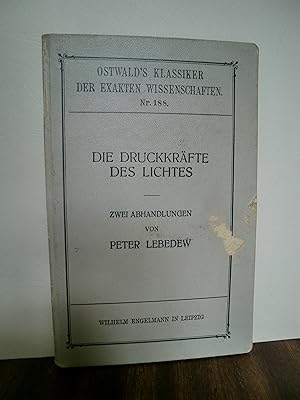
Die Druckkräfte des Lichtes. Zwie Abhandlungen. Ostwald s Klassiker der exakten Wissenschaften Nr. 188
Published by Wilhelm Engelmann, 1913
Seller: Antiquarische Bücher Schmidbauer, München, Germany
Seller rating 5 out of 5 stars

Hardcover. Condition: Gut. herausgeg. von P. Lasareff. Mit 25 Figuren im Text und 1 Bildnis, 58 S. (Annalen der Physik, Bd. 6 S. - 433 1901 u. Bd. 32. S. - 411. 1910) Buchtitel mit Fehlstelle und Rückenkanten leicht berieben Size: Kl.-8°.
-

5 Bücher: Der Mondstein + Schwarze Witwen und eiserne Jungfrauen + Mord -Express + Das graue Zimmer + Das perfekte Gift
Published by verschiede Verlage
Seller: Versandantiquariat Kerzemichel, Wittenberge, Germany
Seller rating 5 out of 5 stars
alle Exemplare 8°, 1 x Oln, Os leicht randrissig, 1 x Oppbd, 3 x Oppbd , Os, 1 Buch hat private Widmung auf Vs, alle sehr gut, über 1000 g.
-
Ueber Messungen der Dielectricitätsconstanten der Dämpfe und über die Mossotti-Clausius'sche Theorie der Dielectrica. Inaugural-Dissertation.der Kaiser-Wilhelms-Universität Strassburg zur Erlangung der Doctorwürde. Mit 3 Abb.
Published by Leipzig, Druck Barth, 1891
Seller: WILFRIED MELCHIOR · ANTIQUARIAT & VERLAG, Spreewaldheide, Germany
Seller rating 5 out of 5 stars
40 S., 1 Bl. (Lebenslauf). Gr.-8°. Orig.-Geheftet. Titel sauber gestempelt. ".vorgelegt von Peter Lebedew aus Moskau (Russland)" (Titel), besuchte die evangelische Petri-Paul-Kirchenschule und die Realschule von Chainowsky, sodann die Moskauer Technische Hochschule.
-
Ueber die abstossende Kraft strahlender Körper (pp.292-297).
Publication Date: 1892
Seller: Antiq. F.-D. Söhn - Medicusbooks.Com, Marburg, Germany
Seller rating 5 out of 5 stars
First Edition
Ann. Phys., 3. Folge, 45. - Leipzig, Verlag von Johann Ambrosius Barth, 1892, 8°, VIII, 824 pp., nebst 8 figurentafeln, Pappband d.Zt.; feines Expl. First printing of a famous paper in astrophysics. Lebedew argues, "that if a small-enough particle is placed near the sun, the attractive force of the sun's gravitation could be more than compensated for by the repulsive force from the light rays." Partington "Breakthroughs", 1892 A. "As early as 1891 Lebedev became seriously interested in the pressure of light. He turned his attention to the fact that since the force of gravity is proportional to the volume of a body whereas light pressure must be proportional to its surface, it may be asserted that in a particle of cosmic dust the forces of light pressure pushing the particle away from the sun will be equals to the force of gravity attracting it toward the sun. Lebedev used this theory to explain why comets'tails always point away from the sun." DSB Pyotr Nikolaevich Lebedev (1866-1912) was a Russian physicist. His name was also transliterated as Peter Lebedew and Peter Lebedev. Lebedev was a creator of first scientific school in Russia.
-
Ueber die abstossende Kraft strahlender Körper.
Seller: Herman H. J. Lynge & Søn ILAB-ABF, Copenhagen, Denmark
Seller rating 4 out of 5 stars

First Edition
Leipzig, Johann Ambrosius Barth, 1892. Orig. printed wrappers, no backstrip. In: "Annalen der Physik und Chemie. Hrsg. von G. Wiedemann.", Neue Folge Bd. 45, No. 2. Pp. (193-) 384 a. 4 plates. Plates loose. (Entire issue offered with wrappers (Heft 2)). Lebedew's paper: pp. 292-297. First printing of a famous paper in astrophysics. Lebedew argues, "that if a small-enough particle is placed near the sun, the attractive force of the sun's gravitation could be more than compensated for by the repulsive force from the light rays." (Partington "Breakthroughs", 1892 A)."As early as 1891 Lebedev became seriously interested in the pressure of light. He turned his attention to the fact that since the force of gravity is proportional to the volume of a body whereas light pressure must be proportional to its surface, it may be asserted that in a particle of cosmic dust the forces of light pressure pushing the particle away from the sun will be equals to the force of gravity attracting it toward the sun. Lebedev used this theory to explain why comets?tails always point away from the sun."(DSB).
-
Untersuchungen über die Druckkräfte des Lichtes.
Seller: Herman H. J. Lynge & Søn ILAB-ABF, Copenhagen, Denmark
Seller rating 4 out of 5 stars
First Edition
Leipzig, Ambrosius Barth, 1901. Without wrappers. In: "Annalen der Physik", Vierte Folge, Bd. 6, No. 11. (Entire issue offered). Pp. 433-458. Lebedew's paper: pp. 433-458., textillustrations. Clean and fine. First printing of Lebedew's importent paper which he presented at an international conference (1899), and in which he described his detection of the pressure of light."He was interested in the possibility that light might exert pressures. This had been predicted by Maxwell's equations and it was a handy explanation, for instance, for the fact that comet's tails always pointed generally away from the sun whether the comet was approaching the sun or receding. In 1901 (in the paper offered), using very light mirrors in a vacuum, Lebedew was actually able to observe and measure the pressure exerted by light, again confirmning Maxwell's theories, as well as providing a vehicle for Arrhenius' life-spores."(Asimov).Parkinson "Breakthroughs", 1899 C.
-

Untersuchungen über die Druckkräfte des Lichtes. SS. (433)-458. In: Annalen der Physik. Folge 4. Band 6.
Language: German
Published by Leipzig Barth, 1901
Seller: Antiquariat Gerhard Gruber, Heilbronn, Germany
Seller rating 4 out of 5 stars
First Edition
(22 x 14,5 cm). VIII, 876 S. Mit 2 gefalteten Tafeln. Moderner Halbleinwandband im Stil der Zeit. Erste Ausgabe. - "As early as 1891 Lebedev became seriously interested in the pressure of light. He turned his attention to the fact that since the force of gravity is proportional to the volume of a body whereas light pressure must be proportional to its surface, it may be asserted that in a particle of cosmic dust the forces of light pressure pushing the particle away from the sun will be equals to the force of gravity attracting it toward the sun. Lebedev used this theory to explain why comets' tails always point away from the sun. His hypothesis was considered correct until the discovery of the solar wind, which creates substantially greater pressure than the sun's light. Around 1898, Lebedev began experimental research on light pressure. Although its presence had been predicted by Maxwell's theory, it had not been detected experimentally before Lebedev. He first undertook research on the pressure of light on solid bodies. By extremely ingenious methods Lebedev succeeded in completely eliminating these side effects and not only detected the pressure of light but also measured it and showed the correctness of Maxwell's quantitative theory. 'Opytnoe issledovanie svetovogo davlenia' ('An Experimental Investigation of the Pressure of Light') was read by Lebedev at the International Congress of Physicists at Paris in 1899 and was published in 1901" (DSB). - Titel verso gestempelt, sonst sehr sauber und wohlerhalten. - DSB 8, 106.
-
UEBER DIE ABSTOSSENDE KRAFT STRAHLENDER KOERPER - article in one complete volume of ANNALEN DER PHYSIK UND CHEMIE 1892 Band XLV
Publication Date: 1892
Seller: Xerxes Fine and Rare Books and Documents, Glen Head, NY, U.S.A.
Seller rating 5 out of 5 stars
Condition: VG. Leipzig 1892 first edition. Barth. Annalen der Physik und Chemie band 45 neue folge. Octavo hardcover. In German. 824p. with 8 plates, most foldout. Lebedew article pp. 292-297. Blue and black marbled boards with 2 mounted paper spine labels (labels lightly chipped.) VG, small old institute stamp on titlepage - no other library marks. No owner marks. Some cover wear; text clean and bright; hinges not cracked in or out.


