

Order Total (1 Item Items):
Shipping Destination:

Lessius Leonardo (4 results)
Skip to main search results
Search filters
Product Type
- All Product Types
- Books (4)
- Magazines & Periodicals (No further results match this refinement)
- Comics (No further results match this refinement)
- Sheet Music (No further results match this refinement)
- Art, Prints & Posters (No further results match this refinement)
- Photographs (No further results match this refinement)
- Maps (No further results match this refinement)
- Manuscripts & Paper Collectibles (No further results match this refinement)
Condition Learn more
- New (No further results match this refinement)
- As New, Fine or Near Fine (No further results match this refinement)
- Very Good or Good (1)
- Fair or Poor (No further results match this refinement)
- As Described (3)
Binding
- All Bindings
- Hardcover (3)
- Softcover (No further results match this refinement)
Collectible Attributes
- First Edition (1)
- Signed (No further results match this refinement)
- Dust Jacket (No further results match this refinement)
- Seller-Supplied Images (4)
- Not Print on Demand (4)
Language (2)
Price
- Any Price
- Under US$ 25 (No further results match this refinement)
- US$ 25 to US$ 50 (No further results match this refinement)
- Over US$ 50
Free Shipping
- Free Shipping to U.S.A. (No further results match this refinement)
Seller Location
Seller Rating
-
![Seller image for Hygiasticon seu vera ratio valetudinis bonae et vitae [.]. Subiungitur tractatus Ludovici Cornari Veneti, eódem pertinens, ex Italico in Latinum sermonem ab ipso Lessio translatus. for sale by Antiquariat INLIBRIS Gilhofer Nfg. GmbH](https://pictures.abebooks.com/inventory/md/md9061115012.jpg)
Hygiasticon seu vera ratio valetudinis bonae et vitae [.]. Subiungitur tractatus Ludovici Cornari Veneti, eódem pertinens, ex Italico in Latinum sermonem ab ipso Lessio translatus.
Published by Antwerpen, ex officina Plantiniana, apud viduam & filios Io. Moreti, 1613., 1613
Seller: Antiquariat INLIBRIS Gilhofer Nfg. GmbH, Vienna, A, Austria
Association Member: ILAB PADA VDA VDAO
Seller rating 5 out of 5 stars

First Edition
(16), 108, (2) SS. Mit Titelvignette und Druckermarke in Holzschnitt am letzten Bl. verso. (Vorgebunden) II: Ders. De providentia numinis et animi immortalitate libri duo adversus atheos & politicos. Ebd., 1613. (16), 351, (17) SS. Mit Titelvignette, Holzschnittvignette im Text und Druckermarke in Holzschnitt am letzten Bl. recto. (Nachgebunden) III: Ders. Disputatio de statu vitae deligendo et religionis ingressu. Ebd., 1613. (16), 210, (4) SS. Mit Titelvignette und Druckermarke in Holzschnitt am letzten Bl. verso. Blindgepr. Schweinslederband der Zeit auf 4 Bünden über Holzdeckeln mit abgeschrägten Deckelkanten. 2 intakte Schließen. 8vo. Jeweils erste Ausgabe. Sammelband mit drei Schriften des flämischen Jesuiten Lessius (1554-1623), darunter sein berühmtes, in zahlreichen Auflagen und Sprachen verbreitetes Werk über die Kunst, lange zu leben und sich bis ins hohe Alter die körperliche und geistige Gesundheit zu erhalten. Dem beigefügt ist die Abhandlung "De vitae sobriae commodis" des italienischen Hygienikers Luigi Cornaro (1467-1566), auf dem Lessius' Werk beruht. "Even now not without interest" (Cath. Enc. IX). - Beigebunden sind Lessius' seltenes Werk über die Vorsehung und die Unsterblichkeit der Seele, ebenfalls "translated into different languages, even into Chinese" (ebd.), sowie seine Abhandlung über die Wahl des geistlichen Standes. - Der etwas beriebene Einband mit Plattenstempeln innerhalb von Feldherrnkopf-Rollen. Aus der Bibliothek des Jesuitenkollegs Hall in Tirol mit entspr. hs. Besitzvermerk am Titel (datiert im Druckjahr 1613). Später, wie durch Titelstempel ausgewiesen, in der Haller Ritter-Waldauf-Bibliothek. Der kaiserliche Protonotar Florian Waldauf (auch: Baldauf; um 1450-1510; 1495 in Antwerpen Gegenzeichner des Vorvertrags zur habsburgisch-spanischen Doppelhochzeit) und seine Frau Barbara hatten 1501 der Pfarrkirche in Hall eine Marienkapelle, eine Reliquiensammlung und ein Predigtamt gestiftet. Die Stadt Hall als Verwalterin der Waldauf-Stiftung hatte dafür zu sorgen, "das alle jar etliche puecher nach anzaigen des predigers zum predigambt gekauft und in der heiligen capellen liberei an ketten gehangen und versorgt werden"; ferner sollten der Bibliothek Bücher aus den Nachlässen der Prediger und Meßkapläne zukommen. Entgegen der Anordnung Waldaufs wurde die Bibliothek kaum durch gezielte Ankäufe vermehrt, sondern größtenteils durch die zufällige Übernahme von Büchern und Schenkungen, hauptsächlich von Geistlichen, Stiften und Schülern. Der bekannteste Vorbesitzer ist Johannes Eck. "Nach 400 Jahren ihres Bestehens und nur fallweisem Zuwachs schien das Interesse am Fortbestand der Ritter-Waldauf-Bibliothek als geschlossener Sammlung verlorenzugehen. Obendrein war das Stiftungsvermögen im Ersten Weltkrieg vollends untergegangen. Während des Zweiten Weltkriegs wurde eine unbekannte Anzahl wertvoller Handschriften und Drucke an Privatpersonen in Hall und Umgebung ausgehändigt, um sie vor der Beschlagnahmung durch die Nationalsozialisten zu sichern. Nach Kriegsende wurde jedoch keines dieser Bücher rückerstattet" (Hdb. der hist. Buchbestände in Dtl.). - I: De Backer/Sommervogel IV, 1737, 13. Krivatsy 6913. Parkinson/L. 1453. Vgl. Hirsch/H. III, 772. Wellcome I, 3755 (3. Ausg.). Waller 5745 (dt. Ausg.). Osler 3218 (engl. Ausg.). Caillet 6607f. (frz. Ausgg.). Rosenthal 2745. - II: De Backer/S. IV, 1736, 11. LThK VI, 523. - De Backer/S. IV, 1736, 12.
-
L'arte di godere sanità perfetta di Leonardo Lessio. Colla Vita sobria di Luigi Cornaro e col discorso del Vitto pittagorico di Antonio Cocchi.
Seller: Libreria Oreste Gozzini snc, Firenze, FI, Italy
Seller rating 5 out of 5 stars
Torino, Presso Francesco Prato, 1794, in-12, cartonatura ottocentesca che imita una mezza pelle con punte, pp. XXIV, 84, 84, 8, da 17 a 69, [3]. Esemplare privo di 8 carte (pp. da 9 a 16) nel "Vitto Pittagorico" del Cocchi.
-
De Providentia Numinis et Animi Immortalitate Libri Duo Adversus Atheos & Politicos
Language: Latin
Published by Ex Officina Plantiniana, Antwerp, 1613
Seller: K Books Ltd ABA ILAB, York, YORKS, United Kingdom
Association Member: ABA ILAB PBFA
Seller rating 5 out of 5 stars
US$ 392.23
US$ 26.06 shipping
Ships from United Kingdom to U.S.A.Quantity: 1 available
Add to basketVellum. Condition: Very Good. 8 leaves + 351 pages + (11) pages of index + (5) leaves, woodcut printer's device on title page + Plantin woodcut device on final page, bound in vellum, folded edges somewhat nibbled, Provenance: the bookplate of the Most Reverend Ambrose Maréchal, S.S. (August 28, 1764 - January 29, 1828) , the third Archbishop of Baltimore, Maryland, as well as a Library plate 'Ex Bibliotheca Archiepiscopali Baltimorensi', Ex Officina Plantiniana, Antwerp, 1613. * First edition of this treatise on Providence and the immortality of the soul. Léonard Leys, a Jesuit humanist, whose name was Latinized into that of Lessius (Brecht near Antwerp, 1554 - Louvain, 1623), was one of the most influential Jesuits of his time.
-
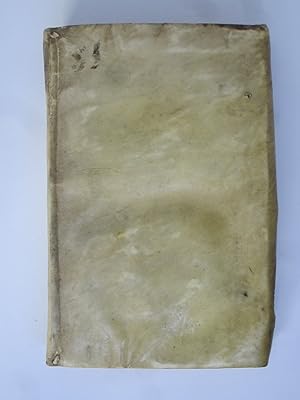
Quae Fides et Religio sit capessenda, consultatio; [bound with:] De Vita Religiose Instituenda, Sive de Quotidiana Virtutum Exercitatione Libellus . . . Nune primum in lucem aedita [by Gonsalvo Barnuevo]. [2 volumes bound as 1].
Published by Burchardum Kuickium; Joannem Kinckium sub Monocerote [Johannes Kinckius], 1612; 1613., Coloniae:, 1612
Seller: Jeff Weber Rare Books, Neuchatel, NEUCH, Switzerland
Seller rating 4 out of 5 stars

Two works bound in 1 volume. 12mo. 258, [6 blank]; [xxiv], 522, [16] pp. Title vignettes; minor worming at rear margins, light waterstaining. Original vellum; a few small worm-holes at spine edges/gutter, edges discolored. Early ownership signatures [ex libris Christophori Redii [?]; . . . 1657], single College of the Sacred Heart rubberstamp on ffep. Very good. Rare. "Four years [after the publication of De justitia et jure] a work of quite a different nature was written by Lessius under the title, "Quae fides et religio sit capessenda" (Antwerp, 1609). It is a short book of some 150 pages, on controversy and apologetics, which brought about a great many conversions, among them that of John of Nassau. The book was often reprinted and was translated into Flemish, German, Italian, Hungarian, Polish, and French." â" The Catholic Encyclopedia. / The second work is written by Alvarez de Paz and edited by Father Gonsalvo Barnuevo. Alvarez de Paz was a Spanish Jesuit mystic and member of the Society of Jesus who preached in Peru. Alleged to have had the gift of prophecy, during his sermons he often fell into ecstasy and had to be carried from the pulpit. Supposedly, when he died in Potosi, 100,000 silver miners left their work to observe his funeral services.


![Seller image for Quae Fides et Religio sit capessenda, consultatio; [bound with:] De Vita Religiose Instituenda, Sive de Quotidiana Virtutum Exercitatione Libellus . . . Nune primum in lucem aedita [by Gonsalvo Barnuevo]. [2 volumes bound as 1]. for sale by Jeff Weber Rare Books](https://pictures.abebooks.com/inventory/md/md30936392321.jpg)
