Order Total (1 Item Items):
Shipping Destination:

Melon J F (2 results)
Author:
melon j f
Refine with Advanced Search
Skip to main search results
Search filters
Product Type
- All Product Types
- Books (2)
- Magazines & Periodicals (No further results match this refinement)
- Comics (No further results match this refinement)
- Sheet Music (No further results match this refinement)
- Art, Prints & Posters (No further results match this refinement)
- Photographs (No further results match this refinement)
- Maps (No further results match this refinement)
- Manuscripts & Paper Collectibles (No further results match this refinement)
Condition Learn more
- New (No further results match this refinement)
- As New, Fine or Near Fine (1)
- Very Good or Good (No further results match this refinement)
- Fair or Poor (No further results match this refinement)
- As Described (1)
Binding
- All Bindings
- Hardcover (2)
- Softcover (No further results match this refinement)
Collectible Attributes
- First Edition (1)
- Signed (No further results match this refinement)
- Dust Jacket (No further results match this refinement)
- Seller-Supplied Images (2)
- Not Print on Demand (2)
Language (2)
Price
- Any Price
- Under US$ 25 (No further results match this refinement)
- US$ 25 to US$ 50 (No further results match this refinement)
- Over US$ 50
Free Shipping
Seller Location
Seller Rating
-
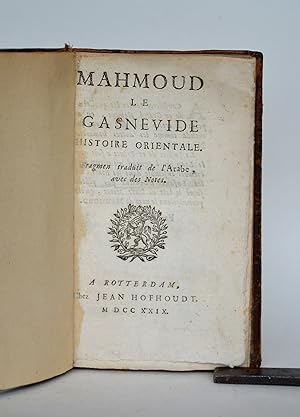
Mahmoud Le Gasnevide, Histoire orientale, Fragmen Traduit De L'arabe, Avec Des Notes
Language: French
Published by Jean Hofhoudt, Rotterdam
Couverture rigide. Condition: Bon. 1929. In-12, Pleine basane dos lisse orné (reliure fin XVIIIe). x pp., 170 pp. Ref. biblio. : Barbier III, 14. On retranscrit ci-après la notice d'une fiche de vente contrecollée sur le second plat : rare - cette traduction supposée est, en réalité, une histoire allégorique de la Régence. Melon, avocat au parlement de Bordeaux, y fonda une société littéraire qui, protégée par le duc de la Force, devint bientôt une Académie. Appelé à Paris par ce seigneur devenu ministre, il travailla ensuite avec le Garde des Sceaux d'Argenson, fut premier commis du Cardinal Dubois, de Law, et secrétaire du Régent, qui le consultait sur toutes les affaires considérables. Des usures minimes à la reliure, notamment au mors du premier plat, avec une petite fente ; bon état général hormis cela.
-
Essai politique sur le commerce.
Seller: Herman H. J. Lynge & Søn ILAB-ABF, Copenhagen, Denmark
Seller rating 4 out of 5 stars

First Edition
Amsterdam, Changuion, 1735. 8vo. In contemporary full sprinkled calf with five raised bands with richly gilt spine. Gilt frame to boards and edges of boards gilt. Small paper label pasted on to upper compartment of spine. Extremities with wear, boards with scratches and missing small part of the leather. Internally very fine and clean. (14), 251 pp. This unoffical second edition was published the year after the first edition (1734) and a year before the official second edition (published in 1736). Here Melon discusses various economic principles and policies, focusing on the role of commerce and trade in the prosperity of nations: ?"His Essai' is noteworthy not only because it constitutes the first systematic presentation of mercantilist doctrines to appear in France but also because it adumbrates the transition to physiocracy" (ESS X, 305). Melon's "Essai politique sur le commerce" is considered a significant work in the history of economic thought, particularly for its advocacy of free trade and its insights into the functioning of markets. It contributed to the development of liberal economic ideas that would later influence thinkers such as Adam Smith and the classical economists.