

Order Total (1 Item Items):
Shipping Destination:

Niger, First Edition (11 results)
Author:
niger
Refine with Advanced Search
Skip to main search results
Search filters
Product Type
- All Product Types
- Books (10)
- Magazines & Periodicals (No further results match this refinement)
- Comics (No further results match this refinement)
- Sheet Music (No further results match this refinement)
- Art, Prints & Posters (No further results match this refinement)
- Photographs (No further results match this refinement)
- Maps (No further results match this refinement)
- Manuscripts & Paper Collectibles (1)
Condition Learn more
- New (No further results match this refinement)
- As New, Fine or Near Fine (No further results match this refinement)
- Very Good or Good (5)
- Fair or Poor (1)
- As Described (5)
Binding
Collectible Attributes
Language (4)
Free Shipping
- Free Shipping to U.S.A. (No further results match this refinement)
Seller Location
Seller Rating
-

Art. IX. - Travels through the Timannee, Kooranko, and Soolima Countrires, to the Sources of the Rokelle and Niger, in the Year 1822. by Captain A. Gordon Laing. with a Map and Plates. 8vo. - Disbound from the Quarterly Review 1825.
Published by John Murray, London, 1825
Seller: Literary Cat Books, Machynlleth, Powys, WALES, United Kingdom
Association Member: IOBA
Seller rating 4 out of 5 stars

First Edition
Disbound. Condition: Very Good. Dust Jacket Condition: No Dust Jacket. First Edition; First Edition. Pages 485-474. Last page loose. Light wear. This is an original book review from the 19th century. ; Octavo (standard book size).
-
The Jewish People Past and Present - Volume III
Language: English
Published by Jewish Encyclopedic Handbooks / Central Yiddish Culture Organizations (CYCO), New York, NY, USA, 1952
Seller: Post Horizon Booksellers, Nokomis, SK, Canada
Association Member: ABAC ILAB IOBA
Seller rating 5 out of 5 stars

First Edition
Cloth. Condition: Very Good +. First U.S. Edition. ix, 419pp w index of Vols I-III. Indexed illustrations including frontis w tissue guard intact. Brick red cloth w gold lettering to cover and spine. Bumping to corners. Light wear to head and tail. Binding square and sound. Volume I and II also available. Quarto - 285 x 220mm.
-
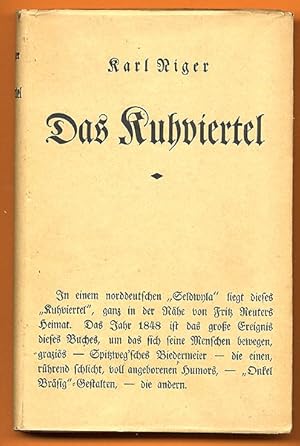
Das Kuhviertel, Mecklenburger Heimatroman
Language: German
Published by Verlag von Georg Westermann Braunschweig und Hamburg, 1925
Seller: Antiquariat an der Linie 3, Darmstadt, Germany
Seller rating 5 out of 5 stars
First Edition
13 cm x 20 cm Leinen. Erste Auflage. 182 Das Kuhviertel, Mecklenburger Heimatroman (unter dem Pseudonym Karl Niger) von dem Mecklenburger Pädagogen und Heimatforscher Karl Rieck (* 25. August 1851 in Neustrelitz; im August 1932 ) verfasst In einer mit G. abgekürzten, fiktiven mecklenburgischen Stadt spielender Novellen-Reigen. Bezeihungsreiches, alltägliches, Figuren haben markierende Namen wie ''Krischan'', sprechen großenteils im (damaligen) Platt, vieles wird in Anmerkungen übersetzt, so auch kleine Einführung ins ''Meckelbörger'' Platt. Stempel im Titel, Schutzumschlag nur gering lädiert. Ansonsten sehr schönes für das Alter fast nuewertiges Exemplar. Saubere Kanten, kaum Nachdunkelung, Fraktur sehr gut lesbar. Riger2500 Sprache: Deutsch Gewicht in Gramm: 500.
-

Handbuch der Mikrochemischen Methoden, Band I, Teil 1 : Organisch-Präparative und Mikroskopische Methoden
Published by Springer - Verlag, Wien:, 1954
First Edition
Hardcover. Condition: Very Good EX-LIBRARY. Dust Jacket Condition: No jacket. First Edition. 1. Auflage. Wien:: Springer - Verlag, 1954. Sehr gutes exemplar. Bibliotheksexemplar. PRÃPARATIVE MIKROMETHODEN IN DER ORGANISCHEN CHEMIE von H. Lieb und W. Schà niger (mit 139 textabbildungen); und MIKROSKOPISCHE METHODEN von L. Kofler und A. Kofler (mit 136 textabbildungen). Literatur. WITHDRAWN stamp, and a few other library markings on the endpapers. Text pages are clean. No underlining. No highlighting. No margin notes. Illustrated with micrographs, photos, and figures. Tables. Graphs. Bibliographical references. Bound in the original blue cloth, lettered in shiny gold on the spine and front cover. . First Edition. 1. Auflage. Hard Cover. Very Good EX-LIBRARY./No jacket. 8vo. vi, 236pp.
-
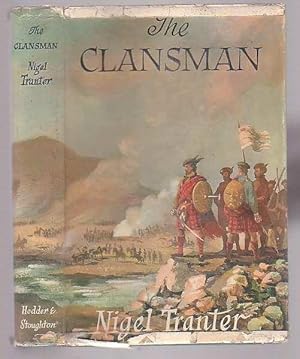
The Clansman
Published by Hodder and Stoughton, London, 1959
Seller: Renaissance Books, ANZAAB / ILAB, Dunedin, New Zealand
Association Member: ANZAAB ILAB
Seller rating 5 out of 5 stars
First Edition
Hardcover. Condition: Fair. Dust Jacket Condition: Fair. First Edition. Original cloth covers. Ex-library. Library stamps and markings. Dustjacket taped at all edges into plastic cover. Rear flap of dustjacket pasted to rear pastedown. Spine lean. Later endpapers. ; Ex-Library; 12mo.
-
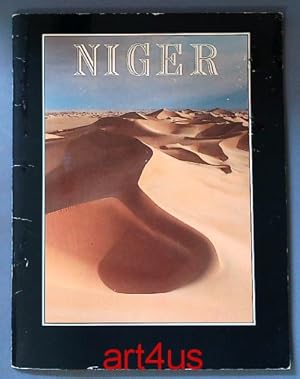
Aventures et découvertes au Niger : Fleuve, Aïr, Ténéré
Language: French
Published by Niamey : Office national du tourisme du Niger (1985)., 1985
First Edition
8°, illustr. Original-Broschur. Condition: Gut. 56 S., farb. ill. Frz. / Engl.; Einband gering berieben und begriffen, gutes Exemplar, sehr selten! 04-06-99 Aufgrund der EPR-Regelung kann zur Zeit in folgende Länder KEIN Versand mehr erfolgen: Bulgarien, Griechenland, Luxemburg, Österreich, Polen, Rumänien, Schweden, Slowakei. Bitte beachten Sie: Auf Grund der vorgegebenen Versandkosten von AbeBooks / ZVAB kann es bei Büchern über 1 kg oder bei mehrbändigen Werken zu höheren Versandkosten kommen. Please note: Due to the shipping costs specified by AbeBooks / ZVAB, there may be higher shipping costs for books over 1 kg or for multi-volume works. Sprache: Französisch Gewicht in Gramm: 160.
-
Autograph letter signed, by first African Bishop of the Anglican Church, Samuel Ajayi Crowther (1809-1891)
Language: English
Published by original letter, 1877
Seller: The Plantagenet King ABA : ILAB : PBFA, Birchington, KENT, United Kingdom
Association Member: ABA ILAB PBFA
Seller rating 5 out of 5 stars
Manuscript / Paper Collectible First Edition Signed
US$ 517.86
US$ 33.52 shipping
Ships from United Kingdom to U.S.A.Quantity: 1 available
Add to basketSoft cover. Condition: Very Good. 1st Edition. CROWTHER, Samuel Ajayi (c.1809-1891) First African Bishop in the Anglican Church. Autograph Letter Signed. Ware, 16 June 1877. Single sheet, written in ink on the recto; original horizontal folds. Light creasing from folding; small loss to top left. Very good. A letter written during Crowther's episcopate as Bishop of the Niger, declining an invitation to preach at Red Lion Church on account of his impending departure: 'no Sunday or week day available in June, and in July I shall be on the voyage for Africa.' Samuel Ajayi Crowther, born in present-day Nigeria, was captured and enslaved as a child, liberated by the Royal Navy, and educated in Sierra Leone. Ordained in the Church of England, he became in 1864 the first African bishop in the Anglican Communion, serving over the Niger mission during a formative period of missionary expansion in West Africa. The present letter dates from a return visit to England and refers directly to his voyage back to Africa during his tenure as bishop. Letters from Crowther are uncommon on the market. Signed by Author(s).
-
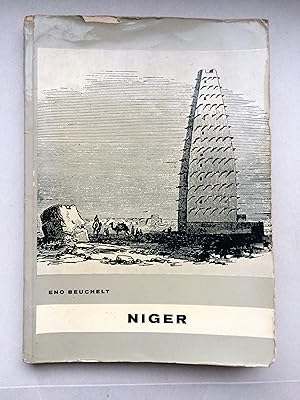
Niger (Reihe: Deutsche Afrika-Gesellschaft e.V. Bonn. Die Länder Afrikas. Band 38)
Language: German
Published by Kurt Schroeder-Verlag, 1968
First Edition
Softcover. Condition: Befriedigend. 1. Auflage. Paperback, acceptable, 143 S. auf deutsch, Coverbug hinten, Ecken bestoßen, Randläs., innen sauber, keine Eintragungen. Mit Karten, Klappkarte mit Läs. Die Niger-Republik liegt in Zentralafrika (Mittelafrika) ein Binnenstaat, der sogar fast ohne Tschadsee auskommen muss. Ein Land mit hoher Geburtenrate, das nicht immer allen Nahrung bietet; Die Hauptstadt Niamey liegt überhaupt nicht auf dem "Hauptgebiet", sondern im westlichen (südwestl.) "Wurmfortsatz". - Niger ist nicht Nigeria, liegt zwischen Tschad und Mali südlich von Libyen und Algerien. SW: Kunsthandwerk, Theatergruppen, Volkslieder, Zinder Niamey, Tuareg, Haussa, Mauri. Aus dieser Reihe haben wir zurzeit noch 2 Titel! Der Niger liegt plötzlich 2023 im "Fokus", im Brennpunkt der Weltpolitik und des öffentlichen Interesses genau wie die anderen Nachbar- und Binnenstaaten Sudan, Mali mit Timbuktu, Zentralafrikanische Republik u.a. China hatte schon seit Jahren großes Interesse an den Ländern Afrikas. Statt englisch oder französisch und geschweige denn deutsch - die Zeit deutscher Kolonien endete etwa 1915/17. - Buch auf deutsch & sofort lieferbar.
-
![Seller image for MISSIONS TO THE NIGER [Four Volumes]. I. The Journal of Friedrich Hornemann's Travels and The Letters of Alexander Gordon Laing; II. The Bornu Mission, 1822-25 Part 1; III. The Bornu Misssion, 1822-25 Part 2; IV. The Bornu Mission, 1822-25 Part 3 for sale by Buddenbrooks, Inc.](https://pictures.abebooks.com/inventory/md/md31223873385.jpg)
MISSIONS TO THE NIGER [Four Volumes]. I. The Journal of Friedrich Hornemann's Travels and The Letters of Alexander Gordon Laing; II. The Bornu Mission, 1822-25 Part 1; III. The Bornu Misssion, 1822-25 Part 2; IV. The Bornu Mission, 1822-25 Part 3
Published by Cambridge For the Hakluyt Society by Cambridge University Press 1964-1966, 1966
Seller: Buddenbrooks, Inc., Newburyport, MA, U.S.A.
Association Member: ABAA ILAB SNEAB
Seller rating 5 out of 5 stars
First Edition
4 volumes. First Edition. Profusely illustrated throughout with frontispieces, photographic plates and folding maps and charts and including a folding map stored in the pocket at the end of Vol. IV. 8vo, publisher's original light blue cloth lettered in gilt on the spine, all volumes housed in their original printed dustjackets. [xiv], 406; xiv, 306; xii, [307]-[596]; x, [597]-798 + maps and illustrations pp. A very fine copy of each volume, essentially as pristine, the spine panels of the dustjackets just a tad mellowed. FIRST EDITION OF EACH VOLUME. Landmark works on the discovery and exploration of the Niger and its adjacent environs. Laing, whose letters are provided in Vol. I is credited with making the first recorded discovery of Timbuktu by a European. Laing's purpose was to explore the Niger itself and he traveled the ancient route from Tripoll in the north to Timbuktu in the south before setting off on the Niger passage. Hornemann's route, different than Laing's, began in Cairo and ended somewhat east of Timbuktu and farther down river than where Laing began his river journey. The first part of Vol. I prints The Journal of Friedrich Hornemann's Travels from Cairo to Murzuk in the years 1797-98, the second part prints The Letters of Major Alexander Gordon Laing from 1824-1826. Vol. II - IV provide a long and useful introduction and print the Narative of Travels and Discoveries in Northern and Central Africa in the Years 1822, 1823 and 1824 by Major Denham, Captain Clapperton and the Late Doctor Oudney Extending Across the Great Desert tot the Tenth Degree of Northern Latitude, and From Koouka in Bornou, to Sackatoo, the Capital of the Felatah Empire. Vol III being Major Denham's Narrative and Vol. IV the Journal of An Excursion from Kouka in Bornou Through Soudan, to Soccatoo, the Capital of Bello, Sultan of the Felatahs. Denham and Clapperton, in the company of Dr. Walter Oudney, travelled from Benioleed, near Tripoli, almost due south to Lake Tchad, with excursions into the mountains west of Mourzuk in Fezzan. Dixon attempted to traverse the circuit around Lake Tchad but was unsuccessful. In the meantime, Clapperton and Oudney journeyed west from the lake toward the Niger, but the doctor only made it about a third of the way, and died in Murmur. Clapperton continued west, but was prevented from passing beyond Sackatoo by the local Sultan. He and Denham subsequently returned to Tripoli and crossed back to England This narrative is compiled primarily from Denham's journal, with a chapter by Dr. Oudney on the excursion to the mountains west of Mourzuk. A final section by Clapperton relates the westward journey from Lake Tchad to Sackatoo and includes an account of Oudney's death. Among the several appendices are translations from the Arabic of various letters and documents brought back by Denham and Clapperton, including a document relating to the death of Mungo Park.
-
Dominici Marii Nigri Veneti Geographiae commentariorum libri XI: nunc primum in lucem magno studio editi. Una cum Laurentii Corvini novoforensis geographia. Et Strabonis epitome per D. Hieronymum Gemusaeum translata, quam adiecimus ut quo cum Marium hunc nostrum lector conferat, habeat
Published by Heinrich Petrus, Basle, 1557
Seller: Hordern House Rare Books, Potts Point, NSW, Australia
Association Member: ANZAAB ILAB
Seller rating 4 out of 5 stars
First Edition
Folio, woodcut printer's device to title and verso of final leaf, woodcut historiated initials; original white pigskin binding over wooden boards, blind-tooled to a panelled design, roll-tooled borders including one with images of the psalmist and evangelists, another with humanist medallion portraits (including those of Erasmus, Luther and Melanchthon), spine with four raised bands, later paper label at head giving title in places. First edition: a handsome copy in contemporary monastic pigskin binding of this mid-sixteenth century compendium of geographical knowledge by the Venetian writer Dominicus Marius Niger, edited by Wolfgang Wissenburg. In the tradition of the great classical geographer Strabo, Niger provides a description of the principal regions of the earth, together with accounts of the habits, customs and laws of its various peoples. The first eleven chapters describe the geography of Europe; four chapters deal with Africa, and are followed by eleven concerning Asia. This edition also contains the Geographia of Laurentius Corvinus and an epitome of Strabo by Hieronymus Gemuseus, first published in 1539. Hakluyt would later produce ten arguments to prove that the Northwest Passage had been successfully sailed: the first century BC writer Cornelius Nepos can't have been wrong, he says, " And for the better proof that the same authority of Cornelius Nepos is not by me wrested to prove my opinion of the North-West Passage, you shall find the same affirmed more plainly in that behalf by the excellent geographer Dominicus Marius Niger, who showeth how many ways the Indian sea stretcheth itself, making in that place recital of certain Indians that were likewise driven through the north seas from India, upon the coasts of Germany, by great tempest, as they were sailing in trade of merchandise". Adams records only two copies at Cambridge (CUL and John's), while OCLC identifies about 15 library copies, but this is a rare work on the market, with no copy appearing at auction in the last fifty years. No copy is held in an Australian library. --- Ralegh's interest in Niger's work is noted by Nicholas Popper (Walter Ralegh's History of the World and the Historical Culture of the Late Renaissance, 2014) who references ". the notes [Ralegh] took while reading the work of Marius Niger. Very little is known about Niger beyond the fact that he also edited a 1518 edition of Ovid's Amores, but, after the Petri printing house's 1557 edition of his Geographiae, he enjoyed a wide readership in Elizabethan England. Wolfgang Wissenburg, the editor of this edition, explained in his preface that the manuscript version of the work was "tarnished both by neglect and by worms, but it also had been polluted and depraved by a certain corruptor into whose hands it unfortunately had come." Correcting the manuscript had taken significant labor, as Wissenburg explained: "if not for repeated intense reading of the ancients, I would not have been able to understand the genuine sense and mind of the author and restore his places and meanings. Correcting Niger's commentaries against ancient texts might have been a suspect method for a travel narrative, but it ably reconstructed his method of compilation. Niger had constructed the text by synthesizing ancient geographical and historical works into an experiential narrative, and his information on Bactria and Sogdiana was cribbed almost entirely from Ptolemy's material, with periodic additions from Plutarch, Quintus Curtius, and others. Thus, Wissenburg's technique of correction imitated Niger's method of composition. Ralegh often cited Niger regarding the geography of Asia both in the notebook and in the History, and he relied heavily on Niger for Bactria and Sogdiana. Niger's descriptions of these areas appeared both in Ralegh's notes and on the maps themselves.". . Provenance: From the Fürstliche Fürstenbergische Hofbibliothek at Donaueschingen, the great German aristocratic library (contents dispersed between 1980 and 2000). Marginal dampstains to first 25 leaves (preface and index), an excellent copy in contemporary binding, small portions of the pigskin worn in two places revealing oak boards beneath.
-
[Drop-head title:] Niger expedition. Return to an Address of the Honourable The House of Commons, dated 6 February 1840.
Published by [s.n.] [1840], [London], 1840
Seller: Antiquates Ltd - ABA, ILAB, Wareham, Dorset, United Kingdom
Association Member: ABA ILAB PBFA
Seller rating 5 out of 5 stars
First Edition
US$ 863.10
US$ 33.52 shipping
Ships from United Kingdom to U.S.A.Quantity: 1 available
Add to basketFirst edition. 6pp. Docket title to verso of final leaf. A trifle creased, some very short tears to margins. A rare survival, ordered to be printed by the House of Commons, of copies of correspondence concerning the setting up of a British expedition to Niger to attempt to repress the foreign slave trade. The expedition, organised by the Society for the Extinction of the Slave Trade and for the Civilization of Africa, was ultimately mounted in 1841 using three British iron steam vessels to travel to Lokoja, at the confluence of the Niger River and Benue River, where treaties against the slave trade where achieved - despite significant casualties from illness amongst members of the expedition - with the cities of Aboh and Idah. OCLC records copies at four locations (Florida, Harvard, NYPL, and Oxford); COPAC adds no further. Size: Folio.





![Seller image for [Drop-head title:] Niger expedition. Return to an Address of the Honourable The House of Commons, dated 6 February 1840. for sale by Antiquates Ltd - ABA, ILAB](https://pictures.abebooks.com/inventory/md/md31835056362.jpg)