
Pedro Txillida (9 results)

Language: English
Published by Galerie Fabrice Galvani, Toulouse, 2002
- Softcover
- First Edition
Seller: Works on Paper, DeKalb, IL, U.S.A.Works on Paper
Contact seller5-star sellerCondition: Used - Very good
US$ 25.00
US$ 6.50 shippingShips within U.S.A.Quantity: 1 available
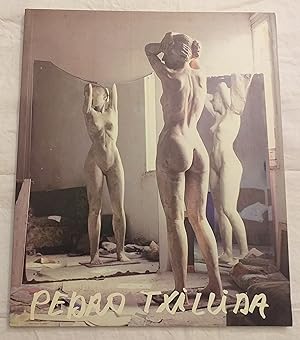
Soft cover. Condition: Very Good. 1st Edition. A very good copy. The text, which is in French and Spanish, is wholly unmarked, pristine, and the binding is bright and fresh in appearance, with no creasing to the spine. A sharp copy.
 More images
Published by Galería Colón XVI., Bilbao, 1996
- Softcover
Seller: Aaromadelibros, Madrid, M, SpainAaromadelibros
Contact seller5-star sellerCondition: Used
US$ 15.24
US$ 17.64 shippingShips from Spain to U.S.A.Quantity: 1 available
1ª edición. First edition. Arte. Escultura. Pintura. Catálogo. Miguel Zugaza "La Costilla de Adán o la espalda del pintor. Preciosas ilustraciones de inturas y esculturas y fotos de Txillida. 28 x 23 cms, sin paginar pero unas 40 pgs. Excelente estado. Excellent condition. Rústica editorial ilustrada con solapas.

Published by Gema Llamazares,, Gijón, 2007
- Softcover
- First Edition
Seller: Carmichael Alonso Libros, Cantabria, S, SpainCarmichael Alonso Libros
Contact seller4-star sellerCondition: Used - Very good
US$ 11.72
US$ 25.04 shippingShips from Spain to U.S.A.Quantity: 1 available
Rústica. Condition: Bueno. 1ª ed. 21x21. 30pp. Profusamente ilustrado. Rústica. Catálogo. Muy buen ejemplar. .

- Hardcover
- First Edition
Seller: Any Amount of Books, London, United KingdomAny Amount of Books
Contact seller5-star sellerCondition: Used
US$ 55.00
US$ 24.70 shippingShips from United Kingdom to U.S.A.Quantity: 1 available
Hardcover. Small oblong 4to. 23cm by 24cm. pp 177. Original publisher's beige cloth, lettered black on spine. Copiously illustrated in colour and black and white throughout. Text in English and Spanish. ISBN: 8460546985 Fine in fine dust jacket.

Published by Galerie Forsblom, 61, 2001
- Softcover
- First Edition
Seller: Moraine Books, Ruovesi, FinlandMoraine Books
Contact seller5-star sellerCondition: Used - Very good
US$ 40.00
US$ 40.42 shippingShips from Finland to U.S.A.Quantity: 1 available
Soft Cover. Condition: Very Good. 1st Edition. Text in English, Spanish and Finnish. 31 pp. Bumped corner, yellowed covers.

Language: English
Published by Bilbao: Galeria Colon XVI, 2002
- First Edition
Seller: BOUQUINIST, München, BY, GermanyBOUQUINIST
Contact seller5-star sellerCondition: Used - Very good
US$ 23.45
US$ 91.07 shippingShips from Germany to U.S.A.Quantity: 1 available
Illustrierte Klappenbroschur. Condition: Gut. Erstausgabe. 23 (1) Seiten mit vielen Abbildungen. 25 x 24,2 cm. Guter Zustand. - Eduardo Chillida Juantegui, or Eduardo Txillida Juantegi in Basque, (10 January 1924 19 August 2002) was a Spanish Basque sculptor notable for his monumental abstract works. Early life and career: Born…in San Sebastián to the major Pedro Chillida and the soprano Carmen Juantegui on 10 January 1924, Eduardo Chillida grew up near the Biarritz Hotel, which was owned by his grandparents. Chillida had been the goalkeeper for Real Sociedad, San Sebastián's La Liga football team, where his knee was so seriously injured that he had five surgeries, ending a promising football career. He then studied architecture at the University of Madrid from 1943 to 1946. In 1947 he abandoned architecture for art, and the next year he moved to Paris, where he set up his first studio and began working in plaster and clay. He never finished his degree and instead began to take private art lessons. He lived in Paris from 1948 to 50 and at Villaines-sous-Bois (Seine-et-Oise) from 1950 to 1955. In 1950 Chillida married Pilar Belzunce and later returned to the San Sebastián area, first to the nearby village of Hernani and in 1959 to the city of his birth, where he remained. He died at his home near San Sebastián at the age of 78. Work: Chillida's earliest sculptures concentrated on the human form (mostly torsos and busts); his later works tended to be more massive and more abstract, and included many monumental public works. Chillida himself tended to reject the label of "abstract", preferring instead to call himself a "realist sculptor". Upon returning to the Basque Country in 1951, Chillida soon abandoned the plaster he used in his Paris works a medium suited to his study of archaic figurative works in the Louvre. Living near Hernani, he began to work in forged iron with the help of the local blacksmith, and soon set up a forge in his studio. From 1954 until 1966, Chillida worked on a series entitled Anvil of Dreams, in which he used wood for the first time as a base from which the metal forms rise up in explosive rhythmic curves. He began to make sculpture in alabaster 1965. Rather than turn over a maquette of a sculpture to fabricators, as many modern artists do, Chillida worked closely with the men in the foundry. He then usually added an alloy that caused the metal to take on a brilliant rust color as it oxidizes. From quite early on, Chillida's sculpture found public recognition, and, in 1954, he produced the four doors for the basilica of Arantzazu, where works by other leading Basque sculptors Jorge Oteiza, Agustin Ibarrola and Nestor Basterretxea were also being installed. The following year, he carved a stone monument to the discoverer of penicillin, Sir Alexander Fleming, for a park in San Sebastián (it subsequently disappeared, but a new version has been installed on the promenade at San Sebastián bay). By the early 1970s, his steel sculptures had been installed in front of the Unesco headquarters in Paris, the Thyssen building in Düsseldorf, and in a courtyard at the World Bank offices in Washington. At their best his works, although massive and monumental, suggest movement and tension. For example, the largest of his works in the United States, De Musica is an 81-ton steel sculpture featuring two pillars with arms that reach out but do not touch. Much of Chillida's work is inspired by his Basque upbringing, and many of his sculptures' titles are in the Basque language Euskera. His steel sculpture De Música III was exhibited at the Yorkshire Sculpture Park in the UK, as part of a retrospective of Chillida's work. Chillida also conceived a distinguished oeuvre of etchings, lithographs and woodcuts since 1959, including illustrations for Jorge Guillen's Mas Alla (1973) and various other books. Chillida Leku: In the 1990s, Chillida set up a foundation for the display of his work, at the Chillida Leku, centred on an old farmhouse, in the Basque countryside. Today there is an outdoor sculpture garden dedicated to his work. Monument to Tolerance, Fuerteventura: According to Chillida's plans for a Monument of Tolerance, an artificial cave is to be bored into the mountain. The huge cubic cave, measuring 40 metres (131 ft) along each side, is to be dug from inside a mountain that has long been revered by the inhabitants of the dusty, barren island to the south of Lanzarote. About 64,000 cubic metres of rock will be taken away from the mountain, which rises out of an arid landscape in the north of the island, to create what Chillida called his 'monument to tolerance'. Chillida's original idea was for visitors to experience the immensity of the space. The project has been in development since 1994, eight years before Chillidas death. In 2011 local authorities decided to go ahead with a project by Chillida inside Mount Tindaya on Fuerteventura despite concerns from environmentalists. As of 2013, local officials are continuing to seek ¤75 million in private funding. Dialogue with Heidegger: In the early 1960s Eduardo Chillida engaged into a dialog with the German philosopher Martin Heidegger. When the two men met, they discovered that from different angles, they were "working" with space in the same way. Heidegger wrote: "We would have to learn to recognize that things themselves are places and do not merely belong to a place," and that sculpture is thereby ".the embodiment of places." Against a traditional view of space as an empty container for discrete bodies, these writings understand the body as already beyond itself in a world of relations and conceive of space as a material medium of relational contact. Sculpture shows us how we belong to the world, a world in the midst of a technological process of uprooting and homelessness. Heidegger suggests how we can still find room to dwell therein. Chillida has been quoted as saying: "My whole Work is a journey of discovery in Space. Space is the liveliest of all, the one that surrounds us. .I do no.

- First Edition
Seller: BOUQUINIST, München, BY, GermanyBOUQUINIST
Contact seller5-star sellerCondition: Used - As new
US$ 70.35
US$ 91.07 shippingShips from Germany to U.S.A.Quantity: 1 available
Illustrierte Klappenbroschur. Condition: Wie neu. Erstausgabe. 167 (1) Seiten mit vielen Abbildungen. 28 x 22,2 cm. Sehr guter Zustand. Frisches Exemplar. Wie ungelesen. - Eduardo Chillida Juantegui, or Eduardo Txillida Juantegi in Basque, (10 January 1924 19 August 2002) was a Spanish Basque sculptor notable for his monumental…abstract works. Early life and career: Born in San Sebastián to the major Pedro Chillida and the soprano Carmen Juantegui on 10 January 1924, Eduardo Chillida grew up near the Biarritz Hotel, which was owned by his grandparents. Chillida had been the goalkeeper for Real Sociedad, San Sebastián's La Liga football team, where his knee was so seriously injured that he had five surgeries, ending a promising football career. He then studied architecture at the University of Madrid from 1943 to 1946. In 1947 he abandoned architecture for art, and the next year he moved to Paris, where he set up his first studio and began working in plaster and clay. He never finished his degree and instead began to take private art lessons. He lived in Paris from 1948 to 50 and at Villaines-sous-Bois (Seine-et-Oise) from 1950 to 1955. In 1950 Chillida married Pilar Belzunce and later returned to the San Sebastián area, first to the nearby village of Hernani and in 1959 to the city of his birth, where he remained. He died at his home near San Sebastián at the age of 78. Work: Chillida's earliest sculptures concentrated on the human form (mostly torsos and busts); his later works tended to be more massive and more abstract, and included many monumental public works. Chillida himself tended to reject the label of "abstract", preferring instead to call himself a "realist sculptor". Upon returning to the Basque Country in 1951, Chillida soon abandoned the plaster he used in his Paris works a medium suited to his study of archaic figurative works in the Louvre. Living near Hernani, he began to work in forged iron with the help of the local blacksmith, and soon set up a forge in his studio. From 1954 until 1966, Chillida worked on a series entitled Anvil of Dreams, in which he used wood for the first time as a base from which the metal forms rise up in explosive rhythmic curves. He began to make sculpture in alabaster 1965. Rather than turn over a maquette of a sculpture to fabricators, as many modern artists do, Chillida worked closely with the men in the foundry. He then usually added an alloy that caused the metal to take on a brilliant rust color as it oxidizes. From quite early on, Chillida's sculpture found public recognition, and, in 1954, he produced the four doors for the basilica of Arantzazu, where works by other leading Basque sculptors Jorge Oteiza, Agustin Ibarrola and Nestor Basterretxea were also being installed. The following year, he carved a stone monument to the discoverer of penicillin, Sir Alexander Fleming, for a park in San Sebastián (it subsequently disappeared, but a new version has been installed on the promenade at San Sebastián bay). By the early 1970s, his steel sculptures had been installed in front of the Unesco headquarters in Paris, the Thyssen building in Düsseldorf, and in a courtyard at the World Bank offices in Washington. At their best his works, although massive and monumental, suggest movement and tension. For example, the largest of his works in the United States, De Musica is an 81-ton steel sculpture featuring two pillars with arms that reach out but do not touch. Much of Chillida's work is inspired by his Basque upbringing, and many of his sculptures' titles are in the Basque language Euskera. His steel sculpture De Música III was exhibited at the Yorkshire Sculpture Park in the UK, as part of a retrospective of Chillida's work. Chillida also conceived a distinguished oeuvre of etchings, lithographs and woodcuts since 1959, including illustrations for Jorge Guillen's Mas Alla (1973) and various other books. Chillida Leku: In the 1990s, Chillida set up a foundation for the display of his work, at the Chillida Leku, centred on an old farmhouse, in the Basque countryside. Today there is an outdoor sculpture garden dedicated to his work. Monument to Tolerance, Fuerteventura: According to Chillida's plans for a Monument of Tolerance, an artificial cave is to be bored into the mountain. The huge cubic cave, measuring 40 metres (131 ft) along each side, is to be dug from inside a mountain that has long been revered by the inhabitants of the dusty, barren island to the south of Lanzarote. About 64,000 cubic metres of rock will be taken away from the mountain, which rises out of an arid landscape in the north of the island, to create what Chillida called his 'monument to tolerance'. Chillida's original idea was for visitors to experience the immensity of the space. The project has been in development since 1994, eight years before Chillidas death. In 2011 local authorities decided to go ahead with a project by Chillida inside Mount Tindaya on Fuerteventura despite concerns from environmentalists. As of 2013, local officials are continuing to seek ¤75 million in private funding. Dialogue with Heidegger: In the early 1960s Eduardo Chillida engaged into a dialog with the German philosopher Martin Heidegger. When the two men met, they discovered that from different angles, they were "working" with space in the same way. Heidegger wrote: "We would have to learn to recognize that things themselves are places and do not merely belong to a place," and that sculpture is thereby ".the embodiment of places." Against a traditional view of space as an empty container for discrete bodies, these writings understand the body as already beyond itself in a world of relations and conceive of space as a material medium of relational contact. Sculpture shows us how we belong to the world, a world in the midst of a technological process of uprooting and homelessness. Heidegger suggests how we can still find room to dwell therein. Chillida has been quoted as saying: "My whole Work is a journey of discovery in Space. Space is the liveliest of.

Published by Caja de Ahorros de Vizcaya, Bilbao, 1981
- Softcover
Seller: LIBRERÍA SOLAR DEL BRUTO, Puente Tocinos, Murcia, MU, SpainLIBRERÍA SOLAR DEL BRUTO
Contact seller4-star sellerCondition: Used - Very good
US$ 18.05
US$ 96.76 shippingShips from Spain to U.S.A.Quantity: 1 available
Rústica. Condition: Buen estado. 18 h. de láminas color, 21 x21 cm Exposición celebrada en octubre, 1981, Bilbao, Sala de Arte 21 Español.
- Softcover
Seller: Almacen de los Libros Olvidados, Barakaldo, BI, SpainAlmacen de los Libros Olvidados
Contact seller5-star sellerCondition: Used
US$ 19.35
US$ 68.30 shippingShips from Spain to U.S.A.Quantity: 1 available
tapa blanda. Condition: 2ª Mano. 2ª Mano. 1996, Catálogo de la exposición Sala Colón. Libro.


