

Order Total (1 Item Items):
Shipping Destination:

Rayleigh Ramsay (19 results)
Skip to main search results
Search filters
Product Type
- All Product Types
- Books (19)
- Magazines & Periodicals (No further results match this refinement)
- Comics (No further results match this refinement)
- Sheet Music (No further results match this refinement)
- Art, Prints & Posters (No further results match this refinement)
- Photographs (No further results match this refinement)
- Maps (No further results match this refinement)
- Manuscripts & Paper Collectibles (No further results match this refinement)
Condition Learn more
Binding
Collectible Attributes
- First Edition (8)
- Signed (No further results match this refinement)
- Dust Jacket (2)
- Seller-Supplied Images (7)
- Not Print on Demand (17)
Language (2)
Price
- Any Price
- Under US$ 25 (No further results match this refinement)
- US$ 25 to US$ 50
- Over US$ 50
Free Shipping
Seller Location
Seller Rating
-

Argon, A New Constituent of the Atmosphere
Published by Smithsonian Institution
Seller: Wonder Book, Frederick, MD, U.S.A.
Seller rating 5 out of 5 stars

Condition: Fair. City of Washington: Smithsonian Institution, 1896. Folio. 43pp. Figures. Good book. Ex-library. Book bound in cardboard covers, which are rubbed, soiled, and a bit bumped. Shelfmark on front cover joint at tail; embossed seal on front cover of book. Free page edges frayed. Inquire if you need further information.
-
Smithsonian Contributions to Knowledge, Vol. XXIX. On the Densities of Oxygen and Hydrogen. . . . The Composition of Expired Air. . . . Argon, a New Constituent of the Atmosphere. Atmospheric Actinometry. . . . (Cont. In Descrip.)
Language: English
Published by Smithsonian Institution, 1895, 1895, 1896, 1896, 1898, 1901, 1903, 1903., City of Washington, 1895
Seller: Pride and Prejudice-Books, Ballston Lake, NY, U.S.A.
Seller rating 5 out of 5 stars
First Edition
Hardcover. Condition: Very Good. First Edition. A Determination of the Ratio. . . . Experiments with Ionized Air. The Structure of the Nucleus. . . . On the Absorption and Emission of Air. . . .Rebound in sturdy green library buckram with gilt title and volume number and dewey decimal number on white label on spine. Ex-library with due date slip and library stamps on top, bottom, and fore-edges. No other library markings such as cardholder, etc. As is often the case, the Smithsonian advertisement has chips, tears, and tape mends. Original front wrappers bound in. Slight edge tanning to leaves, single tape mend to the edge of the Morley and Schumann front wrappers and a Schumann plate, else Very Good. Large quarto (nearly folio). xi + xii + 117 + iii + 81 + 43 + 48 + v + 29 + x + 95 + xiv + 176 + iv + 30 pp. All 5 plates called for in these monographs are present. The Table of Contents calls for a Michelson article entitled "On the Application of Interference Methods to Spectroscopic Measurements" that is not bound in this volume. Includes some important monographs. Bound in are the library catalog slips that go with each monograph.
-
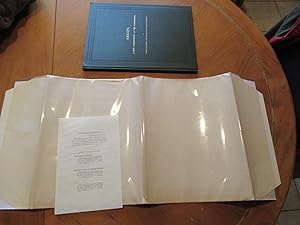
Argon, A New Constituent Of The Atmosphere. (With Dust Jacket And Smithsonian Flyer)
Language: English
Published by Smithsonian Institution, Washington, 1896
Seller: Arroyo Seco Books, Pasadena, Member IOBA, Pasadena, CA, U.S.A.
Association Member: IOBA
Seller rating 4 out of 5 stars

First Edition
Hardcover. Condition: Fine. Dust Jacket Condition: Very Good + Dust Jacket. First Separate Edition. [Iii], 43 Pp. Green Cloth, Gilt. 33 Cm X 25 Cm. First Separate Hardcover Printing Of The Original Paper Describing Their Discovery Of Hydrogen. A Fine Copy, Bright And Fresh, Gilt Brilliant, No Marks Or Stains Or Fading, Slight Waviness To Front Free Endpaper Near The Spine Edge (Binding Flaw), Tiny Rubs Right On Edges At Spine Ends. With The Smithsonian Flyer Of May 1896 Describing The Book And Providing The Library Catalog Slips For The Book. Also With The Scarce Dust Jacket, Unprinted, Clean And Bright, Small Chips At Ends, Slight Browning (Much Less Than Usual).
-
Argon, a New Constituent of the Atmosphere Smithsonian Contributions to Knowledge 1033
Published by Smithsonian Institution, Washington D. C., 1896
Seller: DogStar Books, Lancaster, PA, U.S.A.
Association Member: IOBA
Seller rating 5 out of 5 stars
First Edition
Wraps. Condition: Very Good+. First Edition; First Printing. Line drawings; diagrams; 4to 11" - 13" tall; 43 pages; Oversize paperback in original title lettered wraps. Bright tight and very neat example of Rayleigh and Ramsay's important monograph, the basis, in considerable part, for their being awarded 1904 Nobel Prizes in Physics and Chemistry, respectively. Expected edge toning to covers and mild furring of an unopened edge. Publisher's binding instruction sheet laid in. VG+ . Oversize book may require additional charges for expedited or international shipping.
-
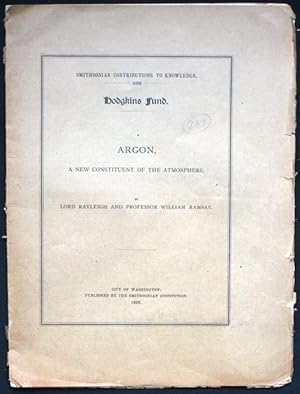
Argon. A New Constituent of the Atmosphere (= Smithsonian Contributions to Knowledge 1033)
Published by The Smithsonian Institution, Washington, 1896
Seller: Graphem. Kunst- und Buchantiquariat, Berlin, Germany
Seller rating 4 out of 5 stars
gr 4°, Brosch., 43 S. - Rücken schadhaft, Bindung jedoch fest, Randbereiche bestoßen, leichte Kncikspuren, unaufgeschnitten, innen sauberes Exemplar / spine damaged, binding firm, lightly creased. Buch.
-
Argon, a New Constituent of the Atmosphere.
Published by City of Washington, Smithsonian Institution., 1896
Seller: JF Ptak Science Books, Hendersonville, NC, U.S.A.
Seller rating 5 out of 5 stars
Hardcover. Condition: Fine. Lord Rayleigh (John Strutt, third Baron.) and William Ramsay. Argon, a New Constituent of the Atmosphere. The Hodgkins Fund. City of Washington, Smithsonian Institution. 1896. Smithsonian Contributions to Knowledge. 1033. 4to., [4], 43 pp., 5 text figures. Superior copy in the original green cloth with blind stamping and gilt stamps. Provenance: Library of Congress, with their "surplus/duplicate" stamp on front free endpaper. This is the first edition published in the U.S., following the very rare offprint of 1894 and the Phil Trans appearance of 1895. First edition, announcing the discovery of the first inert gas, the work (largely) leading to the Nobel Prize in physics for Rayleigh and the Nobel for chemistry for Ramsay in 1904. And from "The Discovery of Argon: a Case of Learning from Data?", by Aris Spanos in Philosophy of Science ,Vol. 77, No. 3, July 2010: "In 1904, Lord Rayleigh (1842 1919) and his collaborator Sir William Ramsay (1852 1916) were awarded the Nobel Prize in physics and chemistry, respectively, primarily for their role in the discovery of argon, an inert gas in the atmosphere. The averse reaction to this discovery by Mendeleev (1834 1907) might have been the main reason for his not being awarded the Nobel prize in chemistry in 1906." "The discovery of argon resulted from a careful unraveling of an empirical discrepancy, initially detected by Rayleigh when measuring the density of nitrogen gas produced by two different procedures. After a long trial and error process based on a carefully designed sequence of experiments and guided by an informal (by today's standards) analysis of the resulting data Rayleigh and Ramsay reached the conclusion that the atmospheric air contains argon, a hitherto unknown element." And this: "Rayleigh and Ramsey had noted that nitrogen obtained from the air had a density greater than that of nitrogen liberated from its compounds by about one-half percent. This led to the isolation of the first of the inert gases which they called argon. In the following year Ramsay found another, helium, in the mineral clevite, although this had been noted in the sun s spectrum by Lockyear in 1868. In four years, 1894-8, five new gases, including neon, krypton and xenon had been discovered. These form a distinct group in the periodic table; all have zero valency."-- [Dibner]. Dibner, Heralds of Science 50.
-
Argon, a New Constituent of the Atmosphere.
Published by City of Washington, Smithsonian Institution., 1896
Seller: JF Ptak Science Books, Hendersonville, NC, U.S.A.
Seller rating 5 out of 5 stars
Hardcover. Condition: Fine. Lord Rayleigh (John Strutt, third Baron.) and William Ramsay. Argon, a New Constituent of the Atmosphere. The Hodgkins Fund. City of Washington, Smithsonian Institution. 1896. Smithsonian Contributions to Knowledge. 1033. 4to., [4], 43 pp., 5 text figures. Superior copy in the original green cloth with blind stamping and gilt stamps. Provenance: Library of Congress, with their "surplus/duplicate" stamp on front free endpaper. This is the first edition published in the U.S., following the very rare offprint of 1894 and the Phil Trans appearance of 1895. First edition, announcing the discovery of the first inert gas, the work (largely) leading to the Nobel Prize in physics for Rayleigh and the Nobel for chemistry for Ramsay in 1904. And from "The Discovery of Argon: a Case of Learning from Data?", by Aris Spanos in Philosophy of Science ,Vol. 77, No. 3, July 2010: "In 1904, Lord Rayleigh (1842 1919) and his collaborator Sir William Ramsay (1852 1916) were awarded the Nobel Prize in physics and chemistry, respectively, primarily for their role in the discovery of argon, an inert gas in the atmosphere. The averse reaction to this discovery by Mendeleev (1834 1907) might have been the main reason for his not being awarded the Nobel prize in chemistry in 1906." "The discovery of argon resulted from a careful unraveling of an empirical discrepancy, initially detected by Rayleigh when measuring the density of nitrogen gas produced by two different procedures. After a long trial and error process based on a carefully designed sequence of experiments and guided by an informal (by today's standards) analysis of the resulting data Rayleigh and Ramsay reached the conclusion that the atmospheric air contains argon, a hitherto unknown element." And this: "Rayleigh and Ramsey had noted that nitrogen obtained from the air had a density greater than that of nitrogen liberated from its compounds by about one-half percent. This led to the isolation of the first of the inert gases which they called argon. In the following year Ramsay found another, helium, in the mineral clevite, although this had been noted in the sun s spectrum by Lockyear in 1868. In four years, 1894-8, five new gases, including neon, krypton and xenon had been discovered. These form a distinct group in the periodic table; all have zero valency."-- [Dibner]. Dibner, Heralds of Science 50.
-
Argon, a New Constituent of the Atmosphere
Published by Washington, D.C.: Smithsonian Institute, 1896
First Edition
Hardcover. Condition: Near Fine. No Jacket. 1st Edition. Both Rayleigh and Ramsay claimed priority for the discovery of argon; they eventually agreed to submit a jointly authored paper. Both later won the Nobel prize (Rayleigh for Physics, Ramsay for Chemistry), and their discovery was a major factor in both awards. "Rayleigh and Ramsay had noted that nitrogen obtained from the air had a density greater than that of nitrogen liberated from its compounds by about one-half percent. This led to the isolation of the first of the inert gases, which they called argon," after the Greek word aergon ("inert, inactive") (Dibner). Ramsay later investigated other atmospheric gases, isolating helium, neon, krypton, and xenon, which pioneered a new section of the periodic table. First American Ed. Slim Large 4to, orig gold-printed green cloth, near fine, in elusive unprinted dust cover (few very minor losses), with tip-in. endpapers; 1 blank, 2 leaves (title page; advertisement), 43 pp, 1 blank, 5 diagrams in text (See A. Greenberg, From Alchemy to Chemistry in Picture and Story, John Wiley & Sons, New York, 2007, pp 513-517).
-
Argon, A New Constituent of the Atmosphere
Published by Published by the Smithsonian Institution, City of Washington, 1896
Seller: Fine Editions Ltd, Willow Street, PA, U.S.A.
Association Member: IOBA
Seller rating 5 out of 5 stars
First Edition
Original Cloth. Condition: Fine. First Printing. First separate appearance of this scientific paper reporting discovery of the first inert gas, for which Rayleigh and Ramsay were awarded the Nobel prize. Royal 8vo (322 x 242mm): [4],43,[1]pp, with tables and five text woodcut illustrations. Original forest green publisher's cloth, covers framed in blind, upper cover lettered in gilt, yellow coated end papers. Publisher catalog slip laid-in. Wanting the plain-paper dust jacket. A Fine, bright copy, pristine inside and out. Dibner 50 (for original periodical appearance). Originally published in the Philosophical Transactions of the Royal Society, in 1895. Both Rayleigh and Ramsay claimed priority for the discovery of argon; they eventually agreed to submit a jointly authored paper. Both later won the Nobel prize (Rayleigh for Physics, Ramsay for Chemistry), and their discovery was a major factor in both awards. "Rayleigh and Ramsay had noted that nitrogen obtained from the air had a density greater than that of nitrogen liberated from its compounds by about one-half percent. This led to the isolation of the first of the inert gases, which they called argon," after the Greek word aergón ("inert, inactive") (Dibner). Ramsay later investigated other atmospheric gases, isolating helium, neon, krypton, and xenon, which pioneered a new section of the periodic table. N. B. With few exceptions (always identified), we only stock books in exceptional condition. All orders are packaged with care and posted promptly. Satisfaction guaranteed. (Fine Editions Ltd is a member of the Independent Online Booksellers Association, and we subscribe to its codes of ethics.).
-

Argon, a New Constituent of the Atmosphere--with rare 19th c dustjacket--Brilliant copy
Published by The Hodgkins Fund. City of Washington, Smithsonian Institution. 1896. Smithsonian Contributions to Knowledge., 1896
Seller: JF Ptak Science Books, Hendersonville, NC, U.S.A.
Seller rating 5 out of 5 stars
First Edition
Hardcover. Condition: Fine. 1st Edition. The Hodgkins Fund. City of Washington, Smithsonian Institution. 1896. Smithsonian Contributions to Knowledge. 1033. 4to., [4], 43 pp., 5 text figures. Brilliant copy in the original green cloth with blind stamping and gilt stamps. Also: this copy comes with the rare, original, dust jacket. (There are few scientific works published in the 19th century issued with dust jackets.) Condition: book, very fine; dust jacket has some dusting, some tears and chips around edges, but is fresh, and Very Good. Provenance: Library of Congress, with their "surplus/duplicate" stamp on front free endpaper. This is the first edition published in the U.S., following the very rare offprint of 1894 and the Phil Trans appearance of 1895. First edition, announcing the discovery of the first inert gas, the work (largely) leading to the Nobel Prize in physics for Rayleigh and the Nobel for chemistry for Ramsay in 1904. And from "The Discovery of Argon: a Case of Learning from Data?", by Aris Spanos in Philosophy of Science ,Vol. 77, No. 3, July 2010: "In 1904, Lord Rayleigh (1842 1919) and his collaborator Sir William Ramsay (1852 1916) were awarded the Nobel Prize in physics and chemistry, respectively, primarily for their role in the discovery of argon, an inert gas in the atmosphere. The averse reaction to this discovery by Mendeleev (1834 1907) might have been the main reason for his not being awarded the Nobel prize in chemistry in 1906." "The discovery of argon resulted from a careful unraveling of an empirical discrepancy, initially detected by Rayleigh when measuring the density of nitrogen gas produced by two different procedures. After a long trial‐and‐error process based on a carefully designed sequence of experiments and guided by an informal (by today s standards) analysis of the resulting data Rayleigh and Ramsay reached the conclusion that the atmospheric air contains argon, a hitherto unknown element." And this: "Rayleigh and Ramsey had noted that nitrogen obtained from the air had a density greater than that of nitrogen liberated from its compounds by about one-half percent. This led to the isolation of the first of the inert gases which they called argon. In the following year Ramsay found another, helium, in the mineral clevite, altho this had been noted in the sun s spectrum by Lockyar in 1868. In four years, 1894-8, five new gases, including neon, krypton and xenon had been discovered. These form a distinct group in the periodic table; all have zero valency. [Dibner]. Dibner, Heralds of Science 50.
-
Argon a new constituent of the atmosphere. (Published as) Smithsonian Contributions to Knowledge 1033 Hodgkins Fund.
Seller: Antiquariaat Wim de Goeij, Kalmthout, ANTW, Belgium
Association Member: ILAB
Seller rating 5 out of 5 stars
10. Washington, Smithsonian Institution, 1896, in-4°, 32 cm, (6)nn pp + 43 pp + (1)nn pp(blanc), some illustrations in the text. Publisher's green coloured cloth with gilt lettering and some blind fillets on the front cover. Fine copy, with stamp on title stating that this copy was sold by the Brooklyn Public Library. First American - and first separate - edition of the report on the discovery of the noble gas argon. (It first appeared as an article in the Transactions of the Royal Society, London, 1895). The authors were awarded the Noble Prize for their discovery in 1904.
-
Soft cover. Condition: Very Good. Nobel Laureates 1895. Good offprint First Edition in German of the discovery of isolation of argon. Same year as the report in the Philosophical Transactions. In original printed wrappers from Zeitschrift fur Physikalische Chemie" XVI, 2. Leipzig, Willhelm Englemann, 1895 pp. 344-368. Spine missing, small pieces missing edges of printed wrappers, mild scattered foxing. 8vo. Paperback. Good.The Nobel Prize in Physics (1904) was awarded to Lord Rayleigh "for his investigations of the densities of the most important gases and for his discovery of argon in connection with these studies".William Ramsay was awarded the Nobel prize in Chemistry in 1904 "In recognition of his services in the discovery of the inert gaseous elements in air, and his determination of their place in the periodic system".//// DW ////Ask for pictures.
-
Soft cover. Condition: Very Good. 1895 Good offprint First Edition in German of the discovery of isolation of argon. Same year as the report in the Philosophical Transactions. In original printed wrappers from Zeitschrift fur Physikalische Chemie" XVI, 2. Leipzig, Willhelm Englemann, 1895 pp. 344-368. Spine missing, small pieces missing edges of printed wrappers, mild scattered foxing. 8vo. Good The Nobel Prize in Physics (1904) was awarded to Lord Rayleigh "for his investigations of the densities of the most important gases and for his discovery of argon in connection with these studies".William Ramsay was awarded the Nobel prize in Chemistry in 1904 "In recognition of his services in the discovery of the inert gaseous elements in air, and his determination of their place in the periodic system".
-
Argon, a new constituent of the atmosphere IN: Phil Trans, v. 186", pt 1. Fine copy in original blind-stamped cloth
Published by London, 1895
Seller: Jeremy Norman's historyofscience, Novato, CA, U.S.A.
Seller rating 4 out of 5 stars
Rayleigh and Ramsay's classic paper occupies pp. 187-241. It is followed by a paper on the spectra of argon by William Crookes.
-
Argon, a new constituent of the atmosphere
Published by Smithsonian Institution, Washington D.C., 1896
Seller: B & L Rootenberg Rare Books, ABAA, Sherman Oaks, CA, U.S.A.
Seller rating 2 out of 5 stars

Text figures. Original printed wrappers. A very good copy. First edition. This memoir was submitted by Raleigh and Ramsay, in competition for one of the Hodgkins fund prizes offered by the Smithsonian. "Rayleigh and Ramsay had noted that nitrogen obtained from the air had a density greater than that of nitrogen liberated from its compounds by about one-half percent. This led to the isolation of the first of the inert gases which they called argon" (Dibner). Both authors received the Nobel Prize in 1904. Rayleigh (1842-1919) formally John Strutt, and Ramsay (1852-1916), were joint discovers of argon. A revised version was printed the prior year in the Philosophical Transactions. Dibner, 50; Nobel, the Man & His Prizes, p. 299.
-
Argon, a New Constituent of the Atmosphere. Received and Read January 31, 1895.
Seller: Herman H. J. Lynge & Søn ILAB-ABF, Copenhagen, Denmark
Seller rating 4 out of 5 stars
First Edition
London, Harrison and Sons, 1895. 4to. Orig. full cloth. Gilt lettering to spine. Blindtooled covers. First corner a bit bumped. In "Philosophical Transactions", Vol. 186 - I, Series A. XIV,(2),602,(4) pp. (Entire volume offered). The paper: p. 187-241 a. 8 textillustrations (apparatus). The title-page with faint brownspots. Otherwise internally clean and fine. First printing of this importent paper in the history of chemistry, Lord Rayleigh's most famous discovery, announcing the discovery of this new gas, the first finding of one of the rare gases (inert gases) having unusual properties, and forming a distinct group in the periodic table, and all with zero valency."The original paper in the "Philosophical Transactions" will undoubtly rank as a classic, the investigation having been a particularly brilliant ine." (Ernst von Meyer in History of Chemistry). For this discovery Lord Rayleigh and W. Ramsay received the Nobel Prize (1904). The volume also contains WILLIAM CROOKES "On the Spectra of Argon", OSBORNE REYNOLD "On the Dynamical Theory of Incompressible Viscous Fluids and the determination of the Criterion", KARL PEARSON "Contributions to the Mathematical Theory of Evolution. - II. Skew Variations in Homogenous Materials" etc.After having made several measuring of the densities of gases, "Rayleigh came across a curious puzzle. With oxygen, he always obtained the same density, regardless of how the oxygen might be produced, whether from one particular compound, from a second compound, or from the air. The situation was different with nitrogen. The nitrogen he obtained from air constantly showed a slightly higher density than the nitrogen he obtained from any of various compounds. Rayleigh could think of several ways in which the nitrogen obtained from air might be contaminated but none of the possibilities checked out experimentally. He was so frustrated that he went so far as to write to the journal "Nature" asking for suggestions. Ramsay, a brilliant Scottish chemist, asked permission to tackle the problem and received it. The upshot was that a new gas, somewhat denser that nitrogen, was discovered to exist in the atmosphere. It was named argon and it was the first of a series of rare gases of unusual properties whose existence had never been suspected."(Asimow).Dibner, Heralds of Science No. 50 - Neville, Historical Chemical Library vol. II, p.358.
-
Argon, a New Constituent of the Atmosphere. Received and Read January 31, 1895.
Seller: Herman H. J. Lynge & Søn ILAB-ABF, Copenhagen, Denmark
Seller rating 4 out of 5 stars
First Edition
(London, Harrison and Sons, 1895). 4to. No wrappers as extracted from "Philosophical Transactions", Vol. 186 - I, Series A. Pp. 187-241 a. 8 textillustrations (apparatus). Fine and clean. First printing of this importent paper in the history of chemistry, Lord Rayleigh's most famous discovery, announcing the discovery of this new gas, the first finding of one of the rare gases (inert gases) having unusual properties, and forming a distinct group in the periodic table, and all with zero valency."The original paper in the "Philosophical Transactions" will undoubtly rank as a classic, the investigation having been a particularly brilliant ine." (Ernst von Meyer in History of Chemistry). For this discovery Lord Rayleigh and W. Ramsay received the Nobel Prize (1904).After having made several measuring of the densities of gases, "Rayleigh came across a curious puzzle. With oxygen, he always obtained the same density, regardless of how the oxygen might be produced, whether from one particular compound, from a second compound, or from the air. The situation was different with nitrogen. The nitrogen he obtained from air constantly showed a slightly higher density than the nitrogen he obtained from any of various compounds. Rayleigh could think of several ways in which the nitrogen obtained from air might be contaminated but none of the possibilities checked out experimentally. He was so frustrated that he went so far as to write to the journal "Nature" asking for suggestions. Ramsay, a brilliant Scottish chemist, asked permission to tackle the problem and received it. The upshot was that a new gas, somewhat denser that nitrogen, was discovered to exist in the atmosphere. It was named argon and it was the first of a series of rare gases of unusual properties whose existence had never been suspected."(Asimow).Dibner, Heralds of Science No. 50 - Neville, Historical Chemical Library vol. II, p.358.
-
Argon, a New Constituent of the Atmosphere. 1894 [Leather Bound]
Publication Date: 2026
Leather Bound. Condition: New. Language: English. {Size: 14.60 x 22.86 cms} Presenting an Exquisite Leather-Bound Edition, expertly crafted with Original Natural Leather that gracefully adorns the spine and corners. The allure continues with Golden Leaf Printing that adds a touch of elegance, while Hand Embossing on the rounded spine lends an artistic flair. This masterpiece has been meticulously reprinted in 2026, utilizing the invaluable guidance of the original edition published many years ago in 1894. The contents of this book are presented in classic black and white. Its durability is ensured through a meticulous sewing binding technique, enhancing its longevity. Imprinted on top-tier quality paper. A team of professionals has expertly processed each page, delicately preserving its content without alteration. Due to the vintage nature of these books, every page has been manually restored for legibility. However, in certain instances, occasional blurriness, missing segments, or faint black spots might persist. We sincerely hope for your understanding of the challenges we faced with these books. Recognizing their significance for readers seeking insight into our historical treasure, we've diligently restored and reissued them. Our intention is to offer this valuable resource once again. We eagerly await your feedback, hoping that you'll find it appealing and will generously share your thoughts and recommendations. Lang: - English, Pages:- 23, Print on Demand. If it is a multi-volume set, then it is only a single volume. We are specialised in Customisation of books, if you wish to opt different color leather binding, you may contact us. This service is chargeable. Product Disclaimer: Kindly be informed that, owing to the inherent nature of leather as a natural material, minor discolorations or textural variations may be perceptible. Explore the FOLIO EDITION (12x19 Inches): Available Upon Request. 23.
-
Argon, a New Constituent of the Atmosphere 1895 [Leather Bound]
Publication Date: 2026
Leather Bound. Condition: New. Language: English. {Size: 14.60 x 22.86 cms} Presenting an Exquisite Leather-Bound Edition, expertly crafted with Original Natural Leather that gracefully adorns the spine and corners. The allure continues with Golden Leaf Printing that adds a touch of elegance, while Hand Embossing on the rounded spine lends an artistic flair. This masterpiece has been meticulously reprinted in 2026, utilizing the invaluable guidance of the original edition published many years ago in 1895. The contents of this book are presented in classic black and white. Its durability is ensured through a meticulous sewing binding technique, enhancing its longevity. Imprinted on top-tier quality paper. A team of professionals has expertly processed each page, delicately preserving its content without alteration. Due to the vintage nature of these books, every page has been manually restored for legibility. However, in certain instances, occasional blurriness, missing segments, or faint black spots might persist. We sincerely hope for your understanding of the challenges we faced with these books. Recognizing their significance for readers seeking insight into our historical treasure, we've diligently restored and reissued them. Our intention is to offer this valuable resource once again. We eagerly await your feedback, hoping that you'll find it appealing and will generously share your thoughts and recommendations. Lang: - English, Pages:- 55, Print on Demand. If it is a multi-volume set, then it is only a single volume. We are specialised in Customisation of books, if you wish to opt different color leather binding, you may contact us. This service is chargeable. Product Disclaimer: Kindly be informed that, owing to the inherent nature of leather as a natural material, minor discolorations or textural variations may be perceptible. Explore the FOLIO EDITION (12x19 Inches): Available Upon Request. 55.



![Seller image for Argon, a New Constituent of the Atmosphere. 1894 [Leather Bound] for sale by Gyan Books Pvt. Ltd.](https://pictures.abebooks.com/inventory/md/md32404187182.jpg)
![Seller image for Argon, a New Constituent of the Atmosphere 1895 [Leather Bound] for sale by Gyan Books Pvt. Ltd.](https://pictures.abebooks.com/inventory/md/md32404198692.jpg)