

Order Total (1 Item Items):
Shipping Destination:

Rosily (8 results)
Author:
rosily
Refine with Advanced Search
Skip to main search results
Search filters
Product Type
- All Product Types
- Books (6)
- Magazines & Periodicals (No further results match this refinement)
- Comics (No further results match this refinement)
- Sheet Music (No further results match this refinement)
- Art, Prints & Posters (No further results match this refinement)
- Photographs (No further results match this refinement)
- Maps (2)
- Manuscripts & Paper Collectibles (No further results match this refinement)
Condition Learn more
- New (No further results match this refinement)
- As New, Fine or Near Fine (2)
- Very Good or Good (No further results match this refinement)
- Fair or Poor (No further results match this refinement)
- As Described (6)
Binding
- All Bindings
- Hardcover (2)
- Softcover (No further results match this refinement)
Collectible Attributes
- First Edition (No further results match this refinement)
- Signed (1)
- Dust Jacket (No further results match this refinement)
- Seller-Supplied Images (5)
- Not Print on Demand (8)
Language (1)
Price
- Any Price
- Under US$ 25 (No further results match this refinement)
- US$ 25 to US$ 50
- Over US$ 50
Free Shipping
- Free Shipping to U.S.A. (No further results match this refinement)
Seller Location
Seller Rating
-

NUEVO DICCIONARIO ESPANOL FRANCES Y FRANCES -ESPANOL con la nueva ortografia establecida por la acaemia espanola Tome 2
Published by HYP SEGUIN, 1826
Couverture rigide. Condition: bon. R240001240: 1826. In-8. Cartonné. Etat passable, Coins frottés, Dos abîmé, Quelques rousseurs. 1275 pages. Texte en 3 colonnes. Couverture cuir marron. Manque dos. Nomrbreuses auréoles à l'intérieur de l'ouvrage. . . . Classification Dewey : 460-Langues espagnole et portugaise.
-
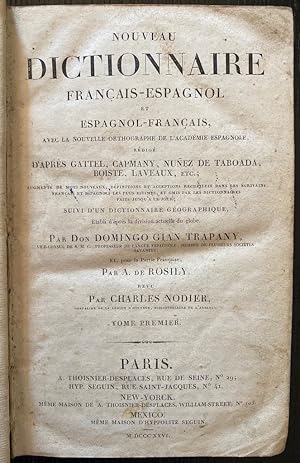
NOUVEAU DICTIONNAIRE FRANÇAIS-ESPAGNOL ET ESPAGNOL-FRANÇAIS, avec la nouvelle orthographie de l'académie espagnole. TOME PREMIER
Seller: Fábula Libros (Librería Jiménez-Bravo), MADRID, M, Spain
Association Member: LANCE LIBRIS
Seller rating 5 out of 5 stars

Paris, A. Thoisner-Desplaces, 1826, 21,5x14 cm, piel, VII+852 págs.
-
NOUVEAU DICTIONNAIRE FRANCAIS ESPAGNOL ET ESPAGNOL FRANCAIS. TOME I. FRANCAIS:ESPAGNOL.
Published by A. THOISNIER-DESPLACES, 1826
Couverture rigide. Condition: bon. R260117915: 1826. In-8. Relié plein cuir. Etat d'usage, Couv. défraîchie, Dos abîmé, Intérieur acceptable. 856 pages. Plein cuir marron, titres, tomaison et ornements dorés. Texte sur 2 colonnes. Premier plat détaché. Manque les coiffes. Epidermures. . . . Classification Dewey : 460-Langues espagnole et portugaise.
-

Nouveau Dictionnaire Francais - Espagnol et Espagno l- Francias.
Published by A. Thoisnier-Desplaces, Paris, 1826
Seller: Jeffrey H. Marks, Rare Books, ABAA, Rochester, NY, U.S.A.
Seller rating 5 out of 5 stars
2 vols. 8vo, old full sheep. 1828 ownership annotations in each volume; some scattered inoffensive foxing; bindings scuffed and worn at extremities but tight and sound.
-

Plan Hydrographique de la Baie de Cadiz levé en 1807, sous la direction de Vice-Admiral Rosily par le lieutenant de vaisseau A.M.A. Raoul, et l'élève hydrographe A.P. Givry. Publie par Ordre son Excellence Le Comte Decrees, Vice Admiral, Ministre de la Marine et des Colonies, Inspecteur general des Cotes de la Meidterranee etc.
Published by Depot General de la Marine,
Seller: Daniel Crouch Rare Books Ltd, London, United Kingdom
Association Member: ABA ILAB PBFA
Seller rating 4 out of 5 stars

Map
US$ 1,098.70
US$ 26.67 shipping
Ships from United Kingdom to U.S.A.Quantity: 1 available
Add to basketWhat price Cadiz? Revised. Double-page engraved chart. Separate issue, with "Prix Trois Francs" lower right. After Columbus's discovery of America in 1492, Cadiz soon became the home of the Spanish treasure fleet, and a target for foreign countries seeking to strike at the heart of the Spanish Empire. Sir Francis Drake famously destroyed much of the Spanish fleet there in 1587; it was blockaded by the British in 1797-1798, and bombarded by them in 1800. In 1808 "Cadiz assumed a pivotal role in the relationship with Spain's new allies. When Napoleon Bonaparte invaded the Iberian Peninsula, first to enforce the Continental System against Great Britain, and shortly afterwards, to put his own Brother on the Spanish Throne, he did not realize the difficulty of his task. Of all the other provinces and cities, only Cadiz remained free of French domination. It became the center of the new Revolutionary government and the focus for allied cooperation in Spain. Blessed with a good harbor and natural defensive barriers, Cadiz proved an ideal location for allied cooperation. It was besieged for thirty months, far longer than any other city would have to endure, and was never taken. Cadiz, along with Andalusia, served as a source of strategic consumption of -the French Army in the Peninsula, and contributed directly, to the loss of Spain for the French. The unsuccessful French siege of Cadiz is one of the most important military actions in the Peninsula. The successful allied defense of this key city made possible the survival of the revolutionary Spanish Government and facilitated the funneling of British arms, money, and soldiers into Spain for its fight against the French. Had Cadiz fallen, and with it the 1812 liberal constitution drafted by the Cortes, the latter history of Spain would have been far different. Had the French taken the last "free" city in Spain, the vicious guerrilla war against her troops may have lacked both reason and coordination in Andalusia. The British government would have had no cliental point of coordination or a secure base of operations. Cadiz served not only as the capital of the Spanish government, it also served as the focal point for Peninsular support operations for the British outside of Lisbon" (Herson)\ After a month of vacillating, at the beginning of June, 1808, the Spanish of Cadiz officially revolted, turning their canon on the French fleet, under the command of Rear Admiral Maurice Rosily, in their harbour. After about ten days the French had capitulated, and the first naval victory of the Spanish Revolution against the Bonaparte regime had been won. Britain was the ultimate victor of the Peninsular War in 1814, when Napoleon abdicated. However the effects of the battle were felt in Europe and America for many decades to come. Provenance 1. Inscribed on the verso: "Baie de Cadix - Ile d'[.]', and "Baie de Cadix", in different early hands; 2. Freycinet family archives Herson, 'For the Cause: Cadiz and the Peninsular War. Military and Siege Operations from 1808 to 1812', 1992.
-
Lithographie de 700x1023mm. Déposé par le Dépôt Général de la Marine pendant la guerre Péninsulaire. Avec une fiche indiquant Penin au Port-Neuf; N° 30 Bayonne Français Très bon état général. Bel intérieur, malgré quelques frottements naturels d'âge. Une réparation en scotch en arrière plan, au droit. Intéressante pièce historique; Cadiz n'a jamais été prise par l'armée napoléonienne, jusqu'à la fin des conflits en 1814. Envoi soigné, sous emballage solide.
-
Grosse d'une lettre autographe du vice-amiral Rosily au vice-amiral Laurent Truguet , Ministre de la Marine et des Colonies.
Seller: Antiquariaat Wim de Goeij, Kalmthout, ANTW, Belgium
Association Member: ILAB
Seller rating 5 out of 5 stars
10. Anvers ( Antwerpen ) , 13 Pluviose an 5 ( 1 Février 1797), lettre manuscrite de 4 pages in-folio (dont 3 écrites), sur papier bluâtre, belle écriture bien lisible ; une grosse vraisemblablement de la main de Rosily. Il informe le ministre sur les possibilités de la port d'Anvers en vu de recevoir des bateaux de ligne françaises. Il remarque que l'abbaye Saint-Michel vient sur le marché et que cette abbaye, située au bord de la fleuve, est singulièrement bien placée pour devenir un dépôt pour l'artillerie de guerre et de la marine.
-
Renseignements divers sur la ville d'Anvers. (Rapport manuscrit 20 Février 1797 signé par Rosily).
Seller: Antiquariaat Wim de Goeij, Kalmthout, ANTW, Belgium
Association Member: ILAB
Seller rating 5 out of 5 stars
Signed
13. Anvers ( Antwerpen ) , 2 Ventose An 5 ( 20 Février 1797 ), manuscrit sur papier, in-folio, 16 pp dont 12 écrites. Rapport sur l'état de la fleuve , ses rivages et ses bassins à Anvers, avec des informations assez détaillées sur l'architecture et les manières de construction à Anvers. Le but de ce rapport est sans doute d'informer sur les possibilités de transformer la ville en port important. L'auteur (signé Rosily , David en forfait) mentionne déjà à la première page Monsieur Blom, architecte de la ville à qui il doit des ''renseignements précieux''. Le rapport se termine avec quelques chiffres sur la marée à l'hauteur de la ville a différentes époques.


