Order Total (1 Item Items):
Shipping Destination:

Shockley Read (11 results)
Skip to main search results
Search filters
Product Type
- All Product Types
- Books (11)
- Magazines & Periodicals (No further results match this refinement)
- Comics (No further results match this refinement)
- Sheet Music (No further results match this refinement)
- Art, Prints & Posters (No further results match this refinement)
- Photographs (No further results match this refinement)
- Maps (No further results match this refinement)
- Manuscripts & Paper Collectibles (No further results match this refinement)
Condition Learn more
- New (No further results match this refinement)
- As New, Fine or Near Fine (1)
- Very Good or Good (6)
- Fair or Poor (No further results match this refinement)
- As Described (4)
Binding
Collectible Attributes
- First Edition (3)
- Signed (No further results match this refinement)
- Dust Jacket (No further results match this refinement)
- Seller-Supplied Images (6)
- Not Print on Demand (11)
Language (2)
Price
- Any Price
- Under US$ 25 (No further results match this refinement)
- US$ 25 to US$ 50
- Over US$ 50
Free Shipping
- Free Shipping to U.S.A. (No further results match this refinement)
Seller Location
Seller Rating
-

Hardcover. Condition: Very Good. The American Institute of Mining, 1954. Hard cover, first edition. Previous owner's name, otherwise VG condition with no dust jacket, as issued. A nice clean copy.
-

Dislocations in Metals
Published by The American Institute of Mining, 1954
Seller: Midtown Scholar Bookstore, Harrisburg, PA, U.S.A.
Seller rating 5 out of 5 stars

Hardcover. Condition: Good. some shelfwear/edgewear but still NICE! - may have remainder mark or previous owner's name Standard-sized.
-

Dislocations in Metals.
Published by The Institute of Metals Division / The American Institute of Mining and Metallurgical Engineers, Inc., New York, 1954
Seller: Emile Kerssemakers ILAB, Heerlen, Netherlands
Seller rating 5 out of 5 stars
Original cloth. x,200 pp.; ills.; 23.5x16 cm. Text in English. - (no dust-jacket, previous owner's stamp, some spots/ foxing mainly to edges) Although very good, see picture 620g.
-

Dislocations in Metals
Published by AMERICAN INSTITUTE OF MINING, NEW YORK, NY, 1954
Seller: Princeton Antiques Bookshop / Ruffolo Enterprises, Atlantic City, NJ, U.S.A.
Seller rating 5 out of 5 stars
HARD BACK BURGUNCY. Condition: GOOD. Boards: gilt title on; very light sun-fading on spine; light wear; front/back hinge cracks. Rubber stamp name/address from the previous owner on the front free end paper. Figures. DATE PUBLISHED: 1954 EDITION: 200.
-

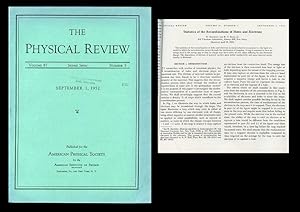
Statistics of the Recombinations of Holes and Electrons
Published by American Physical Society / American Institute of Physics / Physical Review, Lancaster, PA, 1952
Seller: Denominator Books, Washington, DC, U.S.A.
Association Member: IOBA
Seller rating 5 out of 5 stars
Softcover. Condition: Very Good. In The Physical Review, volume 87(5), September 1, 1952. This is pp. 835-842. Entire issue in blue paper wraps; very good with solid binding and slight wear to top of fore-edge and corners. This paper, which has been cited over 2500 times (Science Citation Index), was the first model of electron-hole recombination in a highly pure semiconductor, now known as Shockley-Read-Hall (SRH) recombination and of importance in semiconductors and solar technology. Issue also contains papers by Abraham Pais, Vera Kistiakowsky and others. * 003421.
-
"Statistics of the Recombinations of Holes and Electrons", in Physical Review
Published by American Physical Society, 1952
Seller: JF Ptak Science Books, Hendersonville, NC, U.S.A.
Seller rating 5 out of 5 stars
Soft cover. Condition: Very Good. ++Shockley-Read-Hall (SRH)++ SHOCKLEY, William and W.T. Read, Jr. "Statistics of the Recombinations of Holes and Electrons", in Physical Review, vol. 87, Issue 5, pp. 835-842, offered in the issue of pp 685-913. Original wrappers. Very good, solid copy, with the "AW" iin pen at upper right cover corner. Nice clean spine. An important paper cited 3000+times. "The statistics of the recombination of holes and electrons in semiconductors is analyzed on the basis of a model in which the recombination occurs through the mechanism of trapping. A trap is assumed to have an energy level in the energy gap so that its charge may have either of two values differing by one electronic charge. The dependence of lifetime of injected carriers upon initial conductivity and upon injected carrier density is discussed."--Smithsonian/NASA Astrophysics Data Center.
-
Dislocation Models of Crystal Grain Boundaries - [THE SHOCKLEY PARTIAL DISLOCATION]
Seller: Herman H. J. Lynge & Søn ILAB-ABF, Copenhagen, Denmark
Seller rating 4 out of 5 stars

First Edition
Lancaster, American Physical Society, 1950. Lex8vo. Entire volume offered in the original blue wrappers with previous owner s stamps. In "The Physical Review" Volume 78, May 1, No. 3, 1950 of , Second Series. A fine and clean copy. Pp. 275-290. [Entire volume: Pp. 189-357]. First printing of the classical paper in which the The Shockley Partial Dislocation was described for the first time.
-
Statistics of the Recombinations of Holes and Electrons in The Physical Review, Volume 87, 1952, pp. 835-843 WITH Some Effects of Ionizing Radiation on the Formation of Bubbles in Liquids in Physical Review 87, 1952, p. 665
Published by American Physical Society, Lancaster, 1952
First Edition
1st Edition. BOUND FULL VOLUME FIRST EDITION OF THE FIRST MODEL OF ELECTRON-HOLE RECOMBINATION IN A HIGHLY PURE SEMICONDUCTOR. Cited over 2500 since publication, this model is now known as the Shockley-Read-Hall (SRH) recombination and is of import to solar and semiconductor technology. "Any electron which exists in the conduction band is in a meta-stable state and will eventually stabilize to a lower energy position in the valence band. When this occurs, it must move into an empty valence band state. Therefore, when the electron stabilizes back down into the valence band, it also effectively removes a hole. This process is called recombination" (Honsberg & Bowden, Types of Recombination). The model Shockley and Read put forth in this paper is essentially recombination through defects; in other words, recombination does not happen in a pure material. The steps involved in SRH are two-fold: (1) "An electron (or hole) is trapped by an energy state in the forbidden region which is introduced through defects in the crystal lattice. These defects can either be unintentionally introduced or deliberately added to the material, for example in doping the material; and (2) If a hole (or an electron) moves up to the same energy state before the electron is thermally re-emitted into the conduction band, then it recombines. "The rate at which a carrier moves into the energy level in the forbidden gap depends on the distance of the introduced energy level from either of the band edges. Therefore, if an energy is introduced close to either band edge, recombination is less likely as the electron is likely to be re-emitted to the conduction band edge rather than recombine with a hole which moves into the same energy state from the valence band. For this reason, energy levels near mid-gap are very effective for recombination" (ibid). ALSO INCLUDED IN THIS ISSUE: PFIRST EDITION IN ORIGINAL WRAPS OF DONALD GLASER'S NOBEL PRIZE WINNING INVENTION OF THE BUBBLE CHAMBER USED IN SUB ATOMIC PARTICLE PHYSICS. Glaser was an American physicist and neurobiologist who, inspired by the bubbles in a glass of beer, invented a vessel that, when filled with a superheated transparent liquid like liquid hydrogen, is able to detect electrically charged particles moving through it. Glaser's bubble chamber made it possible for scientists "to observe the paths and lifetimes of particles" in sub atomic particle physics (Wikipedia). Bubble chambers are created by filling "a large cylinder with a liquid heated to just below its boiling point. As particles enter the chamber, a piston suddenly decreases its pressure, and the liquid enters into a superheated, metastable phase. Charged particles create an ionization track, around which the liquid vaporizes, forming microscopic bubbles. Bubble density around a track is proportional to a particle's energy loss. Bubbles grow in size as the chamber expands, until they are large enough to be seen or photographed" (Wikipedia). Glaser was awarded the Nobel Prize in 1960 for his invention. CONDITION & DETAILS: Lancaster: American Physical Society. Complete full volume. Ex-libris with no spine markings whatsoever. Pictorial bookplate of the Bridgeport Library on the front pastedown; stamp on title page and rear flyleaf. 4to (10.5 x 8 inches; 263 x 200mm). Tightly and solidly bound in brown buckram, gilt-lettered at the spine. Very slight wear.
-
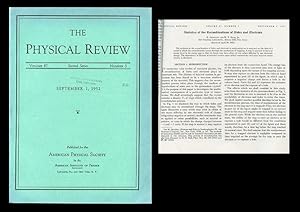
Statistics of the Recombinations of Holes and Electrons in The Physical Review, Volume 87, Issue 5, 1 September 1952, pp. 835-843
Published by American Physical Society, Lancaster, 1952
First Edition
1st Edition. FIRST EDITION IN ORIGINAL WRAPS OF THE FIRST MODEL OF ELECTRON-HOLE RECOMBINATION IN A HIGHLY PURE SEMICONDUCTOR. Cited over 2500 since publication, this model is now known as the Shockley-Read-Hall (SRH) recombination and is of import to solar and semiconductor technology. "Any electron which exists in the conduction band is in a meta-stable state and will eventually stabilize to a lower energy position in the valence band. When this occurs, it must move into an empty valence band state. Therefore, when the electron stabilizes back down into the valence band, it also effectively removes a hole. This process is called recombination" (Honsberg & Bowden, Types of Recombination). The model Shockley and Read put forth in this paper is essentially recombination through defects; in other words, recombination does not happen in a pure material. The steps involved in SRH are two-fold: (1) "An electron (or hole) is trapped by an energy state in the forbidden region which is introduced through defects in the crystal lattice. These defects can either be unintentionally introduced or deliberately added to the material, for example in doping the material; and (2) If a hole (or an electron) moves up to the same energy state before the electron is thermally re-emitted into the conduction band, then it recombines. "The rate at which a carrier moves into the energy level in the forbidden gap depends on the distance of the introduced energy level from either of the band edges. Therefore, if an energy is introduced close to either band edge, recombination is less likely as the electron is likely to be re-emitted to the conduction band edge rather than recombine with a hole which moves into the same energy state from the valence band. For this reason, energy levels near mid-gap are very effective for recombination" (ibid). ALSO INCLUDED IN THIS ISSUE: Papers of significance by Abraham Pais, Vera Kistiakowsky, Robert Karplus, and Abraham Klein. CONDITION & DETAILS: Lancaster: American Physical Society. Original Wraps. Complete. Professionally rebacked at the spine, very light library stamp on front and rear wrap. 4to (10.5 x 8 inches; 263 x 200mm). Original paper wraps - tight and solid -- in very good condition in every way.
-
DISLOCATION MODELS OF CRYSTAL GRAIN BOUNDARIES - article in one complete hardbound copy of PHYSICAL REVIEW, VOL 78, APRIL - JUNE 1950
Publication Date: 1950
Seller: Xerxes Fine and Rare Books and Documents, Glen Head, NY, U.S.A.
Seller rating 5 out of 5 stars
Condition: VG. Lancaster, PA 1950 first edition. American Institute of Physics. Hardcover very thick 4to. Red buckram. 856p. in entire volume. Shockley paper on p. 275-290. VG Plus, text Fine , slight bit of residue where pocket removed from rear end paper. Small research library stamp on end paper and titlepage. no spine numbers. Important papers by Marcia Goeppert Mayer, Hans Bethe, J S Levinger, J A Van Allen, A V Gangnes, Arthur Snell, Frances Pleasonton, R V McCord and John Robson in this volume as well. Pictures available.
-
STATISTICS OF THE RECOMBINATIONS OF HOLES AND ELECTRONS
Publication Date: 1952
Seller: Xerxes Fine and Rare Books and Documents, Glen Head, NY, U.S.A.
Seller rating 5 out of 5 stars
Condition: Near Fine. in one complete issue of Physical Review, in original printed green wraps, 4to. volume 87 second series, number 5. September 1, 1952. First edition. Lancaster, PA. American Physical Society. Article on p. 835-843. Other articles by different scientists in issue as well. Near Fine, no faults, no ownership marks at all, backstrip a bit faded o/w clean and bright. Pictures available on request.