

Order Total (1 Item Items):
Shipping Destination:

Slipsong (3 results)
Author:
slipsong
Refine with Advanced Search
Skip to main search results
Search filters
Product Type
- All Product Types
- Books (3)
- Magazines & Periodicals (No further results match this refinement)
- Comics (No further results match this refinement)
- Sheet Music (No further results match this refinement)
- Art, Prints & Posters (No further results match this refinement)
- Photographs (No further results match this refinement)
- Maps (No further results match this refinement)
- Manuscripts & Paper Collectibles (No further results match this refinement)
Condition Learn more
- New (No further results match this refinement)
- As New, Fine or Near Fine (No further results match this refinement)
- Very Good or Good (No further results match this refinement)
- Fair or Poor (No further results match this refinement)
- As Described (3)
Binding
- All Bindings
- Hardcover (No further results match this refinement)
- Softcover (No further results match this refinement)
Collectible Attributes
- First Edition (No further results match this refinement)
- Signed (No further results match this refinement)
- Dust Jacket (No further results match this refinement)
- Seller-Supplied Images (3)
- Not Print on Demand (3)
Language (1)
Price
- Any Price
- Under US$ 25 (No further results match this refinement)
- US$ 25 to US$ 50 (No further results match this refinement)
- Over US$ 50
Free Shipping
- Free Shipping to U.S.A. (No further results match this refinement)
Seller Location
Seller Rating
-
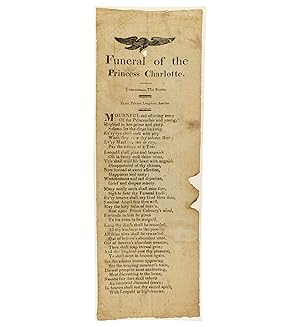
Funeral of the Princess Charlotte.
Published by Evans, printer. [1817], 1817
Seller: Jarndyce, The 19th Century Booksellers, London, United Kingdom
Association Member: ABA ILAB PBFA
Seller rating 4 out of 5 stars

US$ 69.08
US$ 46.95 shipping
Ships from United Kingdom to U.S.A.Quantity: 1 available
Add to basketSingle sheet slipsong; a few tears without loss to text, laid on to recent cream card. 25 x 8cm. Not in Bodleian Ballads Online; not recorded on Copac or OCLC. 'Mournful sad affecting story / Of the princess fair and young, / Blighted in her prime and glory, / Solemn let the dirge be rung.' PLEASE NOTE: For customers within the UK this item is subject to VAT at 20%.
-
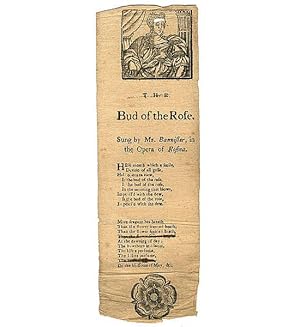
The Bud of the Rose. Sung by Mr. Bannister, in the Opera of Rosina.
Published by (Evans, Long Lane.) [c.1783], 1783
Seller: Jarndyce, The 19th Century Booksellers, London, United Kingdom
Association Member: ABA ILAB PBFA
Seller rating 4 out of 5 stars
US$ 425.55
US$ 46.95 shipping
Ships from United Kingdom to U.S.A.Quantity: 1 available
Add to basketSingle sheet slipsong with illus. at top & bottom, two lines crossed through in contemp. ink; sl. creased with a few pin holes, one sl. larger, within upper illus. Bodleian Ballads Online 17452, printed from the same type but with different illustration; ESTC T197598 records the Bodleian copy and another at NLS only; a variant, with a misprint in the title (a repetition of the word 'in') is recorded in a single copy only at Cambridge. Originally printed as a 4to song sheet with two slipsongs, the other being 'The Buffalo' with the imprint Evans, Long Lane, London. Rosina was a comic adaptation by William Shield of Frances Brooke's libretto. Written in 1771-72, it was not performed until 1782 when it was staged at the Theatre Royal, Covent Garden, on December 31st. This song was sung by the actor, comedian and singer Charles Bannister, 1738-1804, in his role as Mr Belville. Bannister, together with his wife, appeared in many of Shields' operas including The Flitch of Bacon, 1778, The Poor Soldier, 1783, Robin Hood, 1784, and The Crusade of the Csar, 1790.
-

The Wild and Wicked Youth.
Published by Birmingham: Watts, 14 Snow Hill. [c.1840], 1840
Seller: Jarndyce, The 19th Century Booksellers, London, United Kingdom
Association Member: ABA ILAB PBFA
Seller rating 4 out of 5 stars
US$ 577.54
US$ 46.95 shipping
Ships from United Kingdom to U.S.A.Quantity: 1 available
Add to basketSingle sheet slipsong, illus. v.g. 24.5 x 9.5cm. This printing by Watts is not recorded on Bodleian Ballads online. The BBTI records Watts as being at this Snow Hill address between 1838-49. 'In Newery town I was bred and born, At seventeen I took a wife, I loved her dear as I loved my life And to maintain her fine and gay A robbing went on the highway. I robbed Lord Goldin I do Declare Lady Mansfield in Grosvenor Square, Shut the shutters bid e'em good night, And went away to my heart's delight. Till Fielding's gang did me pursue, Taken I was by the cursed crew.' Lord Mansfield is thought to be William Murray, first Earl of Mansfield, 1706-1793, who was Lord Chief Justice of the King's Bench from 1756. Fielding is either the Author Henry Fielding or his brother John, the 'gang' presumably being the Bow Street Runners, founded by Henry Fielding as the first police force in England and refined by his brother John after Henry's death in 1754.
