

Order Total (1 Item Items):
Shipping Destination:

Speroni Speron (3 results)
Skip to main search results
Search filters
Product Type
- All Product Types
- Books (3)
- Magazines & Periodicals (No further results match this refinement)
- Comics (No further results match this refinement)
- Sheet Music (No further results match this refinement)
- Art, Prints & Posters (No further results match this refinement)
- Photographs (No further results match this refinement)
- Maps (No further results match this refinement)
- Manuscripts & Paper Collectibles (No further results match this refinement)
Condition Learn more
- New (No further results match this refinement)
- As New, Fine or Near Fine (1)
- Very Good or Good (No further results match this refinement)
- Fair or Poor (No further results match this refinement)
- As Described (2)
Binding
- All Bindings
- Hardcover (No further results match this refinement)
- Softcover (No further results match this refinement)
Collectible Attributes
- First Edition (1)
- Signed (No further results match this refinement)
- Dust Jacket (No further results match this refinement)
- Seller-Supplied Images (3)
- Not Print on Demand (3)
Language (1)
Price
- Any Price
- Under US$ 25 (No further results match this refinement)
- US$ 25 to US$ 50 (No further results match this refinement)
- Over US$ 50
Free Shipping
Seller Location
Seller Rating
-
Dialoghi di M. Speron Speroni, Nuovamente ristampati, & con molta diligenza riveduti, & corretti.
Published by Per Cpmin da Trino di Monferrato,, In Venezia,, 1564
Seller: Studio Bibliografico Antonio Zanfrognini, Modena, Italy
Seller rating 5 out of 5 stars

In 8° (15×10 cm); 151, (1 b.) pp. Completo. Opera in buone-ottime condizioni di conservazione. Legatura in mezza pelle realizzata fra la fine del settecento ed i primi anni dell'ottocento, con piatti marmorizzati, titolo e fregi in oro al dorso. Un leggero alone al margine basso di una ventina di carte, leggerissimo ed assolutamente ininfluente. Dedicatoria di Daniel Barbato a Ferdinando San Severino principe di Salerno famoso scrittore e filosofo padovano, Sperone Speroni (Padova, 12 aprile 1500 Padova, 2 giugno 1588). Edizione fra le più rare, dei celebri "Dialoghi" dello Speroni che furono proibiti dall'Inquisizione per una denuncia anonima di villipendio della morale. L'opera contiene 10 dialoghi: Dialogo d'amore; Della dignità delle donne; Del tempo di partorire delle donne; Della cura famigliare; Della usura; Della discordia; Delle lingue; Della rhetorica; Delle laudi del Catajo, villa della S. Beatrice Pia degli Obici; Panico e Bichi. Nato in una celebre famiglia nobile podovana, Speroni degli Alvarotti, il padre Bernardino era archiatra di Papa Leone X, mentre la madre apparteneva alla famiglia Contarini. Considerato un bambino prodigio per le sue capacità d'apprendimento, divenne giovanissimo, a 18 anni, professore di Logica all'Università di Padova. Allievo di Pomponazzi a Bologna, ritornò a Padova dopo la morte di questi, prima per insegnare e poi, per necessità, per seguire gli affari di famiglia. Membro dell'Accademia degli Infiammati, fu l'ultimo dei "Principi" del quali ci rimane testimonianza scritta, succedendo alla carica ad Allessandro Piccolomini. Fu grande amico di Torquato Tasso del quale revisionò, anche, la Gerusalemme Liberata. Come scrisse Luca Piantoni (Dizionario Biografico degli Italiani, Treccani, Volume 93, voce dedicata a Sperone Speroni) i Dialoghi "(uscirono a Venezia nel 1542, contro la sua volontà e per le cure di Daniele Barbaro), caratterizzati da una struttura dialetticamente policentrica e da non prevedibili movimenti nei contrasti tra le posizioni evocate. [] Nell'ottobre del 1574 gli giunse la notizia della morte di Guidubaldo, che lo aveva incaricato di comporre un'orazione in difesa del padre, Francesco Maria I, contro le accuse di tradimento che Francesco Guicciardini gli aveva mosse per non aver difeso Clemente VII dalle truppe imperiali nella primavera del 1527. Nel medesimo tempo subì le censure dell'Inquisizione per i suoi Dialoghi a causa di un'ignota denuncia per vilipendio della morale. Proibita la vendita del volume ai librai di Roma, l'autore difese i punti controversi dapprima a voce, e con esiti decisamente favorevoli, poi con un'Apologia che inviò agli amici Antonio Riccoboni di Padova e Alvise Mocenigo di Venezia affinché ne facessero circolare le copie («Io mi difesi in voce e li accusatori s'indolcirono assai, ma nella congregazione ogni cosa divenne zucchero e mele. Faccio la Apologia, e la vederete», Opere, cit., p. 210).". Celeberrimo il Dialogo dedicato al famosissimo Castello del Catajo a Battaglia Terme sui Colli Euganei. Edizione rara ed in buone-ottime condizioni di conservazione. Rif. Bibl.: Graesse vol. VI p. 466; Adams cita altre ediz.
-
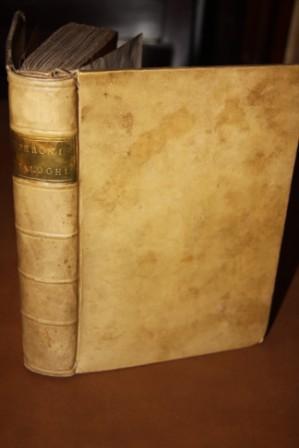
Dialoghi Del Sig. Speron Speroni, Nobile Padovano Di Nuovo Ricorretti; A' Quali Sono Aggiunti Molti Altri Non Piu Stampati e Di Piu L'Apologia Dei Primi. Con Licentia de' Superiori & Privilegi
Published by Appresso Roberto Meietti, Venezia (Venice), 1596
Seller: White Fox Rare Books and Antiques, ABAA/ILAB, New York, NY, U.S.A.
Association Member: ABAA ESA ILAB PBFA
Seller rating 4 out of 5 stars

Vellum. Condition: Fine. [7] + 598 pp., with several errors in pagination (including 433-454 omitted, and 563-592 repeated, in numbering). This is the work of well-known Padovan Humanist from the Renaissance. He reflects on love, women, pregnancy, family care, discord, language, rhetoric, history, fortune, Virgil, etc. Perhaps Speroni is remembered most for his championing the use of vernacular language in scholarship, and thus this important work and edition is rendered in Italian. Interior has some occasional soilage, but remarkably clean nonetheless, and binding is tight. last dedication page has small tear cutout in lower corner, not coming close to affecting text. Vellum is probably eighteenth century. It has soilage but remains quite healthy and attractive nonetheless. Spine has seven raised bands and green black label in one panel with "Speroni Dialoghi" still bright. Shelfwear is relatively light for vintage of binding. One two inch long by 1/2 inch at most area where vellum rubbed raw on back board. Was in collection of Harvard College Library. Only evidence of ex-lib is neat Harvard bookplate, two small/discreet stamps on blank back of title page (one showing 1921 date, other of deaccession, both stamps 1 inch or less in widest span) and a tiny imprint on first dedication page.
-
Orationi. Novamente Poste in Luce. - [ESTABLISHING THE GENRE OF MORAL ORATIONS]
Seller: Herman H. J. Lynge & Søn ILAB-ABF, Copenhagen, Denmark
Seller rating 4 out of 5 stars
First Edition
Venetia, Ruberto Meietti, 1596. (Colophon: In Venetia, 1596, Per Giovani Alberti). 4to. 18th century marbled blue paper binding with traces of wear, especially to spine and extremities. Handwritten paper title-label to spine. A few leaves evenly browned , and some leaves with a damp stain to upper margin, mostly faint. a bit of light brownspotting, but overall a nice and clean copy. Very discreet "stamp" to title-page ("tarquin") and a handwritten symbol with initials (a cross with A. L. M. F. at the ends) to verso of title-page. Woodcut allegorical title-vignette, woodcut printer's device to colophon, and large woodcut initial at beginning. A lovely printing. (8), 215, (1). With a preface, in which Speroni's friend Ingolfo Conte de Conti dedicates the work to the Duke of Urbino. ("Di Padoua di 16. Decembre, 1596"). The scarce first edition of Speroni's highly important work of orations, which is responsible for establishing the entire genre of moral orations and for Speroni's reputation as the first Italian orator. Sperone Speroni, one of the important cultural figures of the time, known from Torquato Tasso, his pupil, as "Sperone, who possesses fully all the arts and sciences", counts as the dominant literary figure on the "terraferma" in the generation following Bembo. During the early 1520s Speroni studied with the greatest of the Renaissance philosophers, Pietro Pomponazzi, and by the 1530s had become a major light at Padua, where he became professor of logic and general philosophy. Due to his eminent oration skills and his widely acknowledged and remembered speeches, he became known as the first Italian orator, and as the first modern thinker to incorporate moral themes into his speeches"Il passait pour le premier orateur de l'Italie. il a réussi dans ses poésies par la grâce et la vivacité, enfin, selon Ginguené, "son style en prose est un des meilleurs de cd siècle". il est le premier Italien qui ait traité dans ce genre des questions de morale." (N.B.G.)He is widely famed for having helped found and shape the Paduan Accademia degli Infiammati (1540).The present work contains his 9 famous orations that each in their way came to influence the development of rhetoric, morals and politics of the Renaissance. In his "In morte del Cardinal Pietro Bembo", he showed that a great literature might be produced if Petrarch were studied and imitated in Italian just as the classics were in Latin, directly influencing the emergence of Petrarch-scholarship.But the most famous of the orations is probably the controversial "Contra le Cortigiane" ["oratin against the Courtesans"], in which he accuses the courtesan of being a glutton and vain, and taking advantage of the name "corte" (court), which associates her erroneously with the noble and honourable environment of the court. "Oh, diabolic pride! Base prostitute, of which state, and of which subjects are you a mistress?". His words finally metamorphose her from woman to serpent or half beast and half devil. (See: Paola Malpezzi Price, "Moderata Fonte: Women and Life in Sixteenth Century Venice", p. 74). The collection of his orations in the first printing became highly influential in the late Renaissance and came to determine the development of the art of writing speeches as well as a certain way of presenting philosophy and moral thought to the people.


![Seller image for Orationi. Novamente Poste in Luce. - [ESTABLISHING THE GENRE OF MORAL ORATIONS] for sale by Herman H. J. Lynge & Søn ILAB-ABF](https://pictures.abebooks.com/inventory/md/md8631753079.jpg)