
Tangiers (3 results)
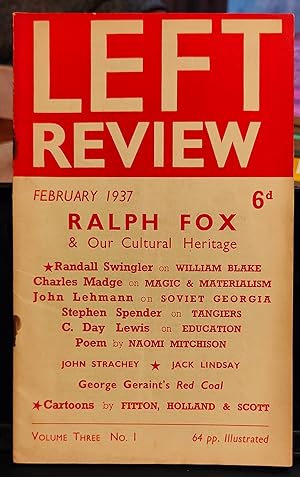
Left Review February 1937 Vol.3 No 1 / Ralph Fox: A Tribute / Dona Torr "Ralph Fox & Our Cultural Heritage" / John Lehmann "Letter from Tiflis" / C Day Lewis "An Expensive Education" / Stephen Spencer "Tangier's & Gibraltar NOW" / Randall Swingler "William Blake - The Imputation of Madness" / Maurice Carpenter"We ask for LIFE" (poem) / "Charles Madge "Magic & Materialism" / George Geraint "Red Coal" / Herbert Read & Hugh Sykes Davies "Surrealism - reply to A.L.Lloyd"
Edgell Rickword (Editor) / Ralph Fox: A Tribute / Dona Torr "Ralph Fox & Our Cultural Heritage" / John Lehmann "Letter from Tiflis" / C Day Lewis "An Expensive Education" / Stephen Spencer "Tangier's & Gibraltar NOW" / Randall Swingler "William Blake - The Imputation of Madness" / Maurice Carpenter"We ask for LIFE" (poem) / "Charles Madge "Magic & Materialism" / George Geraint "Red Coal" / Herbert Read & Hugh Sykes Davies "Surrealism - reply to A.L.Lloyd"
Published by Left Review 1937
- Softcover
- Periodical
Seller: Shore Books, London, United KingdomShore Books
Contact seller5-star sellerCondition: Used - Very good
US$ 54.38
US$ 14.52 shippingShips from United Kingdom to U.S.A.Quantity: 1 available
Soft cover. Condition: Very Good. 68 pages. Illustrated. Ralph Fox: A Tribute / Dona Torr "Ralph Fox & Our Cultural Heritage" / John Lehmann "Letter from Tiflis" / C Day Lewis "An Expensive Education" / Stephen Spencer "Tangier's & Gibraltar NOW" / Randall Swingler "William Blake - The Imputation of Madness" / Maurice Carpenter"…We ask for LIFE" (poem) / "Charles Madge "Magic & Materialism" / George Geraint "Red Coal" / Herbert Read & Hugh Sykes Davies "Surrealism - reply to A.L.Lloyd" (SL#84).

Published by Tangiers: Late 19th-early 20th Century
- Art Print
Seller: Wittenborn Art Books, San Francisco, CA, U.S.A.Wittenborn Art Books
Contact seller5-star sellerCondition: Used - Good
US$ 150.00
US$ 10.00 shippingShips within U.S.A.Quantity: 1 available
Condition: Good. Original platinum print. 16 x 21.5cm. Provenance: A 19th Century guest at John Ansaldo's Continental Hotel, Tangier. Manuscript description of the photograph on hotel stationery.
 More images
Published by London: In the Savoy, printed by Thomas Newcombe, 1680 1680
- First Edition
Seller: Peter Harrington. ABA/ ILAB., London, United KingdomPeter Harrington. ABA/ ILAB.
Contact seller5-star sellerCondition: Used
US$ 1,699.50
US$ 29.04 shippingShips from United Kingdom to U.S.A.Quantity: 1 available
First edition, conspicuously uncommon, ESTC citing just 14 locations worldwide (six in the UK, the remainder in the US), with only one copy appearing on auction records and that dating to 1937. Superb first-hand account that sheds light on a conflict in a contested area of North Africa where Britain had established a defensive a…nd commercial foothold in 1661, in what was referred to as West Barbary, nomenclature used by the chaplain to the garrison at Tangier, and later dean of Lichfield, Lancelot Addison, in his book West Barbary, or, A Short Narrative of the Revolutions of the Kingdoms of Fez and Morocco (London, 1671). "However, the Tangier episode provided the opportunity for close and sustained contact with the local population both in times of peace and war" (Karim Bejjit (ed.), English Colonial Texts on Tangier, 1661-1684: Imperialism and the Politics of Resistance, 2016, p. xi). The distinguished historian Linda Colley goes on to say that "In the official mind, Tangier was projected as a substantial colony of settlement with an agenda from the start of expansion, commerce and anglicisation. The English had always recognized of course that occupying Tangier would bring them into direct contact with Muslim societies, but they had been divided as to the likely consequences of this. Moreover, it was thought that if the Royal Navy could only succeed in establishing itself at Tangier, then the danger that North African corsairs presented to English ships and sea-goers would be much reduced" (Captives: Britain, Empire and the World, 1600-1850, 2003). This is a key primary source for the important action at Tangiers on 24 October 1680. The engagement began when the English governor of Tangier, Sir Palmes Fairborne, "received a mortal shot which emboldened the forces of Q 'id Omar bin Hadd to attack the English fortifications. The Spanish cavalry unit, which had freshly joined the garrison, struggled to repulse them, but given the increasing pressure on the garrison, Colonel Edward Sackville called for a council of war to consult over the best strategy to confront the assailants. The resolution to launch a full-scale attack was carried out at dawn on 27 October. It led to what the account describes as a signal victory over the Moroccan troops, who tried to stand their ground and fight back, but were driven away from their trenches and forced to flee after they had sustained heavy losses. The entrenched ground previously in the possession of the Moroccan forces was recaptured and levelled. The casualties suffered by the enemy were estimated at 500 dead. Those of the garrison are listed [in the account] in detail. They numbered nearly 500 between dead and wounded" (Bejjit, p. 187). In his history of the Horse Guards, Barney White-Spunner notes that Fairborne's offensive was "particularly well planned, with Mackenzie leading the Tangier Horse in a diversionary attack and sailors from the fleet used as auxiliaries, mounted on draft horses. it was a complete victory" (Horse Guards, 2006, p. 79). This is a detailed and gripping account that gives a real flavour of the action: "The Attack proved a hot and very bloody piece of service, by reason of the Enemies having a greater Guard there than ordinary; the two Captains that commanded were immediately carried off dangerously wounded, as were most of the other Officers, among them was Lieutenant Robinson, and had not the Reserve come timely to their relief, that Party had run great hazard of being cut off. By this time the whole Body was engaged, the Enemy very stubbornly disputing every Line and Trench wherein we attacked them, coming to Push of Pike, and handy-blows in several places; The particularities of every action is hard to set down". The account concludes with a list of those killed and wounded, mainly from the regiments of the earls of Dumbarton and Inchiquin; Dumbarton's became the Royal Scots (Tangier being their earliest battle honour), Inchiquin was Captain General of the forces at Tangier and his regiment, the 2nd Tangier, would become the King's Own Royal Regiment (Lancaster). Sir Palmes Fairborne was memorialized by John Dryden, responsible for the epitaph on his tomb in Westminster Abbey, which includes the lines: "More bravely British Generall never fell: / Nor Generall's death was e're reveng'd so well". Wing P593. Folio, 8 pages. Unbound and unstitched as issued. Damp-stained throughout and with some crumpling and splitting at the edges (no loss of text), old rust mark from a staple on first and last pages, but sound and remains very good.


