

Order Total (1 Item Items):
Shipping Destination:

Toth Chalupetzky (19 results)
Skip to main search results
Search filters
Product Type
- All Product Types
- Books (19)
- Magazines & Periodicals (No further results match this refinement)
- Comics (No further results match this refinement)
- Sheet Music (No further results match this refinement)
- Art, Prints & Posters (No further results match this refinement)
- Photographs (No further results match this refinement)
- Maps (No further results match this refinement)
- Manuscripts & Paper Collectibles (No further results match this refinement)
Condition Learn more
- New (No further results match this refinement)
- As New, Fine or Near Fine (No further results match this refinement)
- Very Good or Good (14)
- Fair or Poor (No further results match this refinement)
- As Described (5)
Binding
Collectible Attributes
- First Edition (8)
- Signed (No further results match this refinement)
- Dust Jacket (No further results match this refinement)
- Seller-Supplied Images (13)
- Not Print on Demand (19)
Language (4)
Free Shipping
- Free Shipping to U.S.A. (No further results match this refinement)
Seller Location
Seller Rating
-

Chess: Songs without Words 1941 Volume V / Lieder ohne Worte (in German)
Language: German
Published by Magyar Sakkvilag, Kecskemet
Soft cover. Condition: Good. Games from 1941. No notes. Ex-lib Mechanics Institute. 64 pp.
-
Chess: Songs without Words 1940 Volume IV / Lieder ohne Worte (in German)
Language: German
Published by Magyar Sakkvilag, Kecskemet
Soft cover. Condition: Good. Best games from 1940. No notes. Ex-lib Mechanics Institute. 56 pp.
-
Die Schacholympiade von Hamburg. Erinnerungen an die Länderkämpfe der F. I. D. E. 1930 mit 150 ausgewählten Partien.
Published by British Chess Magazine, 1973
Seller: Kulturgutrecycling Christian Bernhardt, Immenhausen, Germany
Seller rating 2 out of 5 stars

kartoniert. Exempl. in einem guten Gesamtzust., geringe Mängel und Gebrauchsspuren möglich. Deutsch 200g.
-
Capablanca Losses / Capablanca Veszit (in Hungarian)
Language: Hungarian
Published by Magyar Sakkvilag
Soft cover. Condition: Very Good. 32 games lost by Capablance. 59 pp.
-
Die Schacholympiade Von Hamburg Erinnergungen an Die Landerkampfe Der F.I.D.E. 1930 (Chess Olympiad Hamburg 1930 - BCM Classic Reprint No. 14)
Language: German
Published by BCM, St Leonards on Sea, 1973
US$ 11.04
US$ 21.43 shipping
Ships from United Kingdom to U.S.A.Quantity: 1 available
Add to basketSoft cover. Condition: Good. In German. Pb, 156pp. Good, light cover wear, clean contents. Reprint of the 1931 edition. Includes background and commentary on the tournament, round by round results for teams, individual results, and 150 games, most with brief notes. Poland (with Rubinstein and Tartakower) were the winners, ahead of Hungary and Germany. Rubinstein won the individual gold medal.
-

3 x B.C.M. (British Chess Magazine Ltd.) CLASSICS REPRINTS SERIES (10 // 17 // 14): 1) DER VIERZEHNTE KONGRESS DES DEUTSCHEN SCHABUNDES, E.V. COBURG 1904 // 2) DAS CHAMPION-TURNIER ZU OSTENDE IM JAHRE 1907, Sammlung sämtlicher Partien mit ausführlichen Anmerkungen. // 3) DIE SCHACHOLYMPIADE VON HAMBURG 1930, mit 150 ausgewählten Partien.
Language: English
Published by London, B.C.M., British Chess Magazine, 1972 // 1975 // 1973., 1972
ISBN 10: 0900846127 ISBN 13: 9780900846120
Seller: Antiquariat am Ungererbad-Wilfrid Robin, München, Germany
Seller rating 5 out of 5 stars

Condition: Gut. Bll. + VIII + 144 S. // 136 S. // 156 S. jew. mit Namen, Text u. Figures. Sprache: Englisch Gewicht in Gramm: 615 8° small, OIll.-Softcover/Paperback (TB). Minimal vergilbt. Gute Exemplare. Erstauflagen der Reprints / First edition.
-
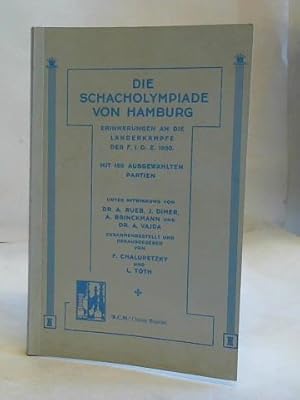
Die Schacholympiade von Hamburg. Erinnerungen an die Länderkämpfe der F. I. D. E. 1930 mit 150 ausgewählten Partien
Seller: Celler Versandantiquariat, Eicklingen, Germany
Association Member: GIAQ
Seller rating 5 out of 5 stars
British Chess Magazin, Sussex, 1973. 155 S. mit einigen Diagrammen, kartoniert---- B. M. C. Classic Reprint/ Reprint der Ausgabe von 1931 (veröffentlicht von L. Tóth) - 206 Gramm.
-
Capablanca Sakkozoi Palyafutasa es Jatszmai 1888-1942 ( Capablanca's Chess Career and Games 1888-1942)
Language: Hungarian
Published by Magyar Sakkvilag, Kecskemet, Hungary, 1943
US$ 52.42
US$ 21.43 shipping
Ships from United Kingdom to U.S.A.Quantity: 1 available
Add to basketHardcover. Condition: Good. In Hungarian. Hb, re-bound in modern brown boards, 308pp, rough-cut pages. Good, a few pages have chipped edges, title page has a cellotaped tear, pages tanned at edges but clean. Includes close to 320 of Capablanca's games, most with notes, plus career and tributes by other players.
-
Lieder Ohne Worte - Sammlung erstklassiger Schachpartien aus dem 1937 Jahre, I. Folge
Published by Magyar Sakkvilág. [Hungarian Chess World.], Kecskemét, 1937
Seller: Abauj Antique Bookshop, Kistokaj, H, Hungary
Seller rating 5 out of 5 stars
First Edition
Soft cover. Condition: Good. 1st Edition. F(erenc) Chalupetzky - L(ászló) Tóth: Lieder Ohne Worte - Sammlung erstklassiger Schachpartien aus dem 1937 Jahre, I. Folge Kecskemét, 1937. Magyar Sakkvilág. [Hungarian Chess World.] 73 [3] p. with chess diagrams. First edition. Publisher's paper wrappers. On the title page is the signature stamp of Dr. Artúr Schwarz-Eggenhofer (1890 -1969). He was a Hungarian Catholic priest and theologian who served as the apostolic administrator of the Archdiocese of Esztergom between 1959 and 1969. He practically led the Hungarian Catholic Church during the difficult period when Cardinal József Mindszenty was living in asylum at the American Embassy. Even as a young priest, he was a passionate chess player. So much so that in the 1920s, he ran the chess column of the famous Catholic youth magazine, Zászlónk, for years. He built a substantial and prestigious private library of chess books, which he marked with this elegant ex libris name stamp that mimics handwriting. "Lieder ohne Worte" (Songs Without Words) is originally the title of Felix Mendelssohn's famous series of piano compositions. In chess literature, this expression refers to a very specific format: the selected master games in the book are published without lengthy textual explanations and analyses. Only the moves and conventional evaluation symbols (e.g., !, ?, +=) are included, allowing the brilliant sequences of moves to speak for themselves. Although the book was printed and published in Kecskemét, Hungary, the language of the cover and the volume is German. The reason for this is that during this era, German was the undisputed "lingua franca" of the chess world. With this volume, László Tóth and his colleagues targeted the international market, and publishing games without textual analysis made the book's global distribution and comprehension even easier. The booklet gathers the international chess games deemed the most beautiful and of the highest quality from the year 1937, functioning as a sort of "yearbook." ( O,O ) /)__) , ,
-
Lieder ohne worte - Sammlung erstklassiger schachpartien aus dem 1941 jahre. V. Folge.
Published by Magyar Sakkvilág. [Hungarian Chess World.], Kecskemét, 1941
Seller: Abauj Antique Bookshop, Kistokaj, H, Hungary
Seller rating 5 out of 5 stars
First Edition
Soft cover. Condition: Good. 1st Edition. F(erenc) Chalupetzky - L(ászló) Tóth: Lieder ohne worte - Sammlung erstklassiger schachpartien aus dem 1941 jahre. V. Folge. Zusammengestellt v. F. Chalupetcky u. L. Tóth. Kecskemét, 1941. Magyar Sakkvilág. [Hungarian Chess World.] 63 p. with chess diagrams. First edition. Publisher's paper wrappers, small stain on cover. "Lieder ohne Worte" (Songs Without Words) is originally the title of Felix Mendelssohn's famous series of piano compositions. In chess literature, this expression refers to a very specific format: the selected master games in the book are published without lengthy textual explanations and analyses. Only the moves and conventional evaluation symbols (e.g., !, ?, +=) are included, allowing the brilliant sequences of moves to speak for themselves. Although the book was printed and published in Kecskemét, Hungary, the language of the cover and the volume is German. The reason for this is that during this era, German was the undisputed "lingua franca" of the chess world. With this volume, László Tóth and his colleagues targeted the international market, and publishing games without textual analysis made the book's global distribution and comprehension even easier. The booklet gathers the international chess games deemed the most beautiful and of the highest quality from the year 1941, functioning as a sort of "yearbook." ( O,O ) /)__) , ,
-

Lieder ohne Worte. Sammlung erstklassiger Schachpartien aus dem Jahre 1938, I. Folge
Seller: Celler Versandantiquariat, Eicklingen, Germany
Association Member: GIAQ
Seller rating 5 out of 5 stars
Magyar Sakkvilag, Kecskemet, 1938. 73 S., kartoniert (starke Gebrauchsspuren/einige Seiten eingerissen)--- 96 Gramm.
-
Die Schacholympiade von Hamburg
Published by Magyar Sakkvilág, Kecskemét, 1930
Seller: Abauj Antique Bookshop, Kistokaj, H, Hungary
Seller rating 5 out of 5 stars
First Edition
Soft cover. Condition: Very Good. 1st Edition. Chalupetzky, Ferenc - Tóth, László: Die Schacholympiade von Hamburg Erinnerungen an die Länderkämpfe der F.I.D.E. 1930. Mit 150 ausgewählten Partien. Uniter mitwirkung von Dr. A. Rueb, J. Dimer, A. Brinckmann und Dr. A. Vajda. Zusammengestellt und herausgegeben von F. Chalupetzky und L. Tóth. Kecskemét, (1930.) Magyar Sakkvilág. 4 plate (pictures) 155 [5] p. with chess diagrams. First edition. Publisher's paper cover. The 3rd Chess Olympiad organized by the FIDE and comprising an open and women's tournament, as well as several events designed to promote the game of chess, took place between July 13 and July 27, 1930, in Hamburg, Germany. The 2nd Women's World Chess Championship also took place during the Olympiad. Gold medal won Akiba Rubinstein (Poland), scoring 15/17. Silver medal won Salo Flohr (Czechoslovakia), scoring 14.5/17. Bronze medal won Isaac Kashdan (USA), scoring 14/17. ( O,O ) /)__) , ,
-
Die Schacholympiade von Hamburg. Erinnerungen an die Länderkämpfe der F.I.D.E. 1930. Mit 150 ausgewählten Partien.
Published by British Chess Magazine, 1973
Seller: Heilbronner Antiquariat - Michael Wahl, Heilbronn, Germany
Seller rating 5 out of 5 stars
155 S. Okart. Einband foliert. St.a.Vors. Gutes Exemplar. - Reprint der Ausgabe von 1931. - Aus unserem Katalog SONDERANGEBOTE ! -.
-
Das Erste Italienische Grossturnier San Remo 1930
Published by Breslau, Adolf Kramer., 1930
Seller: Abauj Antique Bookshop, Kistokaj, H, Hungary
Seller rating 5 out of 5 stars
First Edition
Soft cover. Condition: Very Good. 1st Edition. Franz (Ferenc) Chalupetzky - Ladislaus (László) Tóth: Das Erste Italienische Grossturnier San Remo 1930. Der Rekordsieg Dr. Aljechins. Sammlung aller turnierpartien mit genehmigung der turnierleitung hrsg. von - -. Breslau, (1930.) Adolf Kramer. - (Buchdruckerei Elso Kecskeméti Hirlap, Kecskemét - Ungarn.) 93 [3] p. 2 t. (pictures) First edition. Publisher's paper wrappers. - - - This event (January-February 1930) marks a peak period in Alekhine's tournament career. Neither before nor after was a tournament of such strength won by a score of 14 out of 15 - in fact, nobody has ever remotely approached this achievement, except Bobby Fischer when he won the US Championship with a perfect score. Alekhine 14, Nomzowitsch, 10 1/2, Rubinstein 10 and Bogoljubow 9 1/2. The other remarkable feature of San Remo was the extraordinary number of profound and beautiful games played not only by the winner but also by a number of his rivals.
-
A Siesta-Szanatórium Nemzetközi Sakkversenye Budapest, 1928. szeptember 20-október 1.
Published by Magyar Sakkvilág, Kecskemét, 1929
Seller: The Book Collector, Inc. ABAA, ILAB, Fort Worth, TX, U.S.A.
Association Member: ABAA ILAB IOBA TXBA
Seller rating 4 out of 5 stars

First Edition
Soft cover. Condition: Good. 1st Edition. 72 pages with diagrams, plates and tables. Royal octavo (9 1/4" x 6 1/4") bound in original publisher's wrappers. Introduction by R Capablanca. (Bibliotheca Van der Linde-Niemeijeriana: 5420) First edition. In the aftermath of Kecskemet (1927), good chess forces came together for another international event, this time at the famous Siesta Sanatorium in Budapest. Prize monies were $200 (1st prize, from the New York publisher G. Wells), 800 Pengo (2nd prize, from the City of Budapest), 500, 300, 200 and 100 Pengo. Ten masters were invited, of which Milan Vidmar withdrew in the last moment (causing new pairings and schedule) and was replaced by Zoltan von Balla of Budapest. The former (1921-1927) World Champion Capablanca showed his class with 5 wins and 4 draws. 2nd Marshall at 6; 3rd and 4th Spielmann and Kmoch with 5. It was followed up next year with Budapest (1929). The tournament which is the subject of this book of the games was edited by F. Chalupetzky and L. Toth using the contemporary analyses of Maroczy and other masters. But that work was printed in Hungarian and in a small number of copies; furthermore its arrangement was unusual, the games were arranged according to openings. Condition: Provenance of "Studenterforeningens Skakklub" with their stamp on title verso, wrappers separated, lacks spine, edge wear with tears and chips, front attachment lacking, internally very good. A scarce tournament book.
-
A Siesta-Szanatórium Nemzetközi Sakkversenye - Budapest, 1928. szeptember 20 - október 1. [The Siesta-Sanatorium International Chess Tournament - Budapest, 20 September - 1 October 1928.]
Published by Kecskemét (Hungary), Magyar Sakkvilág. [Hungarian Chess World.], 1929
Seller: Abauj Antique Bookshop, Kistokaj, H, Hungary
Seller rating 5 out of 5 stars
First Edition
Hardcover. Condition: Very Good. 1st Edition. Ferenc Chalupetzky and László Tóth: A Siesta-Szanatórium Nemzetközi Sakkversenye - Budapest, 1928. szeptember 20 - október 1. [The Siesta-Sanatorium International Chess Tournament - Budapest, 20 September - 1 October 1928.] Edited with the collaboration of Géza Maróczy and the most distinguished foreign chess writers: Ferenc Chalupetzky and László Tóth. The foreword was written by: J. R. Capablanca. The introductory essay on the theory of opening was written by: H. Müller. Kecskemét (Hungary), 1929. Magyar Sakkvilág. [Hungarian Chess World.] [2] 71 p. 2 t. (images) with chess diagrams. First edition. Later half cloth binding. The title page of the publisher's paper cover is pasted on. - - In the aftermath of Kecskemet (1927), good chess forces came together for another international event, this time at the famous Siesta Sanatorium in Budapest. Prize monies were $200 (1st prize, from the New York publisher G. Wells), 800 Pengo (2nd prize, from the City of Budapest), 500, 300, 200 and 100 Pengo. Ten masters were invited, of which Milan Vidmar withdrew in the last moment (causing new pairings and schedule) and was replaced by Zoltan von Balla of Budapest. The former (1921-1927) World Champion Capablanca showed his class with 5 wins and 4 draws. 2nd Marshall at 6; 3rd and 4th Spielmann and Kmoch with 5. It was followed up next year with Budapest (1929). (Scarce) ( O,O ) /)__) , ,
-
Das Ereste Italienische Grossturnier San Remo 1930
Published by Verlag Adolf Kramer, Breslau, 1931
Seller: The Book Collector, Inc. ABAA, ILAB, Fort Worth, TX, U.S.A.
Association Member: ABAA ILAB IOBA TXBA
Seller rating 4 out of 5 stars
First Edition
Soft cover. Condition: Very Good. 1st Edition. 93 pages with frontispiece, diagrams, table and plate. Small octavo (7 1/4" x 5 1/4") original wrappers bound in brown boards with gilt lettering to spine. From the library of Jens Endevoldsen. (Bibliotheca van der Linde-Niemeijeriana:5441) First edition. This event (January-February 1930) marks a peak period in Alekhine's tournament career. Neither before nor after was a tournament of such strength won by a score of 14 out of 15 - in fact, nobody has ever remotely approached this achievement, except Bobby Fischer when he won the US Championship with a perfect score. Alekhine 14, Nomzowitsch, 10 1/2, Rubinstein 10 and Bogoljubow 9 1/2. The other remarkable feature of San Remo was the extraordinary number of profound and beautiful games played not only by the winner but also by a number of his rivals. Jens Evald Enevoldsen-Elsing (1907-1980) was a Danish chess master born in Copenhagen. Enevoldsen won the Danish Chess Championship five times (1940, 1943, 1947, 1948, and 1960). In 1939 he shared first but lost a playoff, and in 1950 he again shared first but lost a lottery. He took 4th place at the Helsinki 1947 zonal tournament; Eero Böök and Gösta Stoltz shared first place. Enevoldsen played for Denmark eleven times in Chess Olympiads (1933, 1935, 1937, 1939, 1950, 1952, 1956, 1958, 1966, 1970, and 1972). n a 1933 tournament in Copenhagen, the little known Enevoldsen defeats Aron Nimzowitsch, one of the world's leading players, with an overwhelming king's side attack featuring a rare double knight sacrifice. Condition: Enevoldsen's book plate to front paste down. Frontispiece loose else a very good copy.
-
![Seller image for Capablanca sakkozói pályafutása és játszmái 1888 -1942 [Capablanca's Chess Career and Games 1888 - 1942] for sale by Abauj Antique Bookshop](https://pictures.abebooks.com/inventory/md/md32462894009.jpg)
Capablanca sakkozói pályafutása és játszmái 1888 -1942 [Capablanca's Chess Career and Games 1888 - 1942]
Language: Hungarian
Published by Magyar Sakkvilág [Hungarian Chess World], Kecskemét [Hungary], 1943
Seller: Abauj Antique Bookshop, Kistokaj, H, Hungary
Seller rating 5 out of 5 stars
First Edition
Soft cover. Condition: Good. 1st Edition. Chalupetzky, Ferenc - Tóth, László: Capablanca sakkozói pályafutása és játszmái 1888 - 1942 [Capablanca's Chess Career and Games 1888 - 1942] Kecskemét [Hungary], 1943. Magyar Sakkvilág [Hungarian Chess World]. 306, [2] p. First edition. In original publisher's paper wrappers. Published just a year after the death of the third World Chess Champion, José Raúl Capablanca (1888 - 1942), this book serves as a comprehensive biographical and analytical tribute to the Cuban master. Authored by two prominent figures of Hungarian chess journalism and organization, the work details Capablanca's life, his career milestones, and features a curated collection of his deeply annotated games. As a flagship publication of the esteemed "Magyar Sakkvilág" press, this first edition stands as a classic of Hungarian chess literature. It is highly prized by collectors and chess historians for its contemporary insight into the pure and seemingly effortless genius of one of the greatest players in chess history. ( O,O ) /)__) , ,
-

Die Schacholympiade von Hamburg. Erinnerungen an die Länderkämpfe der F.I.D.E. 1930. Mit 150 ausgewählten Partien
Seller: Celler Versandantiquariat, Eicklingen, Germany
Association Member: GIAQ
Seller rating 5 out of 5 stars
Magyar Sakkvilag, Kecskemet, 1931. 155 S. mit Abb., kartonierter Einband---- gutes original Exemplar/ unter Mitwirkung von Dr. A. Rueb, J. Dimer und weitere - 184 Gramm.


![Seller image for A Siesta-Szanatórium Nemzetközi Sakkversenye - Budapest, 1928. szeptember 20 - október 1. [The Siesta-Sanatorium International Chess Tournament - Budapest, 20 September - 1 October 1928.] for sale by Abauj Antique Bookshop](https://pictures.abebooks.com/inventory/md/md31532524376.jpg)
