

Order Total (1 Item Items):
Shipping Destination:

Warrender Sir George (3 results)
Skip to main search results
Search filters
Product Type
- All Product Types
- Books (1)
- Magazines & Periodicals (No further results match this refinement)
- Comics (No further results match this refinement)
- Sheet Music (No further results match this refinement)
- Art, Prints & Posters (No further results match this refinement)
- Photographs (No further results match this refinement)
- Maps (No further results match this refinement)
- Manuscripts & Paper Collectibles (2)
Condition Learn more
- New (No further results match this refinement)
- As New, Fine or Near Fine (No further results match this refinement)
- Very Good or Good (1)
- Fair or Poor (No further results match this refinement)
- As Described (2)
Binding
- All Bindings
- Hardcover (No further results match this refinement)
- Softcover (1)
Collectible Attributes
- First Edition (1)
- Signed (2)
- Dust Jacket (No further results match this refinement)
- Seller-Supplied Images (2)
- Not Print on Demand (3)
Language (2)
Price
- Any Price
- Under US$ 25 (No further results match this refinement)
- US$ 25 to US$ 50 (No further results match this refinement)
- Over US$ 50
Free Shipping
- Free Shipping to U.S.A. (No further results match this refinement)
Seller Location
Seller Rating
-
Autograph Naval Signal written by Sir George Warrender, Admiral Commanding to Sir John Jellicoe, Commander in Chief, Home Fleet, dated 11 August 1914, The Great War
Language: English
Published by original naval signal, 1914
Seller: The Plantagenet King ABA : ILAB : PBFA, Birchington, KENT, United Kingdom
Association Member: ABA ILAB PBFA
Seller rating 5 out of 5 stars

Manuscript / Paper Collectible First Edition Signed
US$ 129.48
US$ 33.08 shipping
Ships from United Kingdom to U.S.A.Quantity: 1 available
Add to basketSoft cover. Condition: Very Good. 1st Edition. [Royal Navy, 11 August 1914.]; Warrender, Sir George, Admiral Commanding to Jellicoe, Sir John, Admiral and Commander in Chief. Naval Signal from the Admiral Commanding, 2nd Battle Squadron, to the Commander-in-Chief, Home Fleet. Dated 11 August 1914, 12.20 p.m. Printed naval signal form (S.3/1320 b., established May 1900; revised September 1904), completed in pencil: 'It is well known that Germans have ingratiated themselves with Shetlands. Reliable information from natives very doubtful.' Single sheet (205 × 160 mm), torn with loss at head where detached from its pad, otherwise clean and legible. Very good. A rare operational naval signal from the opening week of the First World War, sent by the Admiral Commanding 2nd Battle Squadron (Admiral Sir George Warrender) to the Commander-in-Chief of the Home Fleet (Admiral Sir John Jellicoe), almost certainly from HMS Ajax at Scapa Flow. The message reflects the Admiralty's early-war anxiety over German espionage and the reliability of local intelligence from the Shetland Islands. Within four months, such fears of northern infiltration and communication failures would culminate in the German naval raid on Scarborough, Whitby and Hartlepool. Signed by Author(s).
-

[ Sir George Warrender of Lochend, as Lord of the Admiralty. ] Autograph Letter Signed ('G. Warrender') to an unnamed recipient
Published by Admiralty London 10 April no year
Seller: Richard M. Ford Ltd, London, United Kingdom
Seller rating 5 out of 5 stars
Manuscript / Paper Collectible
2pp., 12mo. In good condition, on aged paper. Reads: 'My Dear Sir | Mr Macpherson Grant the Member for Sutherland wishes to see the Dock Yard at Woolwich tomorrow and you will oblige me very much by directing that he & his party may be admitted into the Dock Yard. | I am My Dear Sir | every Yours truly | G. Warrender'.
-
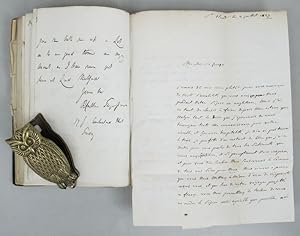
LETTERS ADDRESSED TO SIR GEORGE WARRENDER
Published by N, N, 1827
Seller: Kay Craddock - Antiquarian Bookseller, Melbourne, VIC, Australia
Association Member: ANZAAB ILAB
Seller rating 5 out of 5 stars
Signed
A bound collection of 42 autograph letters from different writers, c.1827-1839, all but one addressed to Sir George Warrender, varying in length from one to twelve pages (the majority being one page), and all but one signed; 8vo; bound with blank interleaves in nineteenth century half green leather, the spine lettered and ruled in gilt, marbled papered boards, lightly rubbed, edges worn, the spine scuffed and grazed, especially at extremities; t.e.g.; armorial bookplate of The Hon. Simon Warrender on upper pastedown, the endpapers slightly offset, hinges starting at a couple of points, occasional light foxing, soiling, and minor wear & tear, including a few mainly small edge chips or tears, with most of the letters showing the original creases from folding for the post, one letter with the correspondent's red wax seal intact. *Sir George Warrender of Lochend, 4th Baronet (1782endash 1849), was a Scottish-born politician who served for a time in the Berwickshire militia, where he reached the rank of Lieutenant-Colonel. He was Member of Parliament for various constituencies (Haddington Burghs, Truro, Sandwich, Westbury and Honiton) between 1807 and 1832, and from 1812 to 1822 served as Lord of the Admiralty. From 1822 he was a member of the Privy Council. Not surprisingly, most of the letters in this collection are from Scottish and British politicians and other dignitaries, including a few foreign diplomats, several aristocrats, and minor royalty. The correspondence is generally private in nature, rather than official, often consisting of acknowledgements of Warrender's hospitality. Approximately half of the letters are dated, from between 1827 to 1839. Letters from soldiers include one from Sir Henry Fane, Commander-in-chief of the British Indian Army; and there are three letters from Admirals, including one from Thomas Bladen Capel, close friend of Nelson and one of the heroes of Trafalgar. The letter from Prince William Frederick, Duke of Gloucester & Edinburgh, has a small piece torn (but extant) from one corner. Three letters are in French, including one from the Duc de Coigny. Politicians amongst the correspondents include two Prime Ministers, and at least two Foreign Secretaries (Henry, Lord Apsley, later Earl of Bathurst; and the Earl of Dudley). The short letter from Frederick John Robinson (Viscount Goderich, later Earl of Ripon), who briefly succeeded George Canning as Prime Minister after the latter's death in 1827, is dated 1839. A brief letter from Henry Temple, 3rd Viscount Palmerston, who twice served as Prime Minister later in the century, is undated. A letter from the incumbent Lord Mayor of London, Alderman Thompson, is dated 1829. Also included is a 2 page letter, complete with red wax seal, from William Huskisson (at that time Secretary of the Colonies), who is perhaps better remembered today as the world's first railway casualty. (He was killed in 1830 by George Stephenson's famous locomotive engine, Rocket). The unsigned letter, which is incomplete, is of a much later (early 20th century) vintage, possibly to another member of the Warrender family, and is loosely inserted near the front of the volume. Signed.


