Order Total (1 Item Items):
Shipping Destination:

1925 1928, Signed (13 results)
Skip to main search results
Search filters
Product Type
- All Product Types
- Books (9)
- Magazines & Periodicals (No further results match this refinement)
- Comics (No further results match this refinement)
- Sheet Music (No further results match this refinement)
- Art, Prints & Posters (3)
- Photographs (No further results match this refinement)
- Maps (No further results match this refinement)
- Manuscripts & Paper Collectibles (1)
Condition Learn more
- New (No further results match this refinement)
- As New, Fine or Near Fine (No further results match this refinement)
- Very Good or Good (1)
- Fair or Poor (No further results match this refinement)
- As Described (12)
Binding
Collectible Attributes
Language (2)
Price
- Any Price
- Under US$ 25 (No further results match this refinement)
- US$ 25 to US$ 50 (No further results match this refinement)
- Over US$ 50
Free Shipping
- Free Shipping to U.S.A. (No further results match this refinement)
Seller Location
Seller Rating
-

BERGE UND MENSCHEN (Grote sche Sammlung, 103. Bd.) G. Grote sche Verlagsbuchhandlung Berlin 1919, 654 SS. gebunden (Hardcover 8°), leicht gegilbt, gut erhalten - verso Titel von Heinrich Federer in lila Tinte mit Datum 31. Okt. 1921 eigenhändig signiert.
-
Karin Anselm (1940), Horst Naumann (1925-2024), Ernst Stankovski (1928-2022)
Manuscript / Paper Collectible Signed
Presse-Großfoto (4°, Ph. Kindermann, Berlin), von allen drei Schauspielern eigenhändig signiert - aus Das Traumschiff , Folge Indien.
-
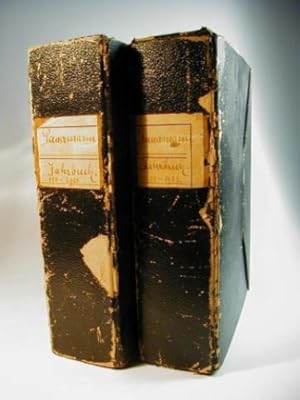
Schleswig - Holstein Kunstkalender / Jahrbuch. mit orginal Holzschnitt Emil Nolde.23 Jg. In 18 Bänden. 1911, 1912, 1913, 1914, 1915, 1916, 1917, 1918/19, 1920, 1921, 1922, 1923, 1924, 1925/26, 1927, 1928/29, 1930/31, 1932/33. (Band 1942/43 fehlt.)
Published by verschiedene Verlage
First Edition Signed
1.Auflage. Ernst Sauermann war Direktor des Kunstgewerbe Museum Flensburg, später Direktor des Thaulow - Museum in Kiel und Provinzialkonservator von Schleswig - Holstein. Die komplette Sammlung sind ein Präsent des Herausgebers Dr. E. Sauermann an den Landrat Billian mit mehreren beigelegten bzw. eingeklebten hand - und maschinenschriftliche Begleitschreiben.,1911 bis 1933 Mit zahlreichen Illustrationen, Abbildungen und Beilagen, u. A. in Heft 1915, eine original Radierung von Professor Axel Eckener Stuttgart: "Gedenkblatt für die Gefallenen" und ein original Holzschnitt von Emil Nolde "Der Sänger". (Bei Schiefler Nr. 97 II Der Sänger 1911 20/22,4 x 15/16,3 Druck: Vereinsdruckerei Potsdam.) Die Pergament - Schutzhüllen nur zum Teil vorhanden und bei einigen Heften an den Kanten gebrochen, ansonsten schön bis sehr schön erhalten. In 2 beschabten Faltkasetten.
-
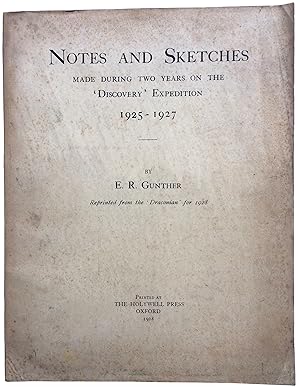
Notes and Sketches made during two years on the Discovery Expedition 1925 -1927 . . . Reprinted from the Draconian for 1928.
Published by Oxford: Holywell Press, 1928
Seller: Meridian Rare Books ABA PBFA, London, United Kingdom
Association Member: ABA ILAB PBFA
Seller rating 5 out of 5 stars

First Edition Signed
US$ 1,104.71
US$ 33.52 shipping
Ships from United Kingdom to U.S.A.Quantity: 1 available
Add to basketSoft cover. Condition: Good. 1st Edition. First separate edition. 4to. pp. [iv, title, preface], 52; coloured frontispiece, 78 photographic illustrations, 4 other illustrations, 27 illustrations to text after original sketches by the author, 12 sketch maps; frontis. chipped and soiled to fore-edge, else very good in the original printed wrappers, neatly repaired to front joint. A presentation copy, with a loosely inserted note inscribed "With the author's compliments and Christmas Wishes E. R. Gunther", the ownership inscription of L. Harrison Matthews to title-page, and with pencilled annotations to several of the photographic illustrations (probably by Matthews). Gunther's Notes and Sketches were originally published in the 'Draconian', the school magazine of the Dragon School in Oxford. They comprise entries and drawings from his diary kept during the 2 years of the "Discovery" expedition. Gunther himself sailed the Discovery, which, together with the William Scoresby, spent 2 years in the South Atlantic Ocean for whaling research. The book includes details of visits to the Canary Islands, Ascension, Tristan da Cunha, South Georgia, the Falklands, and the Palmer Archipelago in Antarctica. This copy was presented by Gunther, and the likely recipient was another member of the Discovery expedition, L. Harrison Matthews (himself author of South Georgia, 1931, and reports from the expedition). This copy also has a few pencilled annotations to some of the illustrations, identifying the scientific crew of the expedition after p. 28, and others elsewhere in the illustrations, that are likely to be in Matthews' hand. Inscribed by Author(s).
-
ELITEN UND DEMOKRATIE Wirtschaft, Wissenschaft und Politik im Dialog - zu Ehren von EBERHARD VON KUENHEIM. Siedler Verlag Berlin, 1. Auflage 1999, ERSTAUSGABE, 424 SS. gebunden (Hardcover 8°) mit Schutzumschlag, gut erhalten - von den Co-Autoren : Arnulf Baring, Hartmut von Hentig und Eberhard von Kuenheim eigenhändig signiert.
-
Frühe IRIS-Fotoporträtpostkarte (am Fenster), in Tinte eigenhändig signiert.
-
ORIGINAL-FARBLITHOGRAPHIE (44 x 31 cm, in alter, weisser Holzleiste mit silberner Innenleiste unter Passepartout und Glas gerahmt, gesamt H 71 x 56 cm), am Unterrand mit Bleistift eigenhändig bezeichnet und signiert MOTIV : Hölderlinturm in Tübingen, Orig.-Graph(ik).
-
E.ALBUMBLATT (NOTENBLATT, 1 S. quer 8°) mit einer eigenhändigen Notenzeile, Bezeichnung BLÄSERQUARTETT OP. 91, Widmung, Datum 4.9.79, Unterschrift signiert.
-
DER BILDHAUER K.H. TÜRK Werkbericht (Grosser Kunstbildband mit Textbeiträgen von Martin Fuchs, Eugen Gomringer, Ehrenfried Kluckert, Ernst Schremmer, Jürgen Thies, K.H. Türk) Belser Verlag Stuttgart und Zürich, 1. Auflage 1988, ERSTAUSGABE, 212 SS. gebunden (Hardcover gr. 4° geprägtes Oln.) mit vielen Fototafeln, mit Schutzumschlag, gut erhal ten - vom Künstler Prof. K.H. Türk und Prof.Dr. Eugen Gomringer mit Datum eigenhändig signiert.
-
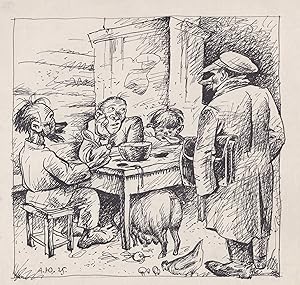
Vorzeichnung für die Satire-Zeitschrift "Behemot" (Nr. 47, 1925); das Magazin erschien in Leningrad (Sankt Petersburg) zwischen 1924 und 1928. / Bauernfamilie beim Essen / Karikatur caricature / Russland Russia
Language: German
Publication Date: 1925
Seller: Antiquariat Steffen Völkel GmbH, Seubersdorf, Germany
Seller rating 5 out of 5 stars
Art / Print / Poster Signed
Original Tuschezeichnung von 1925. -- Blatt-Maße: ca. 22 x 24 cm. -- gut erhalten. || Original ink drawing from 1925. -- in good condition. || "Behemot" was a Soviet weekly satirical magazine, published as a supplement to the "Krasnaya Gazeta". It was published from October 1924 as a continuation of the satirical magazine «Krasnyy voron» ("Red Raven"), until August 1928, when it merged with the humorous newspaper "Pushka". Between 1924and 1926, this publication was printed on 16 pages, with one-color illustrations. From 1927 it was printed on 12 pages, with various colorful illustrations. -- The editors have worked towards expanding communication with the workers' activists. The task was set to create a magazine of real worker satire. In this way, the appearance of the magazine differed significantly from Red Raven: both externally and in terms of content. The main objects of satire were fools, bureaucrats of all stripes, bunglers, nepmen, priests, kulaks, moonshiners, swindlers, hooligans and other negative characters of Soviet reality. || Alexander Alexandrovich Jünger (aka Yunger), born in 1883, in St. Petersburg, comes from a Russified German family. His father was associated with the Richter trading company, and he had two brothers, Vladimir and Nikolai. He pursued his secondary education in Petrishul, concurrently becoming a student at the drawing school of the Society for the Encouragement of the Arts while in high school. Graduating from both institutions in 1902, he later attended the Institute of Civil Engineers, earning a gold medal upon graduation in 1914. Subsequently, Jünger augmented his education at the Academy of Arts, joining the studio of the renowned architect L. N. Benois. Due to financial constraints, he worked as an architect, staying in Benois's workshop until 1917. Evacuated to Ekaterinodar during the 1918 upheavals, he later became a teacher at the Kuban Polytechnic Institute in Krasnodar. Junger continued his architectural pursuits in the south, contributing to the development of the cities of Krasnodar and Novorossiysk. Upon returning to Leningrad in 1925, Jünger engaged in industrial structure design. He participated in numerous architectural competitions across different cities, winning prizes for 11 projects. In the late 1920s, he began teaching at the Leningrad Institute of Municipal Construction Engineers, eventually becoming a professor in 1930. In 1934, Junger assumed leadership of workshop No. 7 at the Lenproekt institute, concurrently writing articles and collaborating with the Union of Architects. His workshop focused on school projects, leading to the construction of several schools in Leningrad. Notable projects under his guidance included the hospital complex named after Mechnikov and buildings for various institutes. The outbreak of the Great Patriotic War interrupted Junger's active career. Surviving the initial siege winter, he was arrested on March 2, 1942, based on a false accusation. Although initially sentenced to death, clemency was granted, substituting the punishment with 10 years in the camps. Alexander Alexandrovich Jünger passed away on August 13, 1948. Jünger's diverse career included work as an artist, lecturer, and professor, contributing significantly to various magazines and artistic endeavors. He worked as an artist/illustrator for the magazines Sprut, Satyricon, New Satyricon (19051918), for the publishing house Modern Lubok (1917), in the group ROSTA Windows (1919), for the magazines Behemoth, Pushka ", "The Inspector General", "The Laugher" (1920s). He also participated in the creation of the first Soviet theater for children in Krasnodar (early 1920s); was engaged in the design of buildings in Voronezh, Krasnodar, Leningrad, Murmansk, Novorossiysk and other Russian cities. He was a lecturer at the Kuban Polytechnic Institute in Krasnodar (19181925). Main collections of his work are at ROSIZO (Moscow), State Museum "Peterhof", Russian State Museum - both in St. Petersburg. // Wir, das Antiquariat Steffen Völkel, kaufen und verkaufen alte Bücher, Handschriften, Zeichnungen, Autographen, Grafiken und Fotografien. Wir sind stets am Ankauf von kompletten Bibliotheken, Sammlungen und Nachlässen interessiert. Sprache: Deutsch Gewicht in Gramm: 15.
-
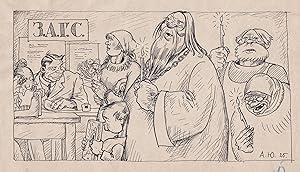
Vorzeichnung für die Satire-Zeitschrift "Behemot" (1925); das Magazin erschien in Leningrad (Sankt Petersburg) zwischen 1924 und 1928. / Hochzeitsgäste wedding guests / Karikatur caricature / Russland Russia
Language: German
Publication Date: 1925
Seller: Antiquariat Steffen Völkel GmbH, Seubersdorf, Germany
Seller rating 5 out of 5 stars
Art / Print / Poster Signed
Original Tuschezeichnung von 1925. -- Blatt-Maße: ca. 21 x 27 cm. -- gut erhalten. || Original ink drawing from 1925. -- in good condition. || "Behemot" was a Soviet weekly satirical magazine, published as a supplement to the "Krasnaya Gazeta". It was published from October 1924 as a continuation of the satirical magazine «Krasnyy voron» ("Red Raven"), until August 1928, when it merged with the humorous newspaper "Pushka". Between 1924and 1926, this publication was printed on 16 pages, with one-color illustrations. From 1927 it was printed on 12 pages, with various colorful illustrations. -- The editors have worked towards expanding communication with the workers' activists. The task was set to create a magazine of real worker satire. In this way, the appearance of the magazine differed significantly from Red Raven: both externally and in terms of content. The main objects of satire were fools, bureaucrats of all stripes, bunglers, nepmen, priests, kulaks, moonshiners, swindlers, hooligans and other negative characters of Soviet reality. || Alexander Alexandrovich Jünger (aka Yunger), born in 1883, in St. Petersburg, comes from a Russified German family. His father was associated with the Richter trading company, and he had two brothers, Vladimir and Nikolai. He pursued his secondary education in Petrishul, concurrently becoming a student at the drawing school of the Society for the Encouragement of the Arts while in high school. Graduating from both institutions in 1902, he later attended the Institute of Civil Engineers, earning a gold medal upon graduation in 1914. Subsequently, Jünger augmented his education at the Academy of Arts, joining the studio of the renowned architect L. N. Benois. Due to financial constraints, he worked as an architect, staying in Benois's workshop until 1917. Evacuated to Ekaterinodar during the 1918 upheavals, he later became a teacher at the Kuban Polytechnic Institute in Krasnodar. Junger continued his architectural pursuits in the south, contributing to the development of the cities of Krasnodar and Novorossiysk. Upon returning to Leningrad in 1925, Jünger engaged in industrial structure design. He participated in numerous architectural competitions across different cities, winning prizes for 11 projects. In the late 1920s, he began teaching at the Leningrad Institute of Municipal Construction Engineers, eventually becoming a professor in 1930. In 1934, Junger assumed leadership of workshop No. 7 at the Lenproekt institute, concurrently writing articles and collaborating with the Union of Architects. His workshop focused on school projects, leading to the construction of several schools in Leningrad. Notable projects under his guidance included the hospital complex named after Mechnikov and buildings for various institutes. The outbreak of the Great Patriotic War interrupted Junger's active career. Surviving the initial siege winter, he was arrested on March 2, 1942, based on a false accusation. Although initially sentenced to death, clemency was granted, substituting the punishment with 10 years in the camps. Alexander Alexandrovich Jünger passed away on August 13, 1948. Jünger's diverse career included work as an artist, lecturer, and professor, contributing significantly to various magazines and artistic endeavors. He worked as an artist/illustrator for the magazines Sprut, Satyricon, New Satyricon (19051918), for the publishing house Modern Lubok (1917), in the group ROSTA Windows (1919), for the magazines Behemoth, Pushka ", "The Inspector General", "The Laugher" (1920s). He also participated in the creation of the first Soviet theater for children in Krasnodar (early 1920s); was engaged in the design of buildings in Voronezh, Krasnodar, Leningrad, Murmansk, Novorossiysk and other Russian cities. He was a lecturer at the Kuban Polytechnic Institute in Krasnodar (19181925). Main collections of his work are at ROSIZO (Moscow), State Museum "Peterhof", Russian State Museum - both in St. Petersburg. // Wir, das Antiquariat Steffen Völkel, kaufen und verkaufen alte Bücher, Handschriften, Zeichnungen, Autographen, Grafiken und Fotografien. Wir sind stets am Ankauf von kompletten Bibliotheken, Sammlungen und Nachlässen interessiert. Sprache: Deutsch Gewicht in Gramm: 15.
-
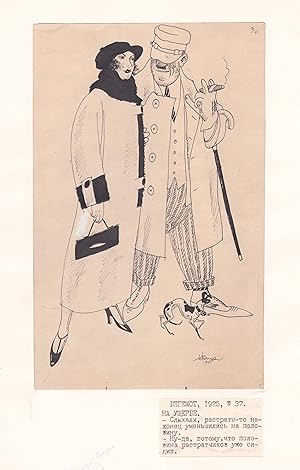
Vorzeichnung für die Satire-Zeitschrift "Behemot" (Nr. 37, 1925); das Magazin erschien in Leningrad (Sankt Petersburg) zwischen 1924 und 1928. / Industrielles Liebespaar mit Hund / Couple with dog / Art Deco / Karikatur caricature / Russland Russia
Language: German
Publication Date: 1925
Seller: Antiquariat Steffen Völkel GmbH, Seubersdorf, Germany
Seller rating 5 out of 5 stars
Art / Print / Poster Signed
Original Tuschezeichnung von 1925. Im Papier-Passepartout aufmontiert. -- Maße: ca. 27 x 21 cm. -- gut erhalten. || Original ink drawing from 1925. Laid down in a paper passepartout. -- in good condition. || "Behemot" was a Soviet weekly satirical magazine, published as a supplement to the "Krasnaya Gazeta". It was published from October 1924 as a continuation of the satirical magazine «Krasnyy voron» ("Red Raven"), until August 1928, when it merged with the humorous newspaper "Pushka". Between 1924and 1926, this publication was printed on 16 pages, with one-color illustrations. From 1927 it was printed on 12 pages, with various colorful illustrations. -- The editors have worked towards expanding communication with the workers' activists. The task was set to create a magazine of real worker satire. In this way, the appearance of the magazine differed significantly from Red Raven: both externally and in terms of content. The main objects of satire were fools, bureaucrats of all stripes, bunglers, nepmen, priests, kulaks, moonshiners, swindlers, hooligans and other negative characters of Soviet reality. || Alexander Alexandrovich Jünger (aka Yunger), born in 1883, in St. Petersburg, comes from a Russified German family. His father was associated with the Richter trading company, and he had two brothers, Vladimir and Nikolai. He pursued his secondary education in Petrishul, concurrently becoming a student at the drawing school of the Society for the Encouragement of the Arts while in high school. Graduating from both institutions in 1902, he later attended the Institute of Civil Engineers, earning a gold medal upon graduation in 1914. Subsequently, Jünger augmented his education at the Academy of Arts, joining the studio of the renowned architect L. N. Benois. Due to financial constraints, he worked as an architect, staying in Benois's workshop until 1917. Evacuated to Ekaterinodar during the 1918 upheavals, he later became a teacher at the Kuban Polytechnic Institute in Krasnodar. Junger continued his architectural pursuits in the south, contributing to the development of the cities of Krasnodar and Novorossiysk. Upon returning to Leningrad in 1925, Jünger engaged in industrial structure design. He participated in numerous architectural competitions across different cities, winning prizes for 11 projects. In the late 1920s, he began teaching at the Leningrad Institute of Municipal Construction Engineers, eventually becoming a professor in 1930. In 1934, Junger assumed leadership of workshop No. 7 at the Lenproekt institute, concurrently writing articles and collaborating with the Union of Architects. His workshop focused on school projects, leading to the construction of several schools in Leningrad. Notable projects under his guidance included the hospital complex named after Mechnikov and buildings for various institutes. The outbreak of the Great Patriotic War interrupted Junger's active career. Surviving the initial siege winter, he was arrested on March 2, 1942, based on a false accusation. Although initially sentenced to death, clemency was granted, substituting the punishment with 10 years in the camps. Alexander Alexandrovich Jünger passed away on August 13, 1948. Jünger's diverse career included work as an artist, lecturer, and professor, contributing significantly to various magazines and artistic endeavors. He worked as an artist/illustrator for the magazines Sprut, Satyricon, New Satyricon (19051918), for the publishing house Modern Lubok (1917), in the group ROSTA Windows (1919), for the magazines Behemoth, Pushka ", "The Inspector General", "The Laugher" (1920s). He also participated in the creation of the first Soviet theater for children in Krasnodar (early 1920s); was engaged in the design of buildings in Voronezh, Krasnodar, Leningrad, Murmansk, Novorossiysk and other Russian cities. He was a lecturer at the Kuban Polytechnic Institute in Krasnodar (19181925). Main collections of his work are at ROSIZO (Moscow), State Museum "Peterhof", Russian State Museum - both in St. Petersburg. // Wir, das Antiquariat Steffen Völkel, kaufen und verkaufen alte Bücher, Handschriften, Zeichnungen, Autographen, Grafiken und Fotografien. Wir sind stets am Ankauf von kompletten Bibliotheken, Sammlungen und Nachlässen interessiert. Sprache: Deutsch Gewicht in Gramm: 15.
-
Eleven autograph letters, three with comic drawings, 30pp., and one autograph postcard signed, to Julian Morrell, various addresses, 1925-1928, the letters various sizes from sm. 8vo to large 4to, via one in the shape of the artists's foot, with toes and
Seller: Paul Rassam ABA ILAB, Charlbury, United Kingdom
Seller rating 4 out of 5 stars

Signed
US$ 1,035.67
US$ 33.52 shipping
Ships from United Kingdom to U.S.A.Quantity: 1 available
Add to basketAffectionately humorous letters to Ottoline Morrell's daughter. The foot-shaped letter reads: 'How pleased I should have been to send you my heart but that I fear is not mine to dispose of so I send you my foot with fondest love. It has been a faithful friend to me these 33 odd years & I sincerely trust that you will appreciate the supreme sacrifice I am making in sending it to you. Of course if it comes back with a leg I shall be more than grateful as since the advent of my plus 4s I find I want all the legs I can get. Walter Turner has not sent me his legs yet & until he does I shant send him my head', while a large quarto leaf bears a charming manuscript composition for piano, signed and dated '1910', and subsequently inscribed, 'To Julians baby daughter on her first birthday (with much expression but no crying) and with a humorous letter beneath. Beyond the whimsy, there are references to Duncan Grant and Mark Gertler, as well as a weekend spent with Henry Lamb: 'he gave me a wonderful lesson on the [Mozart] Fantasia, he turned it inside out & made me do it in front of him on his new Bechstein Grand.' He writes about a successful painting trip to Durweston, a Devon village notable to Gilbert for its 'uncanny atmosphere' and frequent suicides, and mentions two significant paintings, 'The Shepherds Amazed', which Julian's uncle has just bought, and 'Portrait of Joyce Peters', which he has begun working on. His brother, Stanley, makes a number of appearances, most notably in an undated letter in which Gilbert, having been invited to have his photograph taken by a Bond Street photographer, remarks that 'I thought that as Stans show was imminent, that I had better make this last grab at being distinguished before being finally extinguished by the cloud burst of fame which is so soon to break over the head of "Little Stanley".'. Signed by Author(s).