

Order Total (1 Item Items):
Shipping Destination:

Paris 1867, Signed (21 results)
Skip to main search results
Search filters
Product Type
- All Product Types
- Books (9)
- Magazines & Periodicals (No further results match this refinement)
- Comics (No further results match this refinement)
- Sheet Music (No further results match this refinement)
- Art, Prints & Posters (4)
- Photographs (6)
- Maps (No further results match this refinement)
- Manuscripts & Paper Collectibles (2)
Condition Learn more
- New (No further results match this refinement)
- As New, Fine or Near Fine (4)
- Very Good or Good (1)
- Fair or Poor (No further results match this refinement)
- As Described (16)
Binding
Collectible Attributes
- First Edition (6)
- Signed (21)
- Dust Jacket (No further results match this refinement)
- Seller-Supplied Images (16)
- Not Print on Demand (21)
Language (2)
Free Shipping
- Free Shipping to U.S.A. (No further results match this refinement)
Seller Location
Seller Rating
-

Exposition Universelle de 1867 à Paris. Rapports du Jury International CARTES GEOLOGIQUES.
Published by Paris, Paul Dupont, 1867, 1867
Seller: Librairie Xavier Dufaÿ, LA COLLE SUR LOUP, France
Seller rating 3 out of 5 stars

Signed
In-8 (23 x 14 cm), 1 f., 33 pp., broché. Envoi de l'auteur. Softcover.
-

1867 Antique Print FRANCE Paris Russian Tartars Isbah Stables Horse Cottage (68)
Seller: Antique Paper Company, ASHFORD, KENT, United Kingdom
Seller rating 2 out of 5 stars

Art / Print / Poster Signed
1867 Antique Print FRANCE Paris Russian Tartars Isbah Stables Horse Cottage (68) For more info please ask seller a question. Royal Mail 2nd Class - £0.00 Royal Mail 2nd Class Signed For - £4.50 Standard Int'l age - £4.00 Royal Mail International Signed - £8.00 No PICK UP OPTIONSorry, our items are NOT available for pick-up.PAYING VIA PAYPALWe accept on our all our items so you can shop with confidence.Simple choose the option when proceeding through the checkout.
-

1867 Antique Print FRANCE Paris Russian Restaurant Swedish Gustavus Vasa (56)
Seller: Antique Paper Company, ASHFORD, KENT, United Kingdom
Seller rating 2 out of 5 stars
Art / Print / Poster Signed
1867 Antique Print FRANCE Paris Russian Restaurant Swedish Gustavus Vasa (56) For more info please ask seller a question. Royal Mail 2nd Class - £0.00 Royal Mail 2nd Class Signed For - £4.50 Standard Int'l age - £4.00 Royal Mail International Signed - £8.00 No PICK UP OPTIONSorry, our items are NOT available for pick-up.PAYING VIA PAYPALWe accept on our all our items so you can shop with confidence.Simple choose the option when proceeding through the checkout.
-

1867 Antique Print FRANCE PARIS EXHIBITION BRITISH PICTURE GALLERY (187)
Seller: Antique Paper Company, ASHFORD, KENT, United Kingdom
Seller rating 2 out of 5 stars
Art / Print / Poster Signed
1867 Antique Print FRANCE PARIS EXHIBITION BRITISH PICTURE GALLERY (187) For more info please ask seller a question. Royal Mail 2nd Class - £0.00 Royal Mail 2nd Class Signed For - £4.50 Standard Int'l age - £4.00 Royal Mail International Signed - £8.00 No PICK UP OPTIONSorry, our items are NOT available for pick-up.PAYING VIA PAYPALWe accept on our all our items so you can shop with confidence.Simple choose the option when proceeding through the checkout.
-
Faculté de Médecine de Paris - Thèse pour le Doctorat en Médecine, présentée et soutenue le 7 février 1867, par Félix Réfrégé - Essai sur le diagnostic de l'Étranglement Intestinal à symptômes cholériformes. - envoi autographe de l'auteur COPY SIGNED BY THE AUTHOR
Published by Paris : A. Parent, 1867
First Edition Signed
Couverture souple. Condition: Bon. Edition originale. Grand In-8° broché, 44 pages - envoi autographe de l'auteur COPY SIGNED BY THE AUTHOR - page de titre. Dédicacé par l'auteur.
-

DE LA LESION - THESE POUR LE DOCTORAT PRESENTEE LE 24 JUILLET 1867 - FACULTE DE DROIT DE PARIS - ENVOI DE L'AUTEUR.
Published by BONNAUD E., 1867
Signed
Couverture souple. Condition: bon. RO20203393: 1867. In-8. Broché. Etat d'usage, Plats abîmés, Dos abîmé, Intérieur frais. 226 pages - plats desolidarisés - dos partiellement manquant - quelques traces de marquer noir sur le 1er plat - 1 tampon sur la page de titre et 2 tampons au dos - 2 tampons au dos de la table des matieres - ENVOI DE L'AUTEUR. . . . Classification Dewey : 97.2-Dédicace, envoi.
-
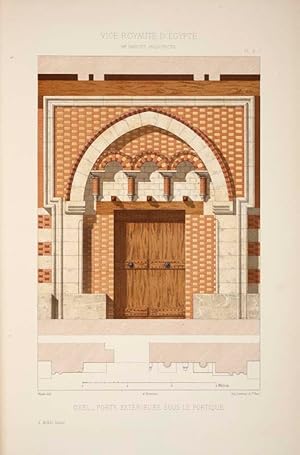
L'architecture des nations étrangères. Etude sur les principales constructions du parc à l'Exposition Universelle de Paris (1867).
Published by Paris, A. Morel, 1870., 1870
Seller: Bernard Quaritch Ltd ABA ILAB, London, United Kingdom
Association Member: ABA ILAB PBFA
Seller rating 5 out of 5 stars

First Edition Signed
US$ 5,542.85
US$ 43.05 shipping
Ships from United Kingdom to U.S.A.Quantity: 1 available
Add to basketFirst Edition. Folio, pp. [iv], 27, [3], with 56 plates (numbered to 73), of which eleven are chromolithographed and four are double-page; some light spotting and dust-soiling (generally restricted to plate margins), but a very good copy in recent red morocco-backed marbled boards, spine richly gilt. `First edition. This is a presentation copy, inscribed on the half-title to the author's friend Charles Garnier, architect of the Paris opera house that bears his name: 'A son ami Ch. Garnier. Souvenir affectueux A. Normand'. The two men had known each other since they were both 'pensionnaires' at the Academy of France in Rome in the late 1840s and early 1850s.Normand's work is a detailed record of the principal edifices of the vast architectural theme park constructed for the Exposition Universelle of 1867, 'a spectacle without equal which, in all probability, future generations will never have the opportunity to witness' (translated from Normand's preface). The 1867 exhibition was the first such event to feature actual buildings (temples, palaces, houses, schools) rather than mere models or architectural drawings. Normand devotes most attention to the Egyptian section (designed by Jacques Drevet) and to those of Tunisia and Morocco (both designed by Alfred Chapon).'In 1867 Tunisia's and Morocco's displays in Paris seemed to some observers a deliberate escape from the economic and political upheavals the two countries were experiencing. Agricultural, industrial, and commercial spheres were omitted: instead, there were palaces with exuberant interiors and furniture, royal costumes, and armour simply "everything that glitters, shines, and adorns". Others noted the artistic value of the Tunisian and Moroccan pavilions. Alfred Normand claimed that they "were important not only for their size, but also for their tastefulness, their picturesque effect, and especially the brand new and charming sensation that they arouse in us . . . . [Here was] a particular type of dwelling, where art was not excluded . . . from everyday activities" ' (Zeynep Çelik, Displaying the Orient: architecture of Islam at nineteenth-century World's Fairs, pp. 1223).Alfred Normand (18221909) was an architect and a photographer. His most notable commission was the celebrated Pompeian-style villa (now demolished) built for the prince Jérôme Bonaparte on the Avenue Montaigne in Paris. Language: French.
-
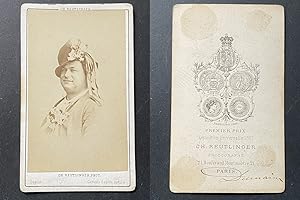
Reutlinger, Paris, Louis-François Dumaine, acteur, circa 1867, signée au dos
Publication Date: 1867
Photograph Signed
Photographie,vintage cdv albumen print - Louis-François Dumaine (1831-1893), artiste dramatique. Pseudonyme de Louis-François Person. Photo signée en bas au dos du carton. // Circa 1867 // CDV, tirage albuminé, 6 x 10.5 cm, vintage albumen print // Format (cm): 6,5x10,5.
-

Femme a Barbe. Mutige Frau und bärtiger Barbar auf Theaterbühne vor Publikum in Paris. Unverschämtheit! Wagen Sie es bloß nicht, in meinen Gebieten zu jagen! Original-Lithographie von Honoré Daumier aus der Satire-Zeitschrift "Le Charivari" 1867
Language: French
Published by Paris: Lithographies Destouches, 1867
Seller: historicArt Antiquariat & Kunsthandlung, Wiesbaden-Breckenheim, Germany
Seller rating 5 out of 5 stars
Art / Print / Poster First Edition Signed
1. Original-Lithographie von Daumiert (im Stein signiert) aus der Serie "Actualités", nummeriert "27", auf rückseitig bedrucktem Blatt einer (fast) ganzen Seite aus einer Ausgabe von "Le Charivari", bildliche Darstellung ca. 25 x 22 cm, Blattgröße ca. 36 x 25 cm, sauber und sehr gut erhalten, selten - Bedeutung und Bezeichnung dieser berühmten Karikatur-Lithographie von Daumier sind bis heute ein Rätsel. Die typische Bezeichnung dieser Karikatur in Kunsthandel "Femme a Barbe" wird oft übersetzt mit "Bearded Lady" oder "Bärtige Dame", was Unsinn ist. Die tatsächliche Bedeutung ist "Frau (spricht) zu einem Bärtigen". Dargestellt ist eine Theaterszene aus dem Pariser Milieu der 1860er Jahre, in der eine mutige Frau es wagt, einen vollbärtigen Mann (=Barbar) in seine Schranken zu weisen. 2100 gr.
-
JULIUS MEIER-GRAEFE (1867-1935) bedt. Schriftsteller & Kunsthistoriker, grd. 1895 Pan, danach in Paris bester Kenner der französischen Malerei des 19. Jahrhunderts und Caspar David Friedrichs
Manuscript / Paper Collectible First Edition Signed
DER VATER Roman S. Fischer Verlag Berlin, 1. Auflage 1932, 1.-5. Tsd., ERSTAUSGABE, 347 SS. gebunden (Hardcover, Oln. 8°), gut erhalten - mit eigenhändiger Widmung, Ort, Datum, Unterschrift in Tinte signiert Berlin 1932.
-
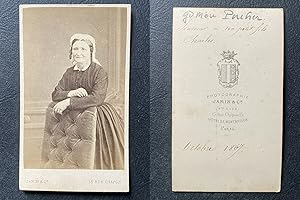
Photographie,CDV vintage albumen - Dédicace au dos : "Souvenir à son petit-fils Charles, octobre 1867." // Circa 1867 // Tirage albuminé // Format (cm): 6,5x10,5.
-
Dryaden Et Eventyr fra Udstillingstiden i Paris 1867 [La Dryade Un conte de fées de l'Exposition de Paris 1867]
Publication Date: 1868
Seller: Librairie Le Feu Follet, Paris, France
Association Member: ILAB
Seller rating 5 out of 5 stars
First Edition Signed
Couverture rigide. "L'Exposition universelle de Paris en 1867, cette grande période merveilleuse des contes de fées." | Kjobenhavn [Copenhague] 1868 | 12 x 18.7 cm | Relié | Édition originale. Reliure en plein papier rocaille, pièce de titre en maroquin havane, couvertures originales conservées. Dos, coins et mors légèrement frottés, tache sans gravité en marge du second plat de couverture conservé. Rare édition originale du conte d'Andersen sur une dryade au sort tragique, souvent comparé à La Petite Sirène (1837). Les deux mettent en scène un esprit féminin de la nature qui aspire à quitter sa forme pour rejoindre le monde des hommes, avec des conséquences fatales. L'exemplaire est exceptionnellement enrichi d'un envoi autographe d'Hans Christian Andersen: «?Fru Grøn. En venlig Erindring om Udstillingstiden i Paris 1867. Ærbødigst H. C. Andersen.?» [à Madame Grøn / en souvenir affectueux de l'exposition de Paris en 1867. Avec toute mon estime. H. C. Andersen.]. Andersen fit un séjour à Paris en 1867, qui lui inspira cette histoire se déroulant lors de l'Exposition universelle. C'est à cette occasion qu'il rencontra la dédicataire Ada Grøn (française d'origine, née Courtois), sa petite fille et son mari le grossiste danois L. J. T. Grøn. Cet envoi est consigné par Andersen dans une entrée de son journal en date du 28 avril 1870, publiée par le H. C. Andersen Centret d'Odensee. * Du 15 avril au 9 mai 1867, Hans Christian Andersen visita l'Exposition universelle de Paris et s'en émerveilla?: «?Ce serait un simplisme ridicule de s'imaginer Andersen en préécolo, un faune sentimental, éthéré, uniquement sensible à la nature. On ne peut ici que le noter en passant, car cela mériterait tout un essai. Andersen envisage le monde de façon globale, non hiérarchisée et surtout dénuée de tout passéisme [.] La science de son temps le fascinait et excitait ses curiosités et ses engouements?: l'éblouissement de l'électricité, le microscope, bien sûr, qui fait voir au-delà des apparences, la photographie et toutes les inventions qui s'annoncent et exaltent la vitesse, l'animation des images, le vol. En effet, l'époque était bien celle du conte et sa matière n'était pas prête à se raréfier.?» (Isabelle Jan, «?Andersen, écrivain de toujours?», La Revue des Livres pour Enfants, n° 226). La Dryade illustre tout à fait l'abondance d'inspiration que lui procure sa visite parisienne. Andersen traduit son expérience de la vie moderne entre exaltation et scepticisme à travers le personnage d'une dryade, esprit féminin d'un arbre, qui vit dans un vieux chêne dans la campagne française, et rêve de découvrir le monde des hommes. Un jour, son vu est exaucé?: un événement exceptionnel permet à son arbre d'être transporté et replanté au cur de l'Exposition universelle de Paris. Libérée de ses racines, la dryade peut désormais observer la vie humaine de près. Elle découvre la ville, ses splendeurs, son art, ses plaisirs et ses souffrances. Mais ce privilège a un prix?: détachée de son sol d'origine, la dryade est vouée à mourir jeune. Son existence terrestre, brève mais intense, s'achève dans une dernière vision de la beauté et de la douleur du monde. On ne peut que constater les similarités avec des grands chefs-d'uvre du conteur, et notamment le leitmotiv qui fit sa célébrité?: le puissant désir de ses personnages de changer leur nature. Comme le remarque Ane Grum-Schwensen?: «?Dans le cas d'Andersen, c'est comme si un recyclage très conscient d'éléments intertextuels internes s'opérait pour créer un réseau plus vaste reliant les uvres entre elles. Ce fonctionnement devient évident lorsque par exemple, dans «?les archives?», on trouve une note décrivant les liens réciproques existant entre les nombreux éléments utilisés par Andersen dans La Dryade, La Petite Sirène, La Vierge des glaces et La Reine des Neiges?», (Ane Grum-Schwensen, «?Images littéraires et recyclage dans les manuscrits d'Andersen?», Genesis, 48, 2019). Précieux envoi de Hans Christian An.
-
Maxime Weygand (1867-1965) - Rare photo signée - Paris 1934
Language: French
Publication Date: 1934
Manuscript / Paper Collectible Signed
Pas de couverture. Condition: Assez bon. Rare - Photo de journal (collée sur un feuillet) signée en décembre 1934. + Enveloppe manuscrite. Format : 14x11 cm. État : légères froissures, voir scans svp. Provenance : collection Louis Goudet. Authenticité garantie. Signé par l'auteur.
-
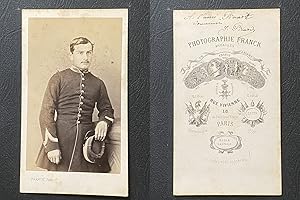
Franck, Paris, Jeune homme nommé Y. Pirard en uniforme militaire, Saint Cyr, circa 1867
Publication Date: 1867
Photograph Signed
Photographie,CDV vintage albumen - Dédicace au dos : "A l'ami Pinart, Y. Pirard". Photo faisant partie d'un lot appartenant à Th. Pinart, de 1867. Ecole de Saint Cyr. // Circa 1867 // Tirage albuminé // Format (cm): 6,5x10,5.
-
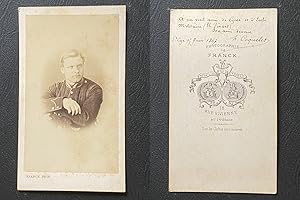
Franck, Paris, Jeune homme nommé Coquelet en uniforme militaire, Saint Cyr, 1867
Publication Date: 1867
Photograph Signed
Photographie,CDV vintage albumen - Dédicace au dos : "A mon vieil ami de lycée et d'école militaire (Th. Pinart), son ami dévoué Coquelet, Saint Cyr 15 juin 1867". // Circa 1867 // Tirage albuminé // Format (cm): 6,5x10,5.
-
PHOTOGRAPHIE par Bisson Jeune : EXPOSITION UNIVERSELLE PARIS 1867, tiage albuminé de l'époque 1866: vue d'une galerie de sculptures
Language: French
Publication Date: 1867
Seller: Librairie Rouchaleou, Saint-André-de-Sangonis, FR, France
Seller rating 5 out of 5 stars
Photograph Signed
Pas de couverture. Condition: Très bon. 1 grande photographie par Auguste-Rosalie Bisson Jeune, tirage albuminé de l'époque (1867) réalisé par Pierre Petit, photographe de la Commission impériale : EXPOSITION UNIVERSELLE PARIS 1867, vue d'une galerie de sculptures. Tirage albuminé de l'époque contreollé sur carton fort, avec la marque armoriée de l'administration de la concession impériale. Tirage de format : 23 cms x 15 cms (support: 45,5 cms x 42 cms). Auguste-Rosalie Bisson Jeune, 1826-1900. Pierre Petit, 1832-1909. Bel état de conservation (encadrement de l'époque, baguette bois vernis noir de style Napoléon III) Nous consulter au préalable pour les frais de port en mode colissimo, Tarif en vigueur La Poste. Dédicacé par l'illustrateur.
-
PHOTOGRAPHIE par Charles-Louis Michellez : EXPOSITION UNIVERSELLE PARIS 1867, tiage de l'époque 1866 : Vue d'une galerie de sculptures, dont Gil ultima giorni di Napoleone Primo
Language: French
Publication Date: 1867
Seller: Librairie Rouchaleou, Saint-André-de-Sangonis, FR, France
Seller rating 5 out of 5 stars
Photograph Signed
Pas de couverture. Condition: Très bon. 1 grande photographie par Charles-Louis Michellez, tirage albuminé de l'époque (1867) réalisé par Pierre Petit, photographe de la Commission impériale : EXPOSITION UNIVERSELLE PARIS 1867, vue d'une galerie de sculptures, dont Gil ultima giorni di Napoleone Primo. Tirage albuminé de l'époque contreollé sur carton fort, avec la marque armoriée de l'administration de la concession impériale. Tirage de format : 23 cms x 15 cms (support: 45,5 cms x 42 cms). Charles-Louis Michelez (1817-1894). Pierre Petit, 1832-1909. Bel état de conservation (encadrement de l'époque, baguette bois vernis noir de style Napoléon III) Nous consulter au préalable pour les frais de port en mode colissimo, Tarif en vigueur La Poste. Dédicacé par l'illustrateur.
-
Droits de l'Homme. 2e édition. Paris, Pagnerre, (1867). Kl.-8vo. 4 Bl., 385 S., 1 Bl. Hldr.d.Zt. mit 4 Bünden u. Vergoldung; Kanten berieben, Deckelbezüge etwas beschabt.
Seller: Jürgen Patzer, Konstanz, Germany
Association Member: GIAQ ILAB VDA
Seller rating 4 out of 5 stars

First Edition Signed
Staatsphilosophische Abhandlung des französischen Publizisten u. Politikers Eugène Pelletan (1813-1884), der 1870 während der Belagerung von Paris vor allem die Ambulanzen leitete u. von 1871-1876 für die republikanischen Linken in der Nationalversammlung saß. Die erste Ausgabe war 1858 erschienen; "ce livre porte le titre de seconde édition, mais en réalité c'est un nouveau travail" (Vorbemerkung). Auf dem Voritel handschriftliche Widmung des Verfassers ("Monsieur Castamel (?) temoignage de vraie sympathie"). - Etwas stockfleckig.
-
Né à Toulouse. 1867-1925. Sculpteur, il fut influencé par Rude, Rodin et surtout Alexandre Falguière. Élève des Beaux-Arts de Paris. 2 L.A.S. « Ségoffin » à Madame Roll [l'épouse du peintre Alfred Roll]. [Paris], sans date et 25 mai 1911. Au total 4 pp. ½ in-8.
Signed
S.d. : Ségoffin est heureux de sa décision et espère quelle naura pas .à regretter le choix du marbre car je suis convaincu que cette matière pourra mettre en valeur certains détails et compléter mon travail. Il va immédiatement satteler au .travail de la mise au point. et se déclare très touché des amabilités dAlfred Roll à son endroit. Il ajoute en P.S. .ce qui minquiète le plus pour M. Roll, ce sont ses yeux, quil ne se fatigue pas surtout, le soleil ne doit pas être très bon et cest pourtant son art. [.] plusieurs personnes qui ont vu le buste men ont fait compliments [.] cela ma fait très grand plaisir.25 mai 1911 : il confirme leur rendez-vous, .très heureux de pouvoir enfin reprendre nos séances.On joint une Lettre Signée « Ségoffin » à une dame, [Paris], 10 janvier 1916. 2 pp. in-8. Relative à des séances de pose qui ont été fixées entre eux et dont il lui rappelle la date.
-

Schöner E.Brief (1 S. quer 4 to) in breiter Tinte mit Ort, Datum, Unterschrift JEHAN-RICTUS signiert Paris, 21. Fevrier 1927 - an Mon cher Lemercier (= EUGENE LEMERCIER, 1862-1939, französischer Chansonnier, Librettist, Cabaret-Künstler), auf französisch, komplette Umschrift (Typoskript) dabei.
-

Rossini Prepares for the Great Worlds Fair in Paris in 1867 (As he is composing his Hymn to Napoleon III, the anthem of the event, he aids an Italian exhibiting there.)
Seller: The Raab Collection, Ardmore, PA, U.S.A.
Association Member: ABAA ILAB PADA
Seller rating 4 out of 5 stars
Signed
Gioachino Rossini, the great Italian composer who wrote operas, chamber music, songs, and some instrumental and piano pieces, is perhaps best-known for works like "The Barber of Seville."? He is often referred to as the Italian Mozart, a reference to his skill and the young age at which it was accomplished.In 1855, Rossini moved to Paris, where he settled, and established himself as a cultural figure in that city, entertaining and occasionally composing.? He hosted many literary and artistic figures and was a well known lover of food and cooking.? He was a celebrity, who had achieved fame and financial comfort.The International Exposition of 1867 in France was the second world's fair to be held in Paris and took place from April 1 to November 3 1867. Many nations were represented at the fair. Following a decree of Emperor Napoleon III, the fair took place in the midst of the renovation of Paris, marking the culmination of the Second French Empire.For such a grand occasion, Rossini was chosen to write the "Hymn to Napoleon III," which he did and it was the musical centerpiece, the anthem of the event.? Rossini also was a liaison for the fair on behalf of Italians at home, particularly those close to where he called home.? His primary fiscal agent and correspondent was Angelo Mignani, who handled his finances and was a link back to Italy.? Professor Rizzoli was the chief surgeon in Bologna, a university town in northern Italy, also the home of Mignani. Rizzoli was the inventor of surgical techniques he wished to exhibit at the fair.Autograph letter signed, Paris, January 29, 1867, to Mignani, accepting a large sum of money, likely for living expenses, and assuring Rizzoli that his funds had cleared.? "Dear Angelo. I received your letter dated the 24th in which is included the draft of 1047.35 francs.? Also tell Mr. Rizzoli that the promissory note was accepted immediately and that it has the signatures (probably not well known by him) of Spaniards who enjoy a great reputation in Paris.? Dear Angelo, continue in your good work.? G. Rossini."? 1000 francs in today's money would be several thousand US dollars, and likely represented his living expenses as he was composing his Hymn and preparing for the Worlds Fair.


![Seller image for Dryaden Et Eventyr fra Udstillingstiden i Paris 1867 [La Dryade Un conte de fées de l'Exposition de Paris 1867] for sale by Librairie Le Feu Follet](https://pictures.abebooks.com/inventory/md/md32223682442.jpg)


