

Order Total (1 Item Items):
Shipping Destination:

Shadow 1940, First Edition (15 results)
Skip to main search results
Search filters
Product Type
- All Product Types
- Books (15)
- Magazines & Periodicals (No further results match this refinement)
- Comics (No further results match this refinement)
- Sheet Music (No further results match this refinement)
- Art, Prints & Posters (No further results match this refinement)
- Photographs (No further results match this refinement)
- Maps (No further results match this refinement)
- Manuscripts & Paper Collectibles (No further results match this refinement)
Condition Learn more
- New (No further results match this refinement)
- As New, Fine or Near Fine (6)
- Very Good or Good (8)
- Fair or Poor (No further results match this refinement)
- As Described (1)
Binding
- All Bindings
- Hardcover (No further results match this refinement)
- Softcover (4)
Collectible Attributes
- First Edition (15)
- Signed (No further results match this refinement)
- Dust Jacket (No further results match this refinement)
- Seller-Supplied Images (13)
- Not Print on Demand (15)
Language (3)
Price
- Any Price
- Under US$ 25 (No further results match this refinement)
- US$ 25 to US$ 50
- Over US$ 50
Free Shipping
- Free Shipping to U.S.A. (No further results match this refinement)
Seller Location
Seller Rating
-

The Shadow : VOICE OF DEATH Feb.15, 1940 the shadow pulp magazine,
Published by Smith and Smith, New York, 1940, 1940
First Edition
Soft cover. Condition: Very Good. No Jacket. 1st Edition. Very Good original 10 cent pulp with small chips top and bottom spine.
-
LETHAL SHADOW MIKE DEBARDELEBE 1940 2011, N, THE MARQUIS DE SADE OF AMERICA HC1ST SCARCE HARDCOVER
Published by ONYX PENGUIN hc, 1994
First Edition
GD. WORSE THAN BUNDY.
-
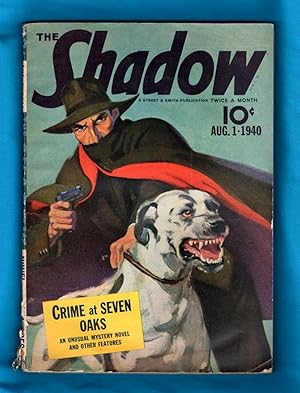
The Shadow # 203 / August 1, 1940 / Vol XXXIV, No.5
Language: English
Published by Street & Smith, New York, 1940
Seller: Singularity Rare & Fine, Baldwinsville, NY, U.S.A.
Seller rating 5 out of 5 stars

First Edition
Single Issue Magazine. Condition: Very Good Plus. Gladney, Graves [cover] (illustrator). First Edition. Very Good. New York: Street & Smith, 1940. First Edition. The Shadow # 203 / August 1, 1940 / Vol XXXIV, No.5. Cover illustration by Graves Gladney. Illustrated wraps, 9 1/4" x 6 5/8", 114 pp. Some roughening and loss at bottom of spine, else remarkably sharp for this publication, Very Good Plus with only moderate, even age toning to the still-supple pages and almost no cover wear. Handsome. See scans. A very scarce true original Street & Smith pulp edition of the timeless crime-fighter's series. In this issue, Maxwell Grant (Walter B. Gibson) offers "Crime at Seven Oaks", a "complete Shadow novel". Grant Lane contributes "The Kid and the Bambino", and on-theme short, and Henry Lysing again authors "Codes", a piece for ciphering hobbyists, in which money can allegedly be won for one's codes. Other Shadow features are "The Shadow Club", "Highlights on The Shadow", and "Theaters Showing the Shadow". Graves Gladney classic cover artwork has the Shadow, in red-lined cloak and brandishing a .45 automatic, restraining, by the collar, an enraged mastiff clearly ready to assail the bad guys. Walter B. Gibson, a professional magician, was hired rather quickly by Street & Smith to pen the theme stories for this famed periodical, primarily because its public was demanding it before it existed. "The Shadow", a now-classic "dark" hero who employed the tactics and reflected the moods of his sinister criminal foes, was in fact originally only an announcer for "Detective Stories", a radio show intended to promote sales of the pulp magazine of the same name (also by Street & Smith). This announcer - The Shadow (played initially by James LaCurto, then by Frank Readick) - commanded such fanship that a popular demand arose for "his magazine". S&S was therefore constrained to, as quickly as possible, create it. The rest is history. Very scarce, particularly in this condition, and of course an American pulp and genre classic. See scans. LT23.
-
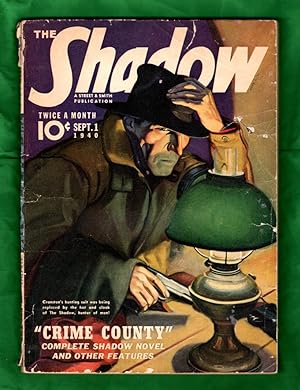
The Shadow # 205 / Sept. 1, 1940 / Vol XXXV, No.1
Language: English
Published by Street & Smith, New York, 1940
Seller: Singularity Rare & Fine, Baldwinsville, NY, U.S.A.
Seller rating 5 out of 5 stars
First Edition
Single Issue Magazine. Condition: Very Good. Gladney, Graves [cover] (illustrator). First Edition. Very Good. New York: Street & Smith, 1940. First Edition. The Shadow # 205, Vol. XXXV, No. 1. Cover illustration by Graves Gladney. Illustrated wraps, 9 1/4" x 6 5/8", 114 pp. Small areas of wear at cover, notably at periphery, 2" closed tear at cover, some roughening/loss at spine ends. See scans. Pages supple, only mildly age toned. Very Good by pulp standards. A very scarce true original Street & Smith pulp edition of the timeless crime-fighter's series. In this issue, Maxwell Grant (a pseudonym of Walter B. Gibson) offers "Crime County", a "complete Shadow novel". Milton Lowe contributes "It Added Up To Murder", and on-theme short, and Henry Lysing authors "Codes", a piece for ciphering hobbyists, in which money can allegedly be won for one's codes. Other Shadow features are "The Shadow Club", "Highlights on The Shadow", and "Theaters Showing the Shadow". Graves Gladney classic cover artwork has the Shadow re-seating his in hat and hunched in his heavy coat, with a .45 automatic at the ready, all in the chiaroscuro lighting effect cast by a hurricane lamp. Walter B. Gibson, a professional magician, was hired rather quickly by Street & Smith to pen the theme stories for this famed periodical, primarily because its public was demanding it before it existed. "The Shadow", a now-classic "dark" hero who employed the tactics and reflected the moods of his sinister criminal foes, was in fact originally only an announcer for "Detective Stories", a radio show intended to promote sales of the pulp magazine of the same name (also by Street & Smith). This announcer - The Shadow (played initially by James LaCurto, then by Frank Readick) - commanded such fanship that a popular demand arose for "his magazine". S&S was therefore constrained to, as quickly as possible, create it. The rest is history. Very scarce, and of course an American pulp and genre classic. See scans. LG8.
-

Shadow 1940 November 15.
Published by Street & Smith, New York, 1940
Seller: Fantasy Illustrated, Silvana, WA, U.S.A.
Association Member: ABAA CBA ILAB
Seller rating 2 out of 5 stars

First Edition
Pulp. Condition: Very Good-. First Edition; First Printing. Shadow 1940 November 15. 2" tear at spine, glue repair to lower spine, G/VG. ; 4to 11" - 13" tall.
-
[A RARE TREATISE OF THE GREEK & TURKISH SHADOW THEATRE: KARAGÖZ] O Karagiózis: Ta ainígmata tis Passopoúlas. Komodía eis práxeis treis [i.e., Karagöz: The riddles of Passopoula. Comedy in three acts]. Illustrated by Sotiris Christidis (1858-1940).
Language: Greek, Modern (post 1453)
Published by A. Gelantalis & Co., [Athens?], [1924-25]., [Athens], 1925
Seller: Khalkedon Rare Books ABA, ILAB, IOBA, ESA, Istanbul, Turkey
Association Member: ABA ESA ILAB IOBA
Seller rating 5 out of 5 stars
First Edition
Soft cover. Condition: Very Good. 1st Edition. Original lithographed text. Cr. 8vo. (20 x 14 cm). In Greek. 40 p., b/w reproduced illustrations by cliché. Front cover is missing, loose pages. Uncut. Overall, a fair-good copy. Types of Karagiozis Stratiotis (A Muslim soldier) and an elephant have been attractively illustrated on double-pages in the treatise. Extremely rare first edition of this treatise of early shadow theatre text "Karagöz" in Greek, written by Karagiozis master Kostas Ganios from Patras, inspired from his master & teacher Leonidas Goranitis (see Mazarakis). This work, which later became one of the most popular pieces of Shadow Theatre, is originally a version of the Turandot tale. It is part of a collection known as "Halime's Tales," also referred to as "The Story of King Kalaf and the Queen of China" or "The Story of Prince Kalaf and the Princess of China." In the tale titled "Three Riddles," the daughter of the pasha (or vizier) challenges prospective suitors to solve three riddles in order to choose a husband for herself. Many attempt to answer, but only one succeeds: Alexander the Great of Macedonia. As a figure embodying legendary feats, Alexander solved riddles posed by Indian Gymnosophist philosophers, according to ancient traditions, and escaped death by answering the riddles presented by the Syrian Queen Semiramis, a prerequisite for marrying her. The old Karagöz masters performed this story under various titles. This particular version is attributed to Dimitrios (Mimis) Sardounis of Patras, known by his stage name, Mimaro. He reworked Karagöz around the 1890s, adapting it to Greek culture. The second archetype in Karagöz's Three Riddles is the folk narrative The Book of Megale Aleksandros (??????? ??? ?????????????). This book remained popular from the late 17th century into the early 20th century, with its last known edition published by Saliveros in Athens, shortly after 1926. This text, which went through 61 different editions during the Ottoman period, is regarded as one of the most successful works of Greek folk literature. Over time, the historical figure of Alexander the Great evolved in these narratives, transforming into a legendary hero and ultimately becoming a mythological figure in both Eastern and Western cultures. The texts were rearranged in the 18th and 19th centuries under the influence of the Greek Enlightenment, aiming to provide both educational and entertaining content. As a result, the "Three Riddles" that became part of Karagöz's repertoire was likely shaped by the influence of "Megale Aleksandros's Booklet." In the play, Alexander the Great's ability to solve riddles takes centre stage, and this motif became one of the core narratives of shadow theatre. Shadow theatre, particularly in plays like "Three Riddles" (Passopoulas' riddles in this version), adopted the traditional structure of riddle tales and merged the oral narratives of folk culture with the comedic dynamics of Karagöz and Hacivat. ON KARAGÖZ & SHADOW THEATRE Some believe that Karagöz originated from the island of Java, where shadow puppet shows (wayang kulit) were performed as early as the 11th century and made their way to the Ottoman Empire through traders. The first Karagöz - Hacivat play was performed for Sultan Selim I (reigned 1512-1520) in Egypt after his conquest of the country in 1517. However, 17th-century writer Evliya Çelebi claimed that it had been performed in the Ottoman palace as early as the reign of Bayezid I (reigned 1389-1402). In the 16th century, Ottoman Grand Mufti Muhammad Ebussuud el-Imadi issued a well-known fatwa permitting the performance of Karagöz plays. The name Karagiozis (or Karaghiozis) comes from the Greek ???????????, borrowed from Turkish Karagöz, meaning 'dark eye'. There are various theories about the origins of shadow theater in Asia Minor. Many suggest a Mediterranean origin, particularly from the Egyptian shadow puppet tradition. Regardless of its true roots, it is important to note that shadow theatre be.
-

Shadow 1940 December 15.
Published by Street & Smith, New York, 1940
Seller: Fantasy Illustrated, Silvana, WA, U.S.A.
Association Member: ABAA CBA ILAB
Seller rating 2 out of 5 stars
First Edition
Pulp. Condition: Very Good. First Edition; First Printing. Shadow 1940 December 1. Lite surface creasing, 1" paper perished from crown of spine, VG. ; Small 4to 9" - 11" tall.
-

Shadow 1940 February 1.
Published by Street & Smith, New York, 1940
Seller: Fantasy Illustrated, Silvana, WA, U.S.A.
Association Member: ABAA CBA ILAB
Seller rating 2 out of 5 stars
First Edition
Pulp. Condition: Very Good. First Edition; First Printing. Shadow 1940 February 1. Mild damp staining, lite readers crease, VG. ; Small 4to 9" - 11" tall.
-

Shadow 1940 August 15.
Published by Street & Smith, New York, 1940
Seller: Fantasy Illustrated, Silvana, WA, U.S.A.
Association Member: ABAA CBA ILAB
Seller rating 2 out of 5 stars
First Edition
Pulp. Condition: Very Good+. First Edition; First Printing. Shadow 1940 August 15. Mild surface creasing, VG+. ; Small 4to 9" - 11" tall.
-

Shadow 1940 May 1.
Published by Street & Smith, New York, 1940
Seller: Fantasy Illustrated, Silvana, WA, U.S.A.
Association Member: ABAA CBA ILAB
Seller rating 2 out of 5 stars
First Edition
Pulp. Condition: Near Fine. First Edition; First Printing. Shadow 1940 May 1. Mild readers creases, VG/FN. ; Small 4to 9" - 11" tall.
-

Shadow 1940 September 1.
Published by Street & Smith, New York, 1940
Seller: Fantasy Illustrated, Silvana, WA, U.S.A.
Association Member: ABAA CBA ILAB
Seller rating 2 out of 5 stars
First Edition
Pulp. Condition: Near Fine. First Edition; First Printing. Shadow 1940 September 1. Shadow with uncovered face. Lite wear and handling, VG/FN. ; 4to 11" - 13" tall.
-

Shadow 1940 October 15.
Published by New York, 1940
Seller: Fantasy Illustrated, Silvana, WA, U.S.A.
Association Member: ABAA CBA ILAB
Seller rating 2 out of 5 stars
First Edition
Pulp. Condition: Near Fine. First Edition; First Printing. Shadow 1940 October 15. Lite wear, mild surface creasing, VG/FN.
-

Shadow 1940 December 15.
Published by Street & Smith, New York, 1940
Seller: Fantasy Illustrated, Silvana, WA, U.S.A.
Association Member: ABAA CBA ILAB
Seller rating 2 out of 5 stars
First Edition
Pulp. Condition: Fine. First Edition; First Printing. Shadow 1940 December 15. General lite wear and handling, FN. ; Small 4to 9" - 11" tall.
-
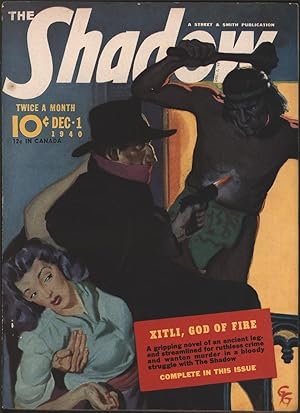
Shadow 1940 December 1.
Published by New York, 1940
Seller: Fantasy Illustrated, Silvana, WA, U.S.A.
Association Member: ABAA CBA ILAB
Seller rating 2 out of 5 stars
First Edition
Pulp. Condition: Fine. First Edition; First Printing. Shadow 1940 December 1. FN.
-

Shadow 1940 May 15. Shiwan Khan.
Published by Street & Smith, New York, 1940
Seller: Fantasy Illustrated, Silvana, WA, U.S.A.
Association Member: ABAA CBA ILAB
Seller rating 2 out of 5 stars
First Edition
Pulp. Condition: Near Fine. First Edition; First Printing. Shadow 1940 May 15. Shiwan Khan. Lite wear and surface creasing, VG/FN. ; Small 4to 9" - 11" tall.


![Seller image for [A RARE TREATISE OF THE GREEK & TURKISH SHADOW THEATRE: KARAGÖZ] O Karagiózis: Ta ainígmata tis Passopoúlas. Komodía eis práxeis treis [i.e., Karagöz: The riddles of Passopoula. Comedy in three acts]. Illustrated by Sotiris Christidis (1858-1940). for sale by Khalkedon Rare Books ABA, ILAB, IOBA, ESA](https://pictures.abebooks.com/inventory/md/md32148832906.jpg)