Order Total (1 Item Items):
Shipping Destination:

Struck Hermann, First Edition (7 results)
Skip to main search results
Search filters
Product Type
- All Product Types
- Books (6)
- Magazines & Periodicals (No further results match this refinement)
- Comics (No further results match this refinement)
- Sheet Music (No further results match this refinement)
- Art, Prints & Posters (1)
- Photographs (No further results match this refinement)
- Maps (No further results match this refinement)
- Manuscripts & Paper Collectibles (No further results match this refinement)
Condition Learn more
- New (No further results match this refinement)
- As New, Fine or Near Fine (1)
- Very Good or Good (4)
- Fair or Poor (No further results match this refinement)
- As Described (2)
Binding
Collectible Attributes
Language (2)
Price
- Any Price
- Under US$ 25 (No further results match this refinement)
- US$ 25 to US$ 50
- Over US$ 50
Free Shipping
- Free Shipping to U.S.A. (No further results match this refinement)
Seller Location
Seller Rating
-

Jacovleff and Other Artists; Alexandre Jacovleff, William Blake and Other Illustrators of Dante, Thomas Rowlandson, Aubrey Beardsley, Marcus Behmer, Arthur Rackham, Hermann Struck, Anne Goldthwaite,
Published by P. A. Struck, New York, 1946
Seller: The Second Reader Bookshop, Buffalo, NY, U.S.A.
Seller rating 5 out of 5 stars

First Edition Signed
Hardcover. Condition: Very Good. Dust Jacket Condition: Good. First Edition; First Printing. Signed by author on title page. (No inscriptions or personalizations) Very Good/Good with edgewear and chipping to Dust Jacket and no marks to text. Art history; Royal Crown Octavo; 235 pages; Signed by Author.
-
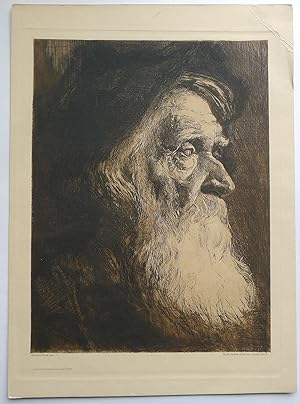
Etching by Hermann Struck. As published in Zeitschrift für bildende Kunst (1903).
Published by E.A. Seemann Verlag., 1903
Art / Print / Poster First Edition
US$ 52.60
US$ 15.46 shipping
Ships from United Kingdom to U.S.A.Quantity: 1 available
Add to basketSoft cover. Condition: Very Good. 1st Edition. An original etching image size 255 x 192cmm, sheet size 234 x 320 mm.As published in Zeitschrift für bildende Kunst. A little thumbed and creased top right margin.
-
AMERIKA - mit Reproduktionen nach zwei Radierungen und acht Lithographien von Hermann Struck
Published by Berlin: Hermann Paetel Verlag,, 1922
Seller: °ART...on paper - 20th Century Art Books, Lugano, Switzerland
Association Member: ILAB
Seller rating 5 out of 5 stars
First Edition
Hardcover. Condition: Good. 1st Edition. 8° - 156 pp. - with 10 illustrations by Hermann Struck (1875-1944) German Jewish artist known for his etchings. - 2 repr. etchings and 8 lithographs - first edition - Very good condition.
-
Gesang an Palästina mit zwölf Radierungen von Hermann Struck
Published by Berlin, Hans Heinrich Tillgner Verlag, 1922
Seller: librairie le Parnasse, Genève, CH, Switzerland
Seller rating 5 out of 5 stars
First Edition
US$ 1,771.82
US$ 57.00 shipping
Ships from Switzerland to U.S.A.Quantity: 1 available
Add to basketCouverture rigide. Condition: Bon. Edition originale. In-folio relié plein cuir bordeaux, dos à cinq nerfs, titre doré sur le plat supérieur, 27 pages, douze eaux-fortes de Hermann Struck. Un des 100 exemplaires (n° 65) sur papier à la cuve après 20 exemplaires sur Japon impérial. Plats frottés, sinon en très bonne état.
-
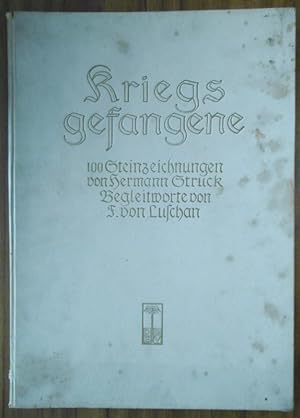
Kriegsgefangene: 100 Steinzeichnungen von Hermann Struck [SIGNED] (Prisoners of War: One hundred etchings signed by Hermann Struck)
Published by Dietrich Reimer (Ernst Vohsen), Berlin, 1916
Seller: ERIC CHAIM KLINE, BOOKSELLER (ABAA ILAB), Santa Monica, CA, U.S.A.
Seller rating 4 out of 5 stars

First Edition Signed
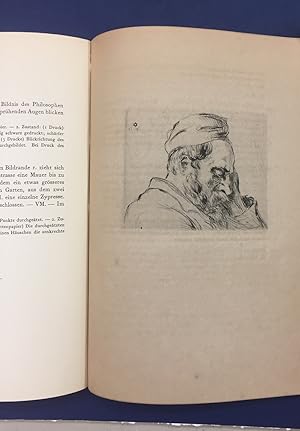
Hardcover. Condition: g- to vg. Limited First edition. 1/50. Folio (19 1/2 x 13 1/2"). [6], 28pp (Booklet), 100 loose leaves (Plates), as issued. Original full vellum portfolio with lettering and publisher's logo in gilt to front cover. Booklet's front cover gold-lettered, numbered, and hand-signed by the artist Hermann Struck*. The plates are housed in their stiff paper chemise, as issued, with printed title to front cover. In this spectacular monograph, artist Hermann Struck, who was serving in the Imperial German army as a translator, liaison officer and military artist, sketched the faces of one hundred prisoners of war in the German camps. Among the French, British, Belgian and Russian inmates were also included soldiers from the British Empire (mostly from India) as well as the French Empire (Algeria, Tunisia, Morocco, and Senegal). The prisoners' age range from 12 (Anton Matyszewski, a volunteer from Lomza, Russian Poland) to 56 (Mohammed ben Ahmed, Spahi from Djelfa, French Algeria). It is interesting to note that the Jewish prisoners were identified first by their religion, then by the place they came from (exemple: Chacus Krasikow, Jew from Lubin, Russian Poland; Isaak Chotoran, Jew from Kiev (Ukraine); Bomblatt David, Polish Jew from Warsaw, etc.). Bomblatt David is sketched twice: After Struck drew his face, he added a second sketch depicting the prisoner reading the Talmud. Each plate is handsigned in pencil by the artist. The booklet contains a foreword, and an essay on ethnology in the World War, by Prof. Dr. Felix von Luschan (1854-1924), an Austrian doctor, anthropologist, explorer, archaeologist and ethnographer who joined the German Society for Racial Hygiene in 1908. The society was an eugenic organization whose goal was "for society to return to a healthy and blooming, strong and beautiful life." As Alfred Ploetz, its founder, put it, the Nordic race was supposed to regain its "purity" through selective reproduction and sterilization. The society ceased to exist after WWI. One of 50 numbered copies, of which this is No. 30. Some foxing to portfolio, with strings missing. Minor age-toning and foxing to wrappers of booklet. 5" closed tear at lower front joint of chemise. Only plates 4 and 5 are foxed along edges (not affecting illustrations). Text in German, Gothic script (Booklet), captions of plates in German. Portfolio in overall fair to good, booklet in very good, chemise in fair to good-, plates in very good condition. * Hermann Struck (1876-1944) was a German Jewish artist known for his etchings. A fervent Zionist and Jewish activist, Struck visited the Land of Israel in 1903, displayed his art at the Fifth Zionist Congress, and was a founder of the Mizrachi Religious Zionist movement. At the same time, he was a German patriot and volunteered for military service in World War I serving as a translator, liaison officer and military artist. Hermann Struck was awarded the Iron Cross 1st Class and promoted to an officer for bravery, in 1917 he became the referent for Jewish affairs at the German Eastern Front High Command. Struck immigrated to Palestine in 1922, taught at Bezalel Academy and helped establish the Tel Aviv Museum of Art. He visited Berlin every summer until the Nazis rose to power. ** From the beginning of the war, the German authorities found themselves confronted with an unexpected influx of prisoners. In September 1914, 125,050 French soldiers and 94,000 Russian ones were held captive. Before 1915, conditions of detention in Germany were very harsh and marked by temporary lodging and the absence of infrastructure. The prisoners slept in hangars or tents, where they dug holes to keep warm. The humid forts requisitioned to serve as places of detention led to numerous cases of pulmonary illness. The German authorities also commandeered schools, barns and various other types of shelters. Camps were established in the countryside as well as near the towns, which had consequences when epidemics of cholera or typhus threatened to spread to the civilian population. Not all the camps were situated on German territory; a certain number were built in occupied territories, notably in northern and eastern France. They began to be developed starting in 1915 when the number of prisoners being held captive in Germany reached 652,000. According to official directives, each prisoner had to have use of 26.9 square foot (2.5 m ). The camps mixed a large number of nationalities sharing the same quarters: French, Russian, British, American, Canadian, Belgian, Italian, Romanian, Serbian, Montenegrin, Portuguese and Japanese prisoners were found there, as well as Greeks and Brazilians. Equally, soldiers of various social origins rubbed elbows: workers, peasants, bureaucrats and intellectuals were among those held. The number of prisoners rose very quickly. From February to August 1915, it went from 652,000 to 1,045,232. In August 1916, it reached 1,625,000, jumping to 2,415,000 by October 1918. For more information, see: Uta Hinz's "Gefangen im Großen Krieg: Kriegsgefangenschaft in Deutschland 1914-1921" (in German). Essen, Klartext Verlag (2006).
-
Kriegsgefangene. Hundert Steinzeichnungen von Hermann Struck. Mit Begleitworten von F. von Luschan. Ein Beitrag zur Völkerkunde im Weltkriege. Mit 60 Textabbildungen und 100 Original-Lithographien von Hermann Struck.
Published by Berlin, Dietrich Reimer ( Ernst Vohsen ), 1916. Seltene erste Ausgabe!, 1916
Seller: Antiquariat Carl Wegner, Berlin, B, Germany
Association Member: GIAQ
Seller rating 5 out of 5 stars
First Edition
Hardcover. Folio ( 38,5 x 28 cm). Originalleinwandband mit goldgeprägtem Reckentitel und Verlagsvignette. Der Einband unschön fleckig, Ecken und Kapitale etwas bestoßen. 3 Blätter Titelei mit Verzeichnis der Textbilder und Steinzeichnungen, 27 (+1) Seiten Vorwort mit den 60 Textabbildungen, 1 Blatt Zwischentitel, 50 Blätter mit den 100 ganzseitigen Lithos. Die Lithographien mit Legende, teilweise vorsichtig in Bleistift um die Standorte ergänzt. Im Innenbereich richtig schönes und schön sauberes Exemplar. Handschriftlicher Vorbesitzernamenszug Hans v. Mechel. Basel, Weihnachten 1917 am oberen Rand des Titelblattes. Kleiner roter Zensurstempel auf der Titelblattmitte. -- Bitte Portokosten außerhalb EU erfragen! / Please ask for postage costs outside EU! / S ' il vous plait demander des frais de port en dehors de l ' UE! // Bitte beachten Sie auch unsere Fotos! / Please also note our photos! / Veuillez noter nos photos -- Lesen Sie etwas Schönes auf einer Bank in der Frühlingssonne! Wir haben die passende Lektüre. -- Wir kaufen Ihre werthaltigen Bücher! FL1113.
-
DAS GRAPHISCHE WERK VON HERMANN STRUCK. Mit vier Originalradierungen und zahlreichen Abbildungen im Text.
Language: German
Published by Paul Cassirer, Berlin, 1911
Seller: M.POLLAK ANTIQUARIAT Est.1899, ABA, ILAB, Tel-Aviv, Israel
Seller rating 5 out of 5 stars
First Edition
Original decorative Boards. Condition: Very Good. Hermann Struck (illustrator). First Edition. 115pp. Bottom edges of binding slight rubbed, side edge with one small insignificant unevenness ( please see photo). OTHERWISE A VERY GOOD COPY. CLEAN AND FRESH INSIDE.


![Seller image for Kriegsgefangene: 100 Steinzeichnungen von Hermann Struck [SIGNED] (Prisoners of War: One hundred etchings signed by Hermann Struck) for sale by ERIC CHAIM KLINE, BOOKSELLER (ABAA ILAB)](https://pictures.abebooks.com/inventory/md/md22923094690.jpg)