
Items related to Yield Simulation for Integrated Circuits (The Springer...
Yield Simulation for Integrated Circuits (The Springer International Series in Engineering and Computer Science, 33) - Hardcover
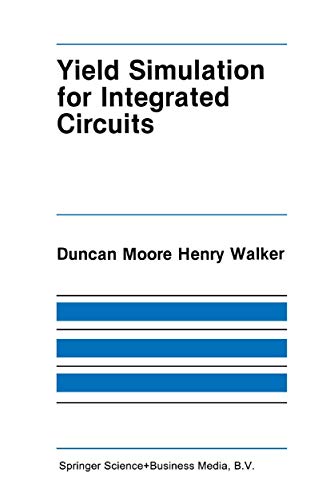
Synopsis
In the summer of 1981 I was asked to consider the possibility of manufacturing a 600,000 transistor microprocessor in 1985. It was clear that the technology would only be capable of manufacturing 100,000-200,000 transistor chips with acceptable yields. The control store ROM occupied approximately half of the chip area, so I considered adding spare rows and columns to increase ROM yield. Laser-programmed polysilicon fuses would be used to switch between good and bad circuits. Since only half the chip area would have redundancy, I was concerned that the increase in yield would not outweigh the increased costs of testing and redundancy programming. The fabrication technology did not yet exist, so I was unable to experimentally verify the benefits of redundancy. When the technology did become available, it would be too late in the development schedule to spend time running test chips. The yield analysis had to be done analytically or by simulation. Analytic yield analysis techniques did not offer sufficient accuracy for dealing with complex structures. The simulation techniques then available were very labor-intensive and seemed more suitable for redundant memories and other very regular structures [Stapper 80J. I wanted a simulator that would allow me to evaluate the yield of arbitrary redundant layouts, hence I termed such a simulator a layout or yield simulator. Since I was unable to convince anyone to build such a simulator for me, I embarked on the research myself.
"synopsis" may belong to another edition of this title.
Search results for Yield Simulation for Integrated Circuits (The Springer...

Seller Image
Yield Simulation for Integrated Circuits (Kluwer international series)
Published by
Kluwer Academic Publishers, 1987
ISBN 10: 0898382440
ISBN 13: 9780898382440
Used
Hardcover
Seller: avelibro OHG, Dinkelscherben, Germany
Seller rating 5 out of 5 stars

4°, Gebundene Ausgabe. Condition: Sehr gut. 221 Seiten Ausgetragenes Bibliotheksexemplar, Einband leicht lagerspurig, Papier in sehr gutem Zustand. B05-03-05C Sprache: Englisch Gewicht in Gramm: 509. Seller Inventory # 1873588
Buy Used
US$ 36.92
US$ 11.20 shipping
Ships from Germany to U.S.A.
Ships from Germany to U.S.A.
Quantity: 1 available
Stock Image
Yield Simulation for Integrated Circuits (The Kluwer International Series in Engineering and Computer Science)
Published by
Kluwer Academic Publishers, Lancaster, United Kingdom, 1987
ISBN 10: 0898382440
ISBN 13: 9780898382440
Used
Hardcover
First Edition
Seller: PsychoBabel & Skoob Books, Didcot, United Kingdom
Seller rating 5 out of 5 stars
Hardcover. Condition: Good. Dust Jacket Condition: No Dust Jacket. First Edition. numerous figures, softening to head of spine, scrape on the bottom of spine, front and back cover, light bump to top corners of cover, FEP is torn off, text and illustrations clean and tight. Ex-Library. Seller Inventory # 098038
Buy Used
US$ 32.61
US$ 16.57 shipping
Ships from United Kingdom to U.S.A.
Ships from United Kingdom to U.S.A.
Quantity: 1 available
Stock Image
Yield Simulation for Integrated Circuits (The Springer International Series in Engineering and Computer Science, 33)
Seller: SHIMEDIA, Brooklyn, NY, U.S.A.
Seller rating 4 out of 5 stars

Condition: New. Satisfaction Guaranteed or your money back. Seller Inventory # 0898382440
Seller Image
Yield Simulation for Integrated Circuits
Seller: GreatBookPrices, Columbia, MD, U.S.A.
Seller rating 5 out of 5 stars
Condition: New. Seller Inventory # 1689675-n
Stock Image
Yield Simulation for Integrated Circuits (The Springer International Series in Engineering and Computer Science, 33)
Seller: California Books, Miami, FL, U.S.A.
Seller rating 5 out of 5 stars
Condition: New. Seller Inventory # I-9780898382440
Seller Image
Yield Simulation for Integrated Circuits
Seller: GreatBookPrices, Columbia, MD, U.S.A.
Seller rating 5 out of 5 stars
Condition: As New. Unread book in perfect condition. Seller Inventory # 1689675
Seller Image
Yield Simulation for Integrated Circuits
Seller: GreatBookPricesUK, Woodford Green, United Kingdom
Seller rating 5 out of 5 stars
Condition: New. Seller Inventory # 1689675-n
Buy New
US$ 188.73
US$ 19.89 shipping
Ships from United Kingdom to U.S.A.
Ships from United Kingdom to U.S.A.
Quantity: Over 20 available
Seller Image
Yield Simulation for Integrated Circuits
Print on DemandSeller: BuchWeltWeit Ludwig Meier e.K., Bergisch Gladbach, Germany
Seller rating 5 out of 5 stars
Buch. Condition: Neu. This item is printed on demand - it takes 3-4 days longer - Neuware -In the summer of 1981 I was asked to consider the possibility of manufacturing a 600,000 transistor microprocessor in 1985. It was clear that the technology would only be capable of manufacturing 100,000-200,000 transistor chips with acceptable yields. The control store ROM occupied approximately half of the chip area, so I considered adding spare rows and columns to increase ROM yield. Laser-programmed polysilicon fuses would be used to switch between good and bad circuits. Since only half the chip area would have redundancy, I was concerned that the increase in yield would not outweigh the increased costs of testing and redundancy programming. The fabrication technology did not yet exist, so I was unable to experimentally verify the benefits of redundancy. When the technology did become available, it would be too late in the development schedule to spend time running test chips. The yield analysis had to be done analytically or by simulation. Analytic yield analysis techniques did not offer sufficient accuracy for dealing with complex structures. The simulation techniques then available were very labor-intensive and seemed more suitable for redundant memories and other very regular structures [Stapper 80J. I wanted a simulator that would allow me to evaluate the yield of arbitrary redundant layouts, hence I termed such a simulator a layout or yield simulator. Since I was unable to convince anyone to build such a simulator for me, I embarked on the research myself. 226 pp. Englisch. Seller Inventory # 9780898382440
Buy New
US$ 185.16
US$ 25.76 shipping
Ships from Germany to U.S.A.
Ships from Germany to U.S.A.
Quantity: 2 available
Stock Image
Yield Simulation for Integrated Circuits (The Springer International Series in Engineering and Computer Science, 33)
Seller: Ria Christie Collections, Uxbridge, United Kingdom
Seller rating 5 out of 5 stars
Condition: New. In English. Seller Inventory # ria9780898382440_new
Buy New
US$ 207.32
US$ 14.97 shipping
Ships from United Kingdom to U.S.A.
Ships from United Kingdom to U.S.A.
Quantity: Over 20 available
Seller Image
Yield Simulation for Integrated Circuits
Seller: GreatBookPricesUK, Woodford Green, United Kingdom
Seller rating 5 out of 5 stars
Condition: As New. Unread book in perfect condition. Seller Inventory # 1689675
Buy Used
US$ 208.07
US$ 19.89 shipping
Ships from United Kingdom to U.S.A.
Ships from United Kingdom to U.S.A.
Quantity: Over 20 available