

Order Total (1 Item Items):
Shipping Destination:

Callot Jacques, Signed (21 results)
Skip to main search results
Search filters
Product Type
- All Product Types
- Books (12)
- Magazines & Periodicals (No further results match this refinement)
- Comics (No further results match this refinement)
- Sheet Music (No further results match this refinement)
- Art, Prints & Posters (9)
- Photographs (No further results match this refinement)
- Maps (No further results match this refinement)
- Manuscripts & Paper Collectibles (No further results match this refinement)
Condition Learn more
- New (No further results match this refinement)
- As New, Fine or Near Fine (1)
- Very Good or Good (6)
- Fair or Poor (No further results match this refinement)
- As Described (14)
Binding
Collectible Attributes
Language (4)
Price
- Any Price
- Under US$ 25 (No further results match this refinement)
- US$ 25 to US$ 50
- Over US$ 50
Free Shipping
Seller Location
Seller Rating
-

Condition: Used: Very Good. SIGNED by Moncure Biddle with a long inscription.
-
Some Business of Affinity
Language: English
Published by Five Seasons Press, Hereford, UK, 2006
ISBN 10: 0947960392 ISBN 13: 9780947960391
First Edition Signed
Hardcover. Condition: Fine. Dust Jacket Condition: Fine. Dale Rawls, Hokkei, Dorothy Shakespear Pound, Jacques Callot, George Catlin, Enok Sweetland, et el [Illustrators] (illustrator). 1st Edition. First printing of the first edition, Translations, Reworkings, Interpretations & Responses with over 40 illustrations, 272pp. Signed by Paul Merchant directly on the title page. Book and dust jacket fine, as new condition. Signed by Author(s).
-
Jacques Callot: catalogue complet de son oeuvre dessiné [with] Supplément (1962-1998). (complete catalogue raisonné in two volumes)
Language: French
Published by De Nobele 1962-1999, Paris, 1962
ISBN 10: 2851890190 ISBN 13: 9782851890191
Seller: Cole & Contreras / Sylvan Cole Gallery, Sitges, B, Spain
Seller rating 5 out of 5 stars

First Edition Signed
Jacques Callot (illustrator). Two volumes, COMPLETE. The scarce catalogue raisonné of Callot's drawings, complete with the supplement. Folio in publisher's cloth and dustjacket (main volume). 4to in wraps (supplement). An excellent set.
-
Antique Master Print-LAST-SUPPER-SIGNED-SILVER-DESIGN-Callot-c.1700-1720
Published by c.1700-1720, 1700
Seller: Pictura Prints, Art & Books, Overasselt, Netherlands
Seller rating 5 out of 5 stars
Art / Print / Poster Signed
Jacques Callot (illustrator). 'CALLOT (SIGNED IN LOWER RIGHT)'Christ at the center of a round table with the twelve apostles seated around. Rays of divine light radiate from the haloed Christ. Likely used as a design model for devotional silver.Made by Jacques Callot after own design.Medium: Etching on hand laid (verge) paper.Sheet size: 6 x 6 cm (2.36 x 2.36 inch). Image size: 6 x 6 cm. (2.36 x 2.36 inch).JACQUES CALLOT, THE LAST SUPPER, DUTCH SILVER, DEVOTIONAL PRINT, ENGRAVING FOR SILVER, CALLOT SCHOOL, DUTCH SILVER II | PCO-E23-28BACKGROUND INFORMATIONClose to Dutch Silver II, plate 1A. Anonymous Dutch silversmith-engraver likely working in Groningen or the northern Netherlands, early 18th century. Possibly connected to the workshop of Focko Raerda.Reference: Dutch Silver II, pl. 1A; Van Rijen, Groninger Keur, p. 267; Frederiks, Dutch Silver, 195860.Biography engraver: Jacques Callot (15921635) was a French Baroque printmaker known for his detailed etchings. His style was widely emulated in 17th and 18th-century devotional prints and design plates. Condition: fair, given age. Soiling probably from use in a silver workshop. General age-related toning and/or occasional minor defects from handling. Please study scan carefully.
-
La Passion de notre Seigneur Jesus Christ. (La Petite Passion, 1624).
Published by Paris, Pasquier o. J. (um 1750)., 1750
Seller: Antiquariat Haufe & Lutz, Karlsruhe, BW, Germany
Seller rating 5 out of 5 stars
Signed
Quer-12° (10,5 x 16 cm.). Gestoch. Titel u. 12 Radierungen (Plattengr. ca. 9 x 7 cm.). Hldr. des 19. Jahrhunderts mit goldgepr. Rückenschild u. Linienvergoldung. Lieure 537-548. Meaume 19-30. - Spätere Ausgabe der "Kleinen Passion", wohl Nachstiche. - Alle Radierungen in der Platte signiert ("J. Callot") und mit gestoch. Bibelstelle. - Le Lavement des pieds. - La Chène. - Jésus au jardin des oliviers. - Jésus est livré aux Juifs. - La Condamnation à mort. - Jésus est battu de verges. - Jésus comaraît devant Caïphe. - La couronnement d'épines. - La présentation au peuple. - Le portement de croix. - Le crucifiement. - Jésus est percé d'une lance. - Einband etwas berieben, durchgehend braunfleckig, meist außerhalb der Darstellung. Sprache: französisch.
-
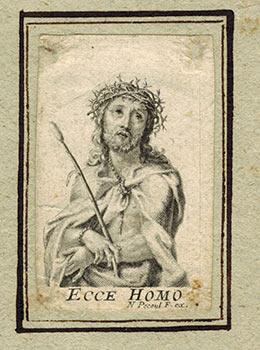
Ecce Homo
Published by 17th or 18th Century impression.
Seller: Wittenborn Art Books, San Francisco, CA, U.S.A.
Seller rating 4 out of 5 stars

Art / Print / Poster Signed
Condition: Good. Etching. 62 x 40mm sheet size. Mounted on old laid paper. Signed "N. Pecoul F. ex." beneath the image.
-
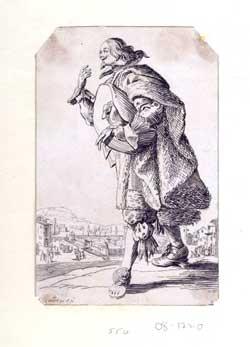
Le gentilhomme qui salue tenant son feutre sous le bras. From La Noblesse series.
Published by 17th cent.
Seller: Wittenborn Art Books, San Francisco, CA, U.S.A.
Seller rating 4 out of 5 stars
Art / Print / Poster Signed
Condition: Good. Etching. Signed Callot in et sc lower left with the number 2 lower right. 142 x 92mm. 4 corner tears. Pasted down at the corners. Lieure, no. 550.
-

Le gentilhomme aux Main jointes. From La Noblesse series.
Published by 17th cent.
Seller: Wittenborn Art Books, San Francisco, CA, U.S.A.
Seller rating 5 out of 5 stars
Art / Print / Poster Signed
Condition: Good. Etching. Signed Callot in et sc lower left with the number 1 lower right. 142 x 91 mm. 2 corner tears. Pasted down at the corners. Lieure, no. 559.
-
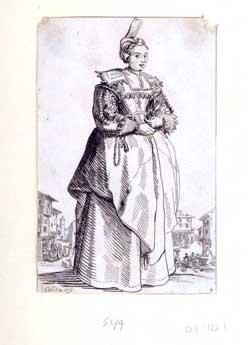
Le dame à la pettite coiffe relevée en arrière. From La Noblesse series.
Published by 17th cent.
Seller: Wittenborn Art Books, San Francisco, CA, U.S.A.
Seller rating 4 out of 5 stars
Art / Print / Poster Signed
Condition: Good. Etching. Signed Callot in et sc lower left with the number 4 lower right. 142 x 91 mm. 3 corner tears. Pasted down at the corners. Lieure, no. 549.
-
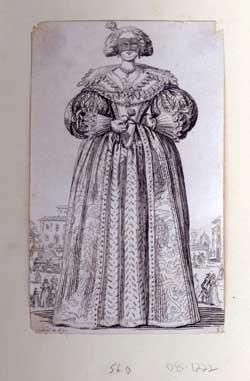
Le dame au masque. From La Noblesse series.
Published by 17th cent.
Seller: Wittenborn Art Books, San Francisco, CA, U.S.A.
Seller rating 4 out of 5 stars
Art / Print / Poster Signed
Condition: Good. Etching. Signed Callot in et sc lower left with the number 3 lower right. 142 x 91 mm. 2 corner tears. Pasted down at the corners. Lieure, no. 560.
-

Editions Karolus 1963. In-8 cartonnage éditeur, pleine toile violette, de 374 pages au format 18 x 3,5 x 23,5 cm. Couverture avec titre et motif doré. Dos rond avec titre doré. Plats et intérieur frais. Etude sur les Bohémiens avec textes, superbes illustrations et photos par Maurice Feaudièrre, dit Serge. Contient aussi trois gravures de Jacques Callot, provenant de la collection personnelle de l'auteur. Superbe état général. Edition originale. Précieux exemplaire enrichi d'une magnifique dédicace autographe signée et d'un superbe dessin original pleine page de Serge.
-
Les Miseres et les Mal-heurs de la guerre. Representez par Jacques Callot Noble Lorrain et mis en lumiere par Israel son amy.
Seller: Antiquariaat Wim de Goeij, Kalmthout, ANTW, Belgium
Association Member: ILAB
Seller rating 5 out of 5 stars
First Edition Signed
Paris, Israël, 1633, oblong album 12,8 x 23,5 cm (copperplate engraings 85 x 190 mm), engraved title and 17 engravings.(complete suite). First edition , third state . Bound in full red morocco, All edges gilt, Gilt title on the spine. Marbled end-papers, the pastedown within a gilt five fold fillet (straight lines and floral fillets). Binding signed by Chambolle-Duru. . This binder is considered the apex of French bibliophile bookbinding in the 19th century. This copy is indeed proof of the extraoridnary fine craftmanship of this bindery.famous for rebinding earlier French classical books in very handsome 19th c. bindings. Binding in perfect condition. Jacques Callot (1592-1635) was a nobleman of the county of Lorraine. He made this obtrusive suite on the horrors of war when he saw his country being invaded by the French in 1633. It became one of the most well-known anti-war statements in European art and was an inspiration for Goya's similar work, nearly 200 years later.
-
Lux claustri. La Lumiere du cloistre. Representees par figures emblematiques, dessignées & gravées par Jaques Callot. Paris, François Langlois,
Publication Date: 1646
Seller: Maggs Bros. Ltd ABA, ILAB, PBFA, London, United Kingdom
Association Member: ABA ILAB PBFA
Seller rating 5 out of 5 stars
First Edition Signed
US$ 3,747.77
US$ 35.72 shipping
Ships from United Kingdom to U.S.A.Quantity: 1 available
Add to basket27 numbered etched emblems (60 x 80mm) by Jacques Callot, the first entitled Lux Claustri with the words 'Obedientia, Paupertas, Caritas, and signed by him. 4to. 29ff. (lacks final blank). 19th century polished calf, triple gilt fillets on covers, spine gilt in compartments (upper joint and headcaps restored). First edition of this emblem book celebrating the cloistered life of the monks of the Carthusian Order and dedicated to the prior of the Paris Charterhouse, Augustine Joyeulx. The subjects are not what one would necessarily expect from a religious emblem book, they are all allegorical in nature with many from the natural world, and some supernatural, such as emblem no. 2 of the "Watchful eye". Most are set in a sparse landscape where signs of civilisation are just noticeable in the far distance which reflects the hermitic existence of the Carthusians. Each emblem has a motto and verse in French and Latin and is printed on one side of the leaf only. Jacques Callot (c. 1592-1635) was one of the outstanding etchers of the Baroque era. He was prolific as printmaker and draftsman and introduced many innovations to the etcher's art. In Florence he worked for the Medici court and after the death of Cosimo II de' Medici returned to his native Nancy where he remained for the rest of his life. His most famous work, on the cruelties of war, was Les Grandes Misères de la Guerre which influenced Goya's series on the same subject almost two centuries later. At around the same time as this publication 'Light of the Cloister', Augustine Joyeulx commissioned the baroque artist Eustache Le Sueur's (1619-55) famous series of twenty-two paintings representing the life of Saint Bruno, executed c. 1645-48, to decorate the walls of the Charterhouse's freshly renovated small cloister (almost all of them are now in the Louvre). According to Lieure the unnumbered plates had previously been published, on their own without text, just before Callot's death in 1635, in a printing described as 'extremement rare'. The printer Langlois also issued an edition of Callot's Vita Beatae Mariae Virginis Matris Dei Emblematibus delineata in the same year. The two works are Callot's only emblem books. Provenance: Armorial bookplate of René Choppin, i.e. René Amédée Choppin de Villy (1806-86), bibliophile, whose library was sold in 1920. Ex-libris Dr. Desnos. Title-page lightly soiled, blank corner of f. 1 repaired. Praz p. 294. Saunders F. 133. Kat. Berlin 4554; Landwehr Romantic 199. Lieure 599-625 (second state); E. de T. Bechtel, Jacques Callot, (1955), Hofer Baroque Book Illustration, no. 37. Bel: KL Bru, Fr BN, Ger BSB, UK BL, Glas, Bod, USA: Yale, Folger, Harvard, Princeton, LoC, Newberry, NYPL, Columbia.
-
The Martyrs of Japan
Published by [France]: 1627, 1627
Seller: Arader Galleries - AraderNYC, New York, NY, U.S.A.
Seller rating 5 out of 5 stars
First Edition Signed
1st Edition. "Single sheet, float mounted and framed (sheet size: 6 5/8 x 4 ½ inches; framed size: 11 ¾ x 9 ½ inches). Extremely fine etching of the Martyrs of Japan, with faint but visible thread lines and a watermark of an anchor, signed and identified within the plate. Provenance: With the collector's mark of Robert Hartshorne (d. 1945) on the verso (Lugt 2215b), his sale, October 1945, Parke-Bernet. First edition, first state (of 2). L. 594. M. 155. A strong impression of Callot's famous depiction of the 26 Christian martyrs of Japan, produced on the occasion of their beatification. The martyrs are displayed on crosses, their sides pierced by a lance. In the foreground on the left is a man on a horse; to the right there are soldiers sitting in the shade. In the sky, cherubim are guided by St. John the Baptist, preparing palms and crows for the martyrs. In the left corner within the plate it is signed "Callot fec." Along the bottom margin it reads, "Le Pourtraict des premier 23 Martire mis en Croix par la predicaon. de la S. foy au Giappon | soubs l'Empe Taicosam en la Cité de Mongasachi, de lordre des freres mineurs Observantin de S. Francois." "[Emperor] Toyotomi Hideyoshi (1537-90) who had unified the country [Japan] in 1587, had suddenly issued an order to expel all foreign missionaries. Because Hideyoshi formerly had shown a favorable attitude towards the Kirishitan [Japanese Christian converts], this turn in policy after he had brought the country under a unified regime came like a bolt out of the blue. The town of Nagasaki was confiscated and put under the government's direct control. The expulsion order was not strictly followed, however, it forced the missionaries to avoid activities that might catch the public eye "In 1593 the Governor of the Philippines sent a group with the Franciscan friar Pedro Baptista (1545-97) as ambassadors to Japan. They met with Hideyoshi and received permission to build a monastery in Kyoto, while they were in Japan. While he was negotiating, Baptista was busy doing missionary work claiming that the expulsion order was issued against the Society of Jesus and, therefore, did not concern the Franciscan Order. At this time the Pope in Rome acknowledged the exclusive right of the Society of Jesus to do mission work in Japan. As a consequence, a confrontation began between the Society of Jesus that was under the patronage of the Portuguese monarch and the Franciscans and other mendicant orders who were under the patronage of the Spanish monarch. "Just at that time, in 1596, the Spanish ship San Felipe on a voyage from Manila to Mexico encountered a typhoon and became stranded at Tosa, the island of Shikoku. Hideyoshi, in need of resources for his Korean adventure, seized the rich cargo of the San Felipe. However, seizure of the ship's cargo was unlawful in terms of the Japan-Spain friendship treaty concluded between Hideyoshi and Baptista. In order to turn it into a lawful action Hideyoshi renewed his order to expel the foreign missionaries in 1587 and ordered that the leaders of the Kirishitan in Kyoto and Osaka be executed. "As a consequence of this, six priests and brothers, including Baptista, together with fourteen of their helpers, were arrested in Kyoto. In Osaka three members of the Society of Jesus were arrested, and this brought the total number of those arrested to twenty-four. They had their ears cut off and were sent off to Nagasaki after they had been paraded through the streets of Kyoto, Osaka, and Sakai as a warning. On their way there they were joined by two more. They were all crucified at Nishizaka in Nagasaki, on 5 February 1597. This is known as the martyrdom of the twenty-six Japanese Saints" (Mullins, ed., pp. 10-11). Callot "was one of the first great artists to practice the graphic arts exclusively. His innovative series of prints documenting the horrors of war greatly influenced the socially conscious artists of the 19th and 20th centuries. "Callot's career was divided in". Signed by Author(s).
-
Les Combats de Cavalerie.
Published by [France], c. 1635., 1635
Seller: Arader Galleries - AraderNYC, New York, NY, U.S.A.
Seller rating 5 out of 5 stars
First Edition Signed
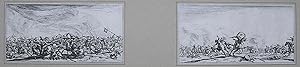
1st Edition. 2 sheets, float mounted and framed together, (sheet size: 1 ¾ x 3 5/8 inches each; framed size: 6 ¾ x 13 ¾ inches). A pair of very fine etchings showing two types of cavalry combat, signed within the plate, a nice dark impression showing faint threadlines (some pale staining). Provenance: With the collector's mark of Robert Hartshorne (d. 1945) on the verso (Lugt 2215b), his sale, October 1945, Parke-Bernet. First edition, first state. L. 1313-1314. "Les Combats de Cavalerie" is a complete set of two etchings: "Le Combat au pistolet" (combat with pistols) and "Le Combat à l'épée" (combat with swords). Usually added to the series "Exercices militaires" (L. 1320-1332). Meaume writes, "C'est dans cette pensée que Fagnani, après avoir acquis ces planches, y fit ajouter les nos. 13 et 14" (It is thought that Fagnani, after having acquired these plates, numbered them 13 and 14 [after the 12 prints in the "Exercices militaires" series]). However, there is no direct relationship between that series and these two prints, which are perhaps more closely related to the third print in the series "Grandes Misères de la Guerre," entitled "la Bataille" (the Battle, L. 1341). Callot "was one of the first great artists to practice the graphic arts exclusively. His innovative series of prints documenting the horrors of war greatly influenced the socially conscious artists of the 19th and 20th centuries. "Callot's career was divided into an Italian period (c. 1609-21) and a Lorraine (France) period (from 1621 until his death). He learned the technique of engraving under Philippe Thomassin in Rome. About 1612 he went to Florence. At that time Medici patronage expended itself almost exclusively in feste, quasi-dramatic pageants, sometimes dealing in allegorical subjects, and Callot was employed to make pictorial records of these mannered, sophisticated entertainments. He succeeded in evolving a naturalistic style while preserving the artificiality of the occasion, organizing a composition as if it were a stage setting and reducing the figures to a tiny scale, each one indicated by the fewest possible strokes. This required a very fine etching technique. His breadth of observation, his lively figure style, and his skill in assembling a large, jostling crowd secured for his etchings a lasting popular influence all over Europe. "Callot also had a genius for caricature and the grotesque. His series of plates of single or dual figures-for example, the Balli di Sfessania ("Dance of Sfessania"), the Caprices of Various Figures, and the Hunchbacks-are witty and picturesque and show a rare eye for factual detail. "With a few exceptions, the subject matter of the etchings of the Lorraine period is less frivolous, and Callot was hardly employed at all by the court at Nancy. He illustrated sacred books, made a series of plates of the Apostles, and visited Paris to etch animated maps of the sieges of La Rochelle and the Île de Ré. In his last great series of etchings, the "small" (1632) and the "large" (1633) The Miseries and Misfortunes of War, he brought his documentary genius to bear on the atrocities of the Thirty Years' War. Callot is also well known for his landscape drawings in line and wash and for his quick figure studies in chalk" (Encyclopedia Brittanica). These two dynamic pieces show incredible movement and compare favorably to the works of the best 17th-century military painters. Trimmed to the threadlines and signed within the plates. A very fine dark impression. Lieure 1313-1314. Meaume 595-596. Signed by Author(s).
-
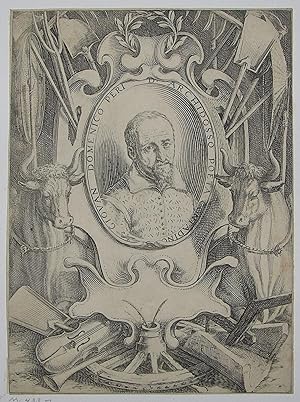
Portrait of Giovanni Domenico Peri.
Published by [France], 1620., 1620
Seller: Arader Galleries - AraderNYC, New York, NY, U.S.A.
Seller rating 5 out of 5 stars
First Edition Signed
1st Edition. Single sheet, float mounted and framed, (sheet size: 7 7/8 x 5 7/8 inches; framed size: 13 x 11 inches). Extremely fine etched portrait of Giovanni Domenico Peri, showing the threadlines, with the watermark of a winged eagle with three prominent tail feathers (a bit toned, remains of original mounting guard on the verso of the right hand edge). First edition, first and only state. L. 305. M. 433. Also known as "Le Jardinier," or The Gardener, this is a portrait of Giovanni Domenico Peri, the Italian farmer-poet. It shows him at three-quarters profile, facing slightly to the right, and bare-headed. The bust is surrounded by an oval frame topped with a laurel wreath and sitting on a rectangular base. On either side is a cow and agricultural tools above, while at the bottom there is an inkpot emerging from the center of a wagon wheel, with a violin and trumpet on the left, each of these adornments highlighting an aspect of his dual nature as both farmer and man of letters. This portrait is often found after the frontispiece of Peri's poem "Fiesole distrutta." "Giovanni Domenico Peri (c. 1590-1666) is an interesting figure who has not yet been adequately studied. According to seventeenth-century biographical sources, he received a humanist education and at first devoted himself to the arts. He also appears briefly in mid-century as director of a printing and publishing enterprise which produced sixteen titles between 1648 and 1650. This enterprise was financed by Anton Giulio Brignole Sale (1605-1665), a leading Genoese politician and intellectual, but came to an abrupt end in 1650 when Brignole Sale decided to become a Jesuit. The editions were signed with the usual formula: 'Sotto la cura/direzione di Gio. Domenico Peri,' which suggests that Peri's functions in this organization were more managerial than technical. His claim to fame rests on a work on business practices, 'Il negotiante,' of which the first volume appeared in Genoa in 1639 and the second in 1647" (Fahy, "Paper Making in Seventeenth-Century Genoa: The Account of Giovanni Domenico Peri"). Callot "was one of the first great artists to practice the graphic arts exclusively. His innovative series of prints documenting the horrors of war greatly influenced the socially conscious artists of the 19th and 20th centuries. "Callot's career was divided into an Italian period (c. 1609-21) and a Lorraine (France) period (from 1621 until his death). He learned the technique of engraving under Philippe Thomassin in Rome. About 1612 he went to Florence. At that time Medici patronage expended itself almost exclusively in feste, quasi-dramatic pageants, sometimes dealing in allegorical subjects, and Callot was employed to make pictorial records of these mannered, sophisticated entertainments. He succeeded in evolving a naturalistic style while preserving the artificiality of the occasion, organizing a composition as if it were a stage setting and reducing the figures to a tiny scale, each one indicated by the fewest possible strokes. This required a very fine etching technique. His breadth of observation, his lively figure style, and his skill in assembling a large, jostling crowd secured for his etchings a lasting popular influence all over Europe. "Callot also had a genius for caricature and the grotesque. His series of plates of single or dual figures-for example, the Balli di Sfessania ("Dance of Sfessania"), the Caprices of Various Figures, and the Hunchbacks-are witty and picturesque and show a rare eye for factual detail. "With a few exceptions, the subject matter of the etchings of the Lorraine period is less frivolous, and Callot was hardly employed at all by the court at Nancy. He illustrated sacred books, made a series of plates of the Apostles, and visited Paris to etch animated maps of the sieges of La Rochelle and the Île de Ré. In his last great series of etchings, the "small" (1632) and the "large" (1633) The Miseries and Misfortunes of War, he brought his documen. Signed by Author(s).
-
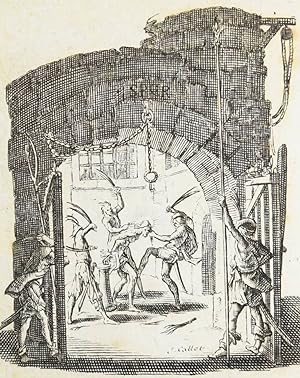
Jacques Callot 1619 Un volume, reliure d'époque, janséniste en vélin ivoire parcheminé petit in-quarto (jansenist's binding full vellum in-quarto, titre manuscrit à l'encre brune sur le dossur le dos (handwritten title on the spine), plats muets (cover without text), toutes tranches lisses (all smooth edges), orné d'une Suite de quarante et une estampes hors-texte (full page engraving), y compris le titre, gravé au burin en noir en Premier Etat par Jacques CALLOT (seul la gravure-titre est du 3ème état voir explication ci-dessous ) d'après les grands artistes florentins : frontispice, du dessin de Mathieu Rosselli, 6 de Mascagni, 2 de Pomerance, 4 de Tempeste et 1 de Fabrizio Boschi,1 de Jean Bilivert, léger manque de papier en marge et sans toucher la gravure-titre elle-même, légères taches brunes en marge sur quelques pages, petites restauration anciennes au dos de quelques gravures mais très légères, dédicace + 254 pages + les tables, 1619 Firenze P. Cecconcelli Editeur (seul la gravure titre est de 1636), Suite de quarante et une estampes, y compris le titre, gravé au burin et qui décorent le livre dont le frontispice, ci-après décrit, indique exactement le titre. Le titre n'est pas chiffré. Il port 182 mm. de haut, dont 4 de marge, sur 116 mm. de large. Les autres pièces sont chiffrées à la droite du bas, dans les marges, et comme suit : 1, 3, 5, 7, 9 etc. jusqu'à la quarantième, qui porte le nombre 79. Voici leurs dimensions :Hauteur : 130 à 139 mm., dont 16 à 22 de marge. Largeur : 78 à 83 mm.A l'exception du titre, dont les différences seront indiquées ci-après, on connaît trois états de ces planches :le premier état (le notre) est celui que nous allons décrire : il n'y a qu'un seul chiffre au bas à droite de chaque planche. Dix-huit pièces n'ont pas de texte au verso. ce sont celles qui portent les numéros 3, 17, 23, 25, 29, 33, 39, 41, 43, 53, 63, 65, 69, 71, 73, 75, 77, 79. A toutes les autres on voit du texte au verso. Dans la première édition, les figures ne sont pas placées dans l'ordre de notre description. Cela tient à ce que les numéros qu'on voit à en bas à droite de chaque estampe ne correspondent pas à l'ordre du texte qu'elles sont destinées à décorer. Ainsi après le numéro 35 on trouve le n 39 et le n 37 se trouve reporté à la page 169. Les nos 41 à 53 qui devraient se trouver après le n 39, sont plus loin dans le volume à côté du texte qui donne une ample description de chaque miracle Ce livre a pour objet de décrire les principaux miracles opérés par la vertu de l'image de Notre-Dame de l'Annonciade de Florence. Il est dédié à Christine de Lorraine, fille de Charles III et veuve de Ferdinand de Médicis, grand duc de Toscane. Le texte et les gravures ont étés composés longtemps avant leur première publication, qui a eu lieu en 1619. Le titre seul est de cette époque. Les quarante gravures qui l'accompagnent sont moins bien exécutées, et datent des premiers temps du séjour de Callot à Florence.(*) Voici ce qu'on lit dans les notes manuscrites de Mariette, fol 66 : Les principaux miracles opérés par l'intercession de l'image miraculeuse de Notre-Dame de l'Annonciade de Florence, représentés en une suite de quarante planches, sans y comprendre le frontispice ; Cette suite a été gravée au burin par J. Callot, pendant son séjour à Florence, et d'après les dessins de Mathieu Rosselli, qui en a fait la plus grande partie, et ceux d'Antoine Pomerance, frère Arsène Mascagni, Antoine Tempeste, Fabrice Boschi, Jean Bilivert et autres peintres de l'école florentine. La date de 1619 est celle de l'édition du livre ; mais il y a grande apparence qu'il y avait déjà quelques années que Callot avait gravé les planches. - Elles sont gravées au burin, d'une manière fort finie. Il y en a 19, en comptant le frontispice, du dessin de Mathieu Rosselli, 6 de Mascagni, 2 de Pomerance (qui ce nomme Antoine, ce qui est remarquable), 4 de Tempeste et 1 de Fabrizio Boschi,1 de Jean Bilivert que le père Orlandi nomme Antoine Bilive.
-
Recueil de pieuses pensées sur la Passion du Fils de Dieu
Signed
Paris : Jacques et Emmanuel Langlois, 1666. In-12, (8)-469-(3) pages et 12 planches. Veau brun de l'époque, dos à nerfs orné à la grotesque. Reliure épidermée, coiffes absentes, charnière fendues, coins fortement érodés ; les 50 premiers feuillets un peu roussis. Cachet à l'encre au titre de la bibliothèque du séminaire de Saint-Sulpice sous l'Ancien Régime ("BIBL SEM S SULP"). Rare édition, illustrée de la suite dite de "La Petite Passion" d'après Jacques Callot. Cette suite compte douze estampes gravées à l'eau-forte par Herman Weyen (actif 1638-1669) d'après Jacques Callot. Chacune est signée "Callot" et seules les deux premières ("La Cène" et "Notre Seigneur lave les pieds à ses apôtres") portent l'excudit d'Herman Weyen. L'ouvrage est dédié à "Mademoiselle de Richelieu", qui, à l'époque de la publication, doit être l'une des deux nièces de la duchesse d'Aiguillon - elle-même nièce du cardinal de Richelieu -, les s?urs Marie-Marthe (ca 1635-1665) et Marie-Thérèse Madeleine (1636-1705) de Vignerot du Plessis. L'épître dédicatoire insiste sur la piété et la dévotion de la jeune femme, des traits qui pourraient convenir à chacune des s?urs. Marie-Marthe mourut aux Carmélites en 1665, date de la première émission de cet ouvrage. Marie-Thérèse contempla à plusieurs reprises une vie de religieuse. Seuls le patronyme et la qualité de l'auteur, "Drouart, ecuyer", sont avérés. Cependant, la proximité de la dédicataire avec la duchesse d'Aiguillon nous fait penser qu'il pourrait vraisemblablement être Bertrand Drouart ou Drouard, sieur de Sommelan, qui évoluait dans le cercle de ses proches. Il fut d'abord gentilhomme ordinaire du duc Gaston d'Orléans, frère du Louis XIV. Membre avant 1636 de la Compagnie du Saint-Sacrement, il en devint supérieur, puis secrétaire à plusieurs reprises. Il passa au service de la duchesse d'Aiguillon comme directeur de ses nombreuses entreprises de charité, au point de passer pour son intendant. En 1644, il fut un des membres fondateurs de l'Hôtel-Dieu de Montréal, financé par la duchesse, et demeura sa vie durant un de ses plus zélés sociétaires. Le CCFR ne recense que trois exemplaires de la première et de la seconde émission confondues, à la BnF et à Saint-Brieuc. Parmi les deux exemplaires conservés à la BnF, l'exemplaire de la seconde émission comprend comme ici les 12 estampes de Callot, ce que n'est pas le cas pour celui de la première émission.
-
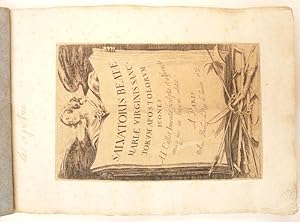
Salvatoris Beatae Mariae Virginis Sanctorvm Apostolorvm Icones. (Die Große Apostelserie) 1631/32. Folge von 16 Radierungen in einem Album. Vollständig.
Language: German
Art / Print / Poster Signed
Alle in der Platte bezeichnet "Israel excud." und "Callot fec." (6) bzw. "Cum Privilegio Regis" (10), teils mit der gestochenen Nr. Kräftige, meist gegensatzreiche Drucke. Auf festem Bütten. Mit schmalem Rändchen um die volle Plattenkante, teils auf diese geschnitten. Nach Lieure 1297 - 1312. Vorhanden sind in der Abfolge des Albums: Titelblatt (L. 1297). Christus als Welterlöser (L. 1298). Der heilige Matthäus (L. 1311). Der heilige Thomas (L. 1306). Der heilige Andreas (L. 1302). Der heilige Bartholomäus (L. 1308). Maria (L. 1299). Der heilige Jakobus d.Ä. (L. 1303, ohne die gekreuzten Schwerter auf der Hutkrempe). Johannes der Evangelist (L. 1304). Der heilige Philippus (L. 1307). Der heilige Paulus (L. 1301). Der heilige Matthias (L. 1309). Der heilige Simon (L. 1310). Der heilige Thaddäus (L. 1312). Der heilige Jakobus d.J. (L. 1305). Der heilige Petrus (L. 1300). - Die Folge erscheint 1631 bei Israel Henriet in Paris, der die Platten Callots aufgekauft hatte. Sie erinnert vom Typus her an "Die Bettler" und den "Adel von Lothringen". Wie diese sind die bildfüllenden Apostelfiguren fest konturiert gestochen und stehen nahezu ohne perspektivischen Bezug zum Hintergrund im Raum. En face oder im Dreiviertel-Profil gegeben trägt jede ihr Attribut, dahinter klein aber dramatisch bewegte Szenen aus ihrem Leben und Martyrium. Der fehlende perspektivischen Bezug zum Hintergrund und der fehlende Blickkontakt zum Betrachter unterstreichen wirkungsvoll ihre Spiritualität. - Insgesamt von guter Erhaltung, leicht gebräunt und wenige Fleckchen. Alle lose auf Bütten (ca. 22,5 x 14,7 cm) montiert, mit Fadenheftung am oberen Rand und graublauem festen Karton außen. Dekorativer Einband, recto mit Darstellung des Heiligen Petrus, Prägedruck in Blau (Weißlinientechnik) und mit Gold gefasst. Sprache: Deutsch Je ca. 14,4 x 9,3 cm (Darstellungsgröße).
-

Die Kleine Passion, um 1632. Folge von 12 Radierungen in einem Album. Vollständig.
Language: German
Art / Print / Poster Signed
Alle in der Platte bezeichnet "J. Callot" ( u.l.), mit lateinischem Titel und der Adresse von J. J. Pasquier, Paris. Klare, differenzierte Drucke auf feinem Bütten. Mit der Einfassungslinie, bzw. auf diese geschnitten. Nach Lieure 537 - 548, davon sieben gegenseitig (537-539, 541, 543-544, 548). Möglicherweise eine von sieben täuschenden, gleichseitig wie gegenseitigen Kopien, die Lieure zwar erwähnt, aber nicht näher beschreibt. - Vorhanden sind (Abfolge des Albums): Das Abendmahl (L. 538), Die Fußwaschung (L. 537), Christus am Ölberg (L. 539), Der Judaskuss (L. 540), Christus vor Kaiphas (L. 543), Die Dornenkrönung (L. 544), Die Geißelung Christi (L. 542), Darstellung vor dem Volk (L. 545), Christus vor Pilatus (L. 541), Kreuztragung (L. 546), Die Kreuzigung (L. 547), Der Stich mit der Lanze (L. 548). - "Die kleine Passion" ist ein sehr schönes Beispiel für Callots Vorliebe für minuziöse Darstellungen, in denen er besonders qualitätvoll und frei arbeitet. Noch während seiner Zeit in Florenz entstehen genaue Gesamtskizzen und vierzig Einzelskizzen zur kleinen Passion. Detailreich entwickelt er die Passionsgeschichte von der Fußwaschung bis zur Kreuzigung. Für die Mehrzahl der Szenen bilden italienische Renaissancepaläste den Hintergrund, deren Komposition an Bühnenbilder erinnert. Der Torbogen der Abendmahlszene (L. 538) zeigt in seinem Wappenschild die fünf Kugeln der Medici. Der Kopist verzichtet auf dieses italienische Element. Die von Callot geplanten Bildunterschriften (vgl. L. Bd. V, S. 50) fügt er in lateinischer Sprache hinzu. - Insgesamt gut erhalten. Partiell wenige Fleckchen. Wenige Bll. im rechten Randbereich mit Quetschspur. Jeweils lose auf Unterlageblatt (11,5 x 10 cm) montiert, am Oberrand mit Fadenheftung und blau und schwarz marmoriertem Papier außen. Minimale Läsuren. Sprache: Deutsch Je ca. 9 x 6,5 cm (Darstellungsgröße).
-
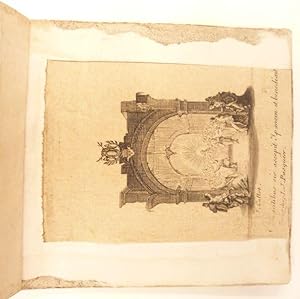
Fantasien, 1635. 12 Radierungen aus der Folge in einem Album.
Language: German
Art / Print / Poster Signed
Eines in der Platte bezeichnet "Callot", alle mit "Cum Privile Reg. Israel excudit" und mit der gestochenen Nr. Ausgezeichnete Drucke auf feinem Bütten, teils mit angeschnittenem Wasserzeichen "Bekröntes Lilienwappen" (Lieure Wasserzeichen Nr. 43). Mit Einfassungslinie, teils auf diese geschnitten. Nach Lieure 1372-1381, 1383 - 1384 (1382 und 1385 fehlen). Abweichend von Lieure mit der gestochenen Nr. o.l. und alle mit Einfassungslinie. - Vorhanden sind in der Abfolge des Album: Titelblatt (L. 1372), Eine Dame mit gerafftem Rock und zwei Kavalieren (L. 1373), Eine musizierende Dame und zwei Kavaliere (L. 1375), Eine Dame im langen Mantel und zwei Kavaliere (L. 1383), Drei Kavaliere (L. 1377), Die Dame mit dem großen Federhut und zwei Kavaliere (L. 1378), Eine Dame mit Federhut und zwei Kavaliere (L. 1374), Eine Dame mit Federhut und zwei Kavaliere (L. 1384), Eine Dame mit untergeschlagenen Armen (L. 1381), Eine Dame im reichen Faltenkleid, von hinten gesehen, und zwei Kavaliere (L. 1379), Eine Dame mit ausgestreckter Hand, von hinten gesehen, und zwei Kavaliere (L. 1380), Eine Dame mit ausgestreckter Hand und zwei Kavaliere (L. 1376). - Die Folge "Fantasien" erschien im Todesjahr Callots. Winzige Damen und Herren, in Kostümen, wie sie am Hof Ludwig XIII. Mode waren, sind zentral und symmetrisch im leeren Raum angeordnet. Mit fein geführter Nadel entstehen ausdrucksstarke Figuren. Sie werden, wegen ihrer Eleganz und Grazie, oft mit den, ein halbes Jahrhundert später entstandenen Figuren des Rokokomalers Watteau verglichen. Die Folge ist einmal mehr ist ein Beleg für Callots herausragende künstlerische Bedeutung. - Insgesamt von guter Erhaltung. Leicht gebräunt, kleine Quetschfalten. Alle lose auf Unterlageblatt (ca. 9,5 x 10,2 cm) montiert, am Oberrand mit Fadenheftung und mit blau, gelb und schwarz marmoriertem Büttenpapier außen. Berieben und mit leichten Randläsuren. Das Papier, auf dem die vorliegende Kopie gedruckt wurde, trägt dasselbe Wasserzeichen wie das Papier der Originalabzüge. Diese Besonderheit kommt bei Callot Kopien mehrfach vor (vgl. L. Bd. I, S. 102). Sprache: Deutsch Je ca. 6,1 x 8,2 cm (Darstellungsgröße).

![Seller image for Jacques Callot: catalogue complet de son oeuvre dessiné [with] Supplément (1962-1998). (complete catalogue raisonné in two volumes) for sale by Cole & Contreras / Sylvan Cole Gallery](https://pictures.abebooks.com/inventory/md/md32181081803.jpg)




![Seller image for SCELTA D'ALCUNI MIRACOLI E GRAZIE GRAZIE DELLA SANTISSIMA NUNZIATA DI FIRENZE, descritti dal P. F. Gio. Angiolo Lottini (Miracles opérés par l'intercession de Notre Dame de l'Annonciade de Florence) [CALLOT Jacques] for sale by Librairie Guimard](https://pictures.abebooks.com/inventory/md/md780659434.jpg)


