Order Total (1 Item Items):
Shipping Destination:

French Armorial (2 results)
Skip to main search results
Search filters
Product Type
- All Product Types
- Books (2)
- Magazines & Periodicals (No further results match this refinement)
- Comics (No further results match this refinement)
- Sheet Music (No further results match this refinement)
- Art, Prints & Posters (No further results match this refinement)
- Photographs (No further results match this refinement)
- Maps (No further results match this refinement)
- Manuscripts & Paper Collectibles (No further results match this refinement)
Condition Learn more
- New (No further results match this refinement)
- As New, Fine or Near Fine (No further results match this refinement)
- Very Good or Good (No further results match this refinement)
- Fair or Poor (No further results match this refinement)
- As Described (2)
Binding
- All Bindings
- Hardcover (No further results match this refinement)
- Softcover (No further results match this refinement)
Collectible Attributes
- First Edition (2)
- Signed (No further results match this refinement)
- Dust Jacket (No further results match this refinement)
- Seller-Supplied Images (2)
- Not Print on Demand (2)
Language (1)
Price
- Any Price
- Under US$ 25 (No further results match this refinement)
- US$ 25 to US$ 50 (No further results match this refinement)
- Over US$ 50
Free Shipping
- Free Shipping to U.S.A. (No further results match this refinement)
Seller Location
Seller Rating
-
L'Office de la quinzaine de Pasque, Latin-François, a l'usage de Rome et de Paris, pour la maison de monsigneur le duc d'Orleans, premier prince du sang.
Published by Paris: d'Houry, seul imprimeur-libraire de monseigneur le Duc d'Orleans, 1755, 1755
Seller: Peter Harrington. ABA/ ILAB., London, United Kingdom
Association Member: ABA ILAB PBFA
Seller rating 5 out of 5 stars

First Edition
US$ 2,748.20
US$ 29.35 shipping
Ships from United Kingdom to U.S.A.Quantity: 1 available
Add to basketA beautiful copy of the Easter liturgy for the year 1755, printed and finely bound in Paris for the House of Orléans. The covers bear the arms of Louis-Philippe I (1725-1785), Duke of Orléans, Valois, and Montpensie, premier prince du sang, and grandfather of Louis-Philippe I, the last king of France. Editions of the Easter liturgy were produced every year and printed by d'Houry, the official printer to the duke of Orléans. Copies in fine bindings such as this, bearing the arms of the current duke, were destined for members of the family and court and to faithful subjects. The binding was very likely made by Jean-Charles-Henri LeMonnier le jeune, who is documented as bookbinder to the duke of Orléans from 1759. The LeMonniers were one of the most famous families of bookbinders of the period. Henry le jeune, son of Jean-Charles senior, "lived with his father in the Rue Saint-Jean-de-Beauvais, probably sharing his atelier and his tools, and it is difficult to distinguish their work. The bindings for the duke of Orléans and his family are most probably the work of le jeune" (Foot, p. 199). Mirjam M. Foot, The Henry Davis Gift I, 1978. Stamp: close to OHR 2572, no. 1; Guigard attributes it to Philippe-Égalité, see p. 39. Octavo (193 x 122 mm). Copper-engraved frontispiece. Contemporary red morocco, spine with raised bands, lettering in second compartment, other compartments framed in gilt with floral corner pieces and armorial centrepieces, covers bordered with gilt fillets and two fleur-de-lis rolls, gilt armorial centrepieces of Louis Philippe I, Duke of Orléans, board edges and turn-ins tooled in gilt, marbled endpapers, edges gilt. Small printed illustration of a fly, hand-coloured, loosely inserted. Binding sometime skilfully polished, a little wear to corners, front inner hinge split, but firm, faint small damp stain to lower margin of a couple of gatherings. A handsomely bound copy.
-
THE PILOT
Published by L. Daubry, Paris, 1825
Seller: Phillip J. Pirages Rare Books (ABAA), McMinnville, OR, U.S.A.
Seller rating 3 out of 5 stars

First Edition
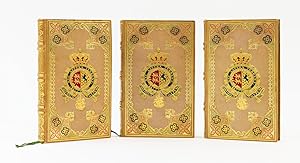
First French Edition (text in English). 170 x 103 mm. (6 3/4 x 4"). Three volumes. REGAL CONTEMPORARY BEIGE MOROCCO, GILT AND INLAID, covers with gilt frame and inlaid cornerpieces of pink and burgundy morocco in floral designs, ARMS OF WILLIAM, DUKE OF BRUNSWICK, at center, inlaid in red and green morocco and lavishly gilt, raised bands, spine panels with graceful design of flowers and acanthus leaves, gilt lettering, gilt-ruled turn-ins, all edges gilt. Front pastedowns with bookplate of Wilhelm, Herzog zu Braunschweig, printed in colors and embossed with gilt; title pages with ink stamp "Prinz von Braunschweig." âSpines darkened to tan, head panels with traces of brown residue, possibly from library labels, boards faintly soiled at edges, but A FINE SET with no signs of use, inside or out. This is an exceptionally fine copy, with distinguished provenance, of the first Paris printing of a nautical adventure by a great American writer who enjoyed unusual popularity in France. Set during the American Revolution and first printed in 1823, "The Pilot" has for its protagonist a real-life American naval hero, John Paul Jones. Cooper (1789-1851) had himself worked as a commercial seaman and served in the U.S. Navy, and his firsthand knowledge of both the technical aspects of seamanship and the day-to-day realities of life at sea lend a ring of authenticity to his sea novels, of which this was the first. According to Encyclopedia Americana, "Cooper may be said in 'The Pilot' to have created a new literary type, the tale of adventure on the sea . . . . Smollett had already discovered the racy humors of seamen, but he had seen little else in their calling; it remained for Cooper to capture for fiction the mystery and beauty, the shock and thrill, of the sea, which in his pages has much of the proud pomp of Byron's ocean." Cooper spent the years 1826-28 in Paris, where his literary reputation gained him access to the best salons, and where he became a close friend of the marquis de Lafayette. Given the ornate decoration and the quality of materials and execution, this binding was very likely done by a Parisian workshop as a commission for Duke William of Brunswick-Lüneburg (1806-84), the last member of his family to rule the duchy of Brunswick. Although he was the ruler of the Duchy of Brunswick for more than 50 years, he preferred to spend his time enjoying the life of an aristocrat and left most of the official business to his ministers. He also failed to produce a legitimate heir (though he had a number of illegitimate children), and ended the House of Brunswick's rule over the duchy.