

Order Total (1 Item Items):
Shipping Destination:

French Print (6 results)
Skip to main search results
Search filters
Product Type
- All Product Types
- Books (3)
- Magazines & Periodicals (2)
- Comics (No further results match this refinement)
- Sheet Music (No further results match this refinement)
- Art, Prints & Posters (No further results match this refinement)
- Photographs (No further results match this refinement)
- Maps (No further results match this refinement)
- Manuscripts & Paper Collectibles (1)
Condition Learn more
- New (No further results match this refinement)
- As New, Fine or Near Fine (No further results match this refinement)
- Very Good or Good (3)
- Fair or Poor (No further results match this refinement)
- As Described (3)
Binding
Collectible Attributes
- First Edition (No further results match this refinement)
- Signed (No further results match this refinement)
- Dust Jacket (No further results match this refinement)
- Seller-Supplied Images (6)
- Not Print on Demand (6)
Language (1)
Free Shipping
- Free Shipping to U.S.A. (No further results match this refinement)
Seller Location
Seller Rating
-

Labour Research July, 1958 / Big Changes In Coal / French Dairy: Spring 1958 / Dockers Want More Pay / After the Busmens' Victory/ Profits In Print / Widows & Children Last
Published by L.R.D. (Publications) Ltd, 1958
Magazine / Periodical
Soft cover. Condition: Very Good. 16 pages. Big Changes In Coal / French Dairy: Spring 1958 / Dockers Want More Pay / After the Busmens' Victory/ Profits In Print / Widows & Children Last (SL#96).
-
US$ 13.89
US$ 14.83 shipping
Ships from United Kingdom to U.S.A.Quantity: 1 available
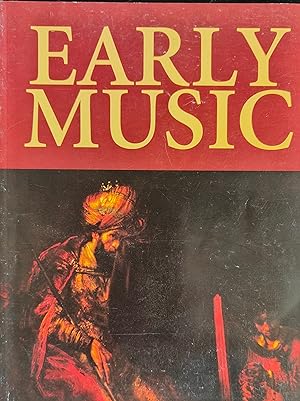
Add to basketSoft cover. Condition: Very Good. 168 pages. Illustrated. Ruth Smith "Early music's dramatic significance in Handel's Saul" / Naomi J Barker "Un-discarded images: illustrations of antique musical instruments in 17th and 18th-century books, their sources and transmission" / Christopher Macklin "Approaches to the use of iconography in historical reconstruction, and the curious case of Renaissance Welsh harp technique" / Jane A Bernstein "Publish or perish? Palestrina and print culture in 16th-century Italy" / DonFader "Philippe II of d'Orleans's 'chanteurs italiens', the Italian cantata and the gouts-reunis under Louis XIV" / Alexandro Vera "Santiago de Murcia's Cifras Selectas de Guitarra (1722): a new source for the Baroque guitar" / Graham Pont "French overtures at the keyboard: the Handel tradition".
-
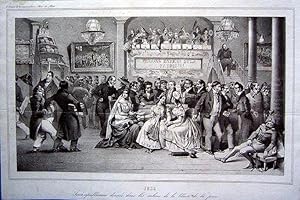
Loiree Republicaine Donnee Dans Les Salons. De La Liberte De La Press (Lithograph)
Published by Mois De Mars 1834, 1834
No Binding. Condition: Good. This is a French print title: "Loiree Republicaine Donnee Dans Les Salons De La Liberte De La Press. Print'; at top text reads " 8th Dessin de la souscrition, Mois de Mars"; paper size: 13-3/4 x 9-1/2, image size: 12 x 7in; the print is to a blue piece of paper which is attached to matt; a little foxing to edges of the print, invisible crease thru middle; otherwise in GOOD COND.
-
[AN ALBUM CONTAINING 38 COPPER PLATES, 32 FROM THE SERIES "BEGGARS" AND THE OTHERS OF RICHLY DRESSED KNIGHTS] DIE BETTLER
Published by France Privately Printed 1622-1623, 1623
Seller: Buddenbrooks, Inc., Newburyport, MA, U.S.A.
Association Member: ABAA ILAB SNEAB
Seller rating 5 out of 5 stars

First of the Edition. With a description in Italian penned to the inside wrapper and a collation and description on two pages in German for each of the plates, additional ephemeral items depicting other Callot engravings slipped into the volume. With 38 copper plates, 32 of beggars and 6 of knights in fine dress. Small Folio 215 x 167 mm. a large copy, the collection bound into old cloth covered flexible boards, hand written title to the tipped on plate at the cover. 38 pp. A very fine survival, all the plates in very pleasing condition. FIRST OF THE EDITION. The notes in Italian written at the front of the volume describe the work slightly differently, calling the engravings original figures of hunchbacks and cripples while the notes and collation done in German refer to the work as Die Bettler, the Beggars, as it has been known through history. The 38 figures in this book were copied from the originals, as can be seen below in figure 34, in which it is written "In Bas. no p. il Remondini". Jacques Callot]; c. 1592 1635) was a baroque printmaker and draftsman from the Duchy of Lorraine[. He is an important person in the development of the old master print, having made more than 1,400 etchings that chronicled the life of his period, featuring soldiers, clowns, drunkards, Gypsies, beggars, as well as court life. He also etched many religious and military images, and many prints featured extensive landscapes in their background. Callot was born and died in Nancy, the capital of Lorraine, now in France. He came from an important family (his father was master of ceremonies at the court of the Duke), and he often describes himself as having noble status in the inscriptions to his prints. At the age of fifteen he was apprenticed to a goldsmith, but soon afterward travelled to Rome where he learned engraving from an expatriate Frenchman, Philippe Thomassin. He probably then studied etching with Antonio Tempesta in Florence, where he lived from 1612 to 1621. More than 2,000 preparatory drawings and studies for prints survive, but no paintings by him are known, and he probably never trained as a painter. During his period in Florence he became an independent master, and worked often for the Medici court. After the death of Cosimo II de' Medici during 1621, he returned to Nancy where he lived for the rest of his life, visiting Paris and the Netherlands later during the decade. He was commissioned by the courts of Lorraine, France and Spain, and by publishers, mostly in Paris. Although he remained in Nancy, his prints were distributed widely through Europe; Rembrandt was a keen collector of them. His technique was exceptional, and was helped by important technical advances he made. He developed the échoppe, a type of etching-needle with a slanting oval section at the end, which enabled etchers to create a swelling line, as engravers were able to do. He also seems to have been responsible for an improved recipe for the etching ground that coated the plate and was removed to form the image, using lute-makers varnish rather than a wax-based formula. This enabled lines to be etched more deeply, prolonging the life of the plate in printing, and also greatly reducing the risk of "foul-biting", such that acid gets through the ground to the plate where it is not intended to, producing spots or blotches on the image. Previously the risk of foul-biting had always been present, preventing an engraver from investing too much time on a single plate that risked being ruined by foul-biting. Now etchers could do the very detailed work that was previously the monopoly of engravers, and Callot made good use of the new possibilities. He also made more extensive and sophisticated use of multiple "stoppings-out" than previous etchers had done. This is the technique of letting the acid dissolve lightly over the whole plate, then stopping-out those parts of the work which the artist wishes to keep shallow by covering them with ground before bathing the plate in acid again. He achieved unprecedented subtlety in effects of distance and light and shade by careful control of this process. Most of his prints were relatively small as much as about six inches or 15 cm on their longest dimension. One of his devotees, the Parisian Abraham Bosse spread Callot's innovations all over Europe with the first published manual of etching, which was translated into Italian, Dutch, German and English.
-

Autograph letter signed.
Published by N. p. o. d.
Seller: Antiquariat INLIBRIS Gilhofer Nfg. GmbH, Vienna, A, Austria
Association Member: ILAB VDA VDAO
Seller rating 5 out of 5 stars
Manuscript / Paper Collectible
Large 8vo. 1 p. To the French actor and director Sacha Guitry, probably concerning a commission for Guitry's art collection. Rouault cynically - and somewhat cryptically - remarks that "the taboo, as some of my contemporaries are wont to underline, is not to paint flowers unless in a somewhat decorative manner". He announces that his daughter will explain to Guitry "what is possible considering the current retrospective" and Rouault's ill health: "Considérez que le maudit comme le soulignaient parfois certains de mes contemporains n'est pas peintre de fleurs sinon quelque peu décoratives cependant ma fille - vous expliquera mieux que moi avec cette retrospective actuelle et mon état de santé ce qu'il est possible de faire. En vous souhaitant meilleur état de santé je vous prie [.]". - No direct connection between Rouault and Guitry is known, but Guitry was an avid collector of modern art. - With collector's number in pencil. Well preserved.
-
Il voudrait abbattre ce qui les soutient. Si vous avez peur des Feuilles n'attaquez pas le Corp de l'Arbre; Le Pied est bon mais la Cime n'est pas de meme; La multitude des Branches derange leur ambition.
Published by Valencienne and Brussels, J.B. Terry, []., 1789
Seller: Susanne Schulz-Falster Rare Books ABA, Woodstock, United Kingdom
Seller rating 5 out of 5 stars
US$ 1,041.46
US$ 26.96 shipping
Ships from United Kingdom to U.S.A.Quantity: 1 available
Add to basketSingle sheet, etching and aquatint in brown ink, (312 x 430 mm) platemark; a fine etching in three sections. A visual satire on the remonstrances against abuses. The print shows, on the far left, Louis XVI sitting on a throne on a raised pedestal with Necker at the base, holding balance scales and appealing for justice. In the centre, the clergy, the parliament, and the nobility are attempting to pull over a tree filled with members of the Third Estate; Necker stands at the base supporting the tree. On the far right, Louis XVI and Jacques Necker are helping a female figure, representing France, to her feet. The 'tree' of the Third Estate is attacked by assorted clergy and aristocrats, who attempt to pull it down with ropes, but supported by Necker and the King. de Vinck, 1381; OCLC: Library of Congress; Stanford, Bibliothèque Nationale.


![Seller image for [AN ALBUM CONTAINING 38 COPPER PLATES, 32 FROM THE SERIES "BEGGARS" AND THE OTHERS OF RICHLY DRESSED KNIGHTS] DIE BETTLER for sale by Buddenbrooks, Inc.](https://pictures.abebooks.com/inventory/md/md31412317321.jpg)
