

Order Total (1 Item Items):
Shipping Destination:

Wien Willy (25 results)
Skip to main search results
Search filters
Product Type
- All Product Types
- Books (24)
- Magazines & Periodicals (No further results match this refinement)
- Comics (No further results match this refinement)
- Sheet Music (No further results match this refinement)
- Art, Prints & Posters (No further results match this refinement)
- Photographs (No further results match this refinement)
- Maps (No further results match this refinement)
- Manuscripts & Paper Collectibles (1)
Condition Learn more
- New (No further results match this refinement)
- As New, Fine or Near Fine (2)
- Very Good or Good (7)
- Fair or Poor (No further results match this refinement)
- As Described (16)
Binding
Collectible Attributes
- First Edition (8)
- Signed (4)
- Dust Jacket (No further results match this refinement)
- Seller-Supplied Images (14)
- Not Print on Demand (25)
Language (2)
Free Shipping
Seller Location
Seller Rating
-
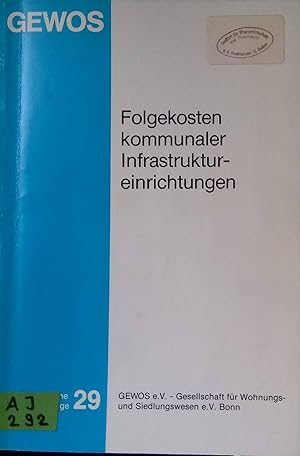
Folgekosten kommunaler Infrastruktureinrichtungen : Dokumentation des GEWOS-Fachgespräches am 9. Okt. 1979 im Hause des Verbandes norddeutscher Wohnungsunternehmen e.V. Hamburg. GEWOS-Schriftenreihe, N. F. 29.
Language: German
Published by Hammonia Verlag;, 1979
Seller: books4less (Versandantiquariat Petra Gros GmbH & Co. KG), Welling, Germany
Seller rating 5 out of 5 stars

Broschiert. Condition: Gut. 66 Seiten; Der Erhaltungszustand des hier angebotenen Werks ist trotz seiner Bibliotheksnutzung sehr sauber. Es befindet sich neben dem Rückenschild lediglich ein Bibliotheksstempel im Buch; ordnungsgemäß entwidmet. Sprache: Deutsch Gewicht in Gramm: 150.
-

I Geschichtsphilosophie und Geschichtsunterricht II Zur Praxis des Geschichtsunterrichtes in Preussen, Bayern, Sachsen und Österreich
Published by Leipzig - Wien Franz Deuticke 1927, 1927
Seller: Versandantiquariat Peter Kardos, Zürich, Switzerland
Association Member: ILAB VEBUKU
Seller rating 4 out of 5 stars

Erstausgabe 4° 1 Blatt, VIII + 290 Seiten, 1 Blatt Halbleineneinband der Zeit mit schönem Marmorpapierüberzug, mit goldbeschriftetem Rücken Bleistiftnotizen, sonst gutes, sauberes Exemplar Handbuch für den Geschichtslehrer. Unter Mitarbeit von Otto Bauer, Bielefeld; Wilhelm Ensslin, Marburg a.d.L.; Fritz Hartung, Berlin; Oskar Kende, Wien; Walter Kolbe, Freiburg i.B.; Hans Loewe, München; Willy Moog, Braunschweig; Bernhard Schmeidler, Erlangen; Hellmuth Schmidt-Breitung, Meissen; Fedor Schneider, Frankfurt a.M. herausgegeben von Oskar Kende, Wien. Bd.1.
-
UEBER DIE GESTALT DER MEERESWELLEN
Publication Date: 1895
Seller: Xerxes Fine and Rare Books and Documents, Glen Head, NY, U.S.A.
Seller rating 5 out of 5 stars
First Edition
Condition: VG. 1895 first edition. Sitzungsberichte der Konig. reussischen Akad. der Wissen. zu Berlin. XVIII. Original orange printed octavo wraps. 20p. VG folded in half. Wien was awarded the Nobel in Physics in 1911 .
-

Oberstleutnant, Tanzschulbesitzer und Anstandslehrer.
Published by 2 eigenh. Postkarten m.U., Wien 11. IV. 1933 und "Feldpost" 09.11.1939., 1939
Seller: Antiquariat MEINDL & SULZMANN OG, Wien - Vienna, Austria
Seller rating 5 out of 5 stars
Qu.-Kl.-8° (guter Zustand). An Frau Trude Prassée in Wien IX, der er 1. dankt und die Grüße erwidert (Karte mit Ansicht des Palais Pallavicini), 2. "aus weiter Ferne [als Rittmeister] recht viele liebe Grüße" sendet mit dem Nachsatz: "Ich gedenke immer gerne an die gemeinsamen Zeiten!". - Bis zum Beginn des Ersten Weltkriegs war Elmayer-Vestenbrugg einer der erfolgreichsten Reiter des k. u. k. Reitlehrerinstituts und errang zahlreiche Preise. Am 19. November 1919 eröffnete er eine Tanzschule im Palais Pallavicini (1, Josefsplatz 5), die sich nach anfänglichen Schwierigkeiten größter Beliebtheit erfreute.In der Zwischenkriegszeit etablierte sich Elmayer-Vestenbrugg als führender Tanz- und Anstandslehrer und konnte in Berlin ein Zweiginstitut errichten; 1935 wurde er mit dem Arrangement des "Balls der Stadt Wien" beauftragt, der zu einem glänzenden Erfolg wurde. Er nahm am Zweiten Weltkrieg teil und wurde 1945 als Oberstleutnant abgerüstet.
-

Kleines Albumblatt in Tinte mit Datum Dez. 1925 eigenhändig signiert - mit Repro-Porträtfoto unter dunkelgrünes Passepartout (4 to) gerahmt (dito zum gleichen Preis : Autogrammkarte in 8° mit aufgezogenem, schönem Rollenfoto, mit Datum "Mai 1905" eigenhändig signiert).
-

Albumblatt (1 S. kl. 8° quer, etwas stockfleckig) in Tinte mit Datum 9.6.1899 eigenhändig signiert Rückseitig gleichartiger Eintrag mit Ort, Datum, Unterschrift signiert von KARL GRENGG (1851-1914, österreichischer Baß). DAZU : Original-Fotoporträtpostkarte der Zeit (phot. Pietzner) von Willy Hesch in einer Rolle.
-
"Ueber die Energievertheilung im Emissionsspectrum eines schwarzen Körpers" in Annalen der Physik.
Published by ‎Leipzig, Johann Ambrosius Barth, 1896
Seller: JF Ptak Science Books, Hendersonville, NC, U.S.A.
Seller rating 5 out of 5 stars
Hardcover. Condition: Good. WIEN, Willy. "Ueber die Energievertheilung im Emissionsspectrum eines schwarzen Körpers" in Annalen der Physik, Leipzig, Johann Ambrosius Barth, 1896, volume 58; viii,776, xvi pp, six folding plates, with the Wien on pp. 662-669. Bound in contemporary paper-covered boards, with hand-lettered labels, library stamps on spine, with several discrete older library rubber stamps on the title page. [Wien's Displacement Law, though the term displacement law (Verschiebungsgesetz) was coined by Otto Lummer and Ernst Pringsheim in 1899. ] [++] Also bound in this volume are two significant papers by Wilhelm OSTWALD, "Zur Energetik", pp 154-167; and with Ludwig BOLTZMANN, "Zur Energetik", pp. 595-598.Also in this volume are:. Also with: WIEN, W. "Uber die auf einer schweren Flüssigkeit möglichen Wellen von sehr Höhe", pp. 729-735; Rydberg, J.J., "Die Neuen Grundstoffe des Cleveïtgases" pp. 674-679; KOHLRAUSCH, F. "Ueber Widerstandsmessungen von Electrolyten mit Wechselströmen durch das Dynamometer", pp. 514-516. GOOD+ copy. [++] "Wien also published, in 1896 [the paper offered here], the theoretical derivation of a law of the energy distribution of the radiation, which differs only slightly from the currently accepted Planck law."--Complete DSB online. [++] "Wien s law, also called Wien s displacement law, relationship between the temperature of a blackbody (an ideal substance that emits and absorbs all frequencies of light) and the wavelength at which it emits the most light. It is named after German physicist Wilhelm Wien, who received the Nobel Prize for Physics in 1911 for discovering the law. Wien studied the wavelength or frequency distribution of blackbody radiation in the 1890s. It was his idea to use as a good approximation for the ideal blackbody an oven with a small hole. Any radiation that enters the small hole is scattered and reflected from the inner walls of the oven so often that nearly all incoming radiation is absorbed and the chance of some of it finding its way out of the hole again can be made exceedingly small. The radiation coming out of this hole is then very close to the equilibrium blackbody electromagnetic radiation corresponding to the oven temperature."--Encyclopedia Britannica [++] "In 1894 [Wien] published a paper on temperature and the entropy of radiation, in which the terms temperature and entropy were extended to radiation in empty space. In this work he was led to define an ideal body, which he called the black body, which completely absorbs all radiations. In 1896 he published the formula of Wien, which was the result of work undertaken to find a formula for the composition of the radiation of such a black body. Later it was proved that this formula is valid only for the short waves, but Wien s work enabled Max Planck to resolve the problem of radiation in thermal equilibrium by means of quantum physics. For this work Wien was awarded the Nobel Prize for Physics for 1911. An interesting point about it is that this theoretical work came from an Institute devoted to technical problems and it led to new techniques for illumination and the measurement of high temperatures."--Nobelprize org [++] See Magie, A Source Book in Pjhysics, A Source Book in Physics, pp. 597-600. [++] "Wien's displacement law states that the black-body radiation curve for different temperatures will peak at different wavelengths that are inversely proportional to the temperature. The shift of that peak is a direct consequence of the Planck radiation law, which describes the spectral brightness of black-body radiation as a function of wavelength at any given temperature. However, it had been discovered by Wilhelm Wien several years before Max Planck developed that more general equation, and describes the entire shift of the spectrum of black-body radiation toward shorter wavelengths as temperature increases." Eric Weisstein site.
-
"Ueber die Energievertheilung im Emissionsspectrum eines schwarzen Körpers" in Annalen der Physik.
Published by Leipzig, Johann Ambrosius Barth, 1896
Seller: JF Ptak Science Books, Hendersonville, NC, U.S.A.
Seller rating 5 out of 5 stars
Hardcover. Condition: Fine. WIEN, Willy. "Ueber die Energievertheilung im Emissionsspectrum eines schwarzen Körpers" in Annalen der Physik, Leipzig, Johann Ambrosius Barth, 1896, volume 58; viii,776, xvi pp, six folding plates, with the Wien on pp. 662-669. Newly rebound in half-calf and (antiqued) marbled boards. Very strong, crisp, bright copy in a lovely binding. [++] [Wien's Displacement Law, though the term displacement law (Verschiebungsgesetz) was coined by Otto Lummer and Ernst Pringsheim in 1899. ] [++] Also bound in this volume are two significant papers by Wilhelm OSTWALD, "Zur Energetik", pp 154-167; and with Ludwig BOLTZMANN, "Zur Energetik", pp. 595-598. Also in this volume are:. Also with: WIEN, W. "Uber die auf einer schweren Flüssigkeit möglichen Wellen von sehr Höhe", pp. 729-735; Rydberg, J.J., "Die Neuen Grundstoffe des Cleveïtgases" pp. 674-679; KOHLRAUSCH, F. "Ueber Widerstandsmessungen von Electrolyten mit Wechselströmen durch das Dynamometer", pp. 514-516. FINE copy. [++] "Wien also published, in 1896 [the paper offered here], the theoretical derivation of a law of the energy distribution of the radiation, which differs only slightly from the currently accepted Planck law."--Complete DSB online. [++] "Wien s law, also called Wien s displacement law, relationship between the temperature of a blackbody (an ideal substance that emits and absorbs all frequencies of light) and the wavelength at which it emits the most light. It is named after German physicist Wilhelm Wien, who received the Nobel Prize for Physics in 1911 for discovering the law. Wien studied the wavelength or frequency distribution of blackbody radiation in the 1890s. It was his idea to use as a good approximation for the ideal blackbody an oven with a small hole. Any radiation that enters the small hole is scattered and reflected from the inner walls of the oven so often that nearly all incoming radiation is absorbed and the chance of some of it finding its way out of the hole again can be made exceedingly small. The radiation coming out of this hole is then very close to the equilibrium blackbody electromagnetic radiation corresponding to the oven temperature."--Encyclopedia Britannica [++] "In 1894 [Wien] published a paper on temperature and the entropy of radiation, in which the terms temperature and entropy were extended to radiation in empty space. In this work he was led to define an ideal body, which he called the black body, which completely absorbs all radiations. In 1896 he published the formula of Wien, which was the result of work undertaken to find a formula for the composition of the radiation of such a black body. Later it was proved that this formula is valid only for the short waves, but Wien s work enabled Max Planck to resolve the problem of radiation in thermal equilibrium by means of quantum physics. For this work Wien was awarded the Nobel Prize for Physics for 1911. An interesting point about it is that this theoretical work came from an Institute devoted to technical problems and it led to new techniques for illumination and the measurement of high temperatures."--Nobelprize org [++] See Magie, A Source Book in Pjhysics, A Source Book in Physics, pp. 597-600. [++] "Wien's displacement law states that the black-body radiation curve for different temperatures will peak at different wavelengths that are inversely proportional to the temperature. The shift of that peak is a direct consequence of the Planck radiation law, which describes the spectral brightness of black-body radiation as a function of wavelength at any given temperature. However, it had been discovered by Wilhelm Wien several years before Max Planck developed that more general equation, and describes the entire shift of the spectrum of black-body radiation toward shorter wavelengths as temperature increases." Eric Weisstein site.
-
"Ueber die Energievertheilung im Emissionsspectrum eines schwarzen Körpers" in Annalen der Physik.
Published by Leipzig, Johann Ambrosius Barth., 1896
Seller: JF Ptak Science Books, Hendersonville, NC, U.S.A.
Seller rating 5 out of 5 stars
Hardcover. Condition: Fine. WIEN, Willy. "Ueber die Energievertheilung im Emissionsspectrum eines schwarzen Körpers" in Annalen der Physik, Leipzig, Johann Ambrosius Barth, 1896, volume 58; viii,776, xvi pp, six folding plates, with the Wien on pp. 662-669. Newly rebound in half-calf and (antiqued) marbled boards. Very strong, crisp, bright copy in a lovely binding. [++] [Wien's Displacement Law, though the term displacement law (Verschiebungsgesetz) was coined by Otto Lummer and Ernst Pringsheim in 1899. ] [++] Also bound in this volume are two significant papers by Wilhelm OSTWALD, "Zur Energetik", pp 154-167; and with Ludwig BOLTZMANN, "Zur Energetik", pp. 595-598. Also in this volume are:. Also with: WIEN, W. "Uber die auf einer schweren Flüssigkeit möglichen Wellen von sehr Höhe", pp. 729-735; Rydberg, J.J., "Die Neuen Grundstoffe des Cleveïtgases" pp. 674-679; KOHLRAUSCH, F. "Ueber Widerstandsmessungen von Electrolyten mit Wechselströmen durch das Dynamometer", pp. 514-516. FINE copy. [++] "Wien also published, in 1896 [the paper offered here], the theoretical derivation of a law of the energy distribution of the radiation, which differs only slightly from the currently accepted Planck law."--Complete DSB online. [++] "Wien s law, also called Wien s displacement law, relationship between the temperature of a blackbody (an ideal substance that emits and absorbs all frequencies of light) and the wavelength at which it emits the most light. It is named after German physicist Wilhelm Wien, who received the Nobel Prize for Physics in 1911 for discovering the law. Wien studied the wavelength or frequency distribution of blackbody radiation in the 1890s. It was his idea to use as a good approximation for the ideal blackbody an oven with a small hole. Any radiation that enters the small hole is scattered and reflected from the inner walls of the oven so often that nearly all incoming radiation is absorbed and the chance of some of it finding its way out of the hole again can be made exceedingly small. The radiation coming out of this hole is then very close to the equilibrium blackbody electromagnetic radiation corresponding to the oven temperature."--Encyclopedia Britannica [++] "In 1894 [Wien] published a paper on temperature and the entropy of radiation, in which the terms temperature and entropy were extended to radiation in empty space. In this work he was led to define an ideal body, which he called the black body, which completely absorbs all radiations. In 1896 he published the formula of Wien, which was the result of work undertaken to find a formula for the composition of the radiation of such a black body. Later it was proved that this formula is valid only for the short waves, but Wien s work enabled Max Planck to resolve the problem of radiation in thermal equilibrium by means of quantum physics. For this work Wien was awarded the Nobel Prize for Physics for 1911. An interesting point about it is that this theoretical work came from an Institute devoted to technical problems and it led to new techniques for illumination and the measurement of high temperatures."--Nobelprize org [++] See Magie, A Source Book in Pjhysics, A Source Book in Physics, pp. 597-600. [++] "Wien's displacement law states that the black-body radiation curve for different temperatures will peak at different wavelengths that are inversely proportional to the temperature. The shift of that peak is a direct consequence of the Planck radiation law, which describes the spectral brightness of black-body radiation as a function of wavelength at any given temperature. However, it had been discovered by Wilhelm Wien several years before Max Planck developed that more general equation, and describes the entire shift of the spectrum of black-body radiation toward shorter wavelengths as temperature increases." Eric Weisstein site.
-
UEBER DURCHSICHTIGKEIT DER METALLE ( article offered in one complete volume of Annalen der Physik und Chemie, neue folge Band XXXV 1888)
Publication Date: 1888
Seller: Xerxes Fine and Rare Books and Documents, Glen Head, NY, U.S.A.
Seller rating 5 out of 5 stars
Condition: Good. Article on pp. 48-61 in one hardcover volume of Wiedemann, Annalen der Physik und chemie, neue folge Band XXXV, Leipzig. 1888 Barth. octavo. Complete volume has 840p. and 8 plates. 3/4 black leather with gilt spine bands and gilt lettering. Naval college bookplates - no other ownership marks, no spine numbers. Volume contains other important articles by Rontgen "Electrischen Felde befindlichen Dielectricums hervorgerufene elecctrodynamische Kraft"; K E F Schmidt "Zur Theorie des Babinet'schen Compensators", Winkelmann "Ueber die Verdampfung von den einzelmen Theilen einer Kreisformigen freien Oberflache", and others. Good, cover rubbed. Cover tips and spine ends rounded and worn. All hinges secure and unbroken. Wilhelm Wien was awarded the Physics Nobel in 1911.
-

Über den Spannungseffekt der Leitfähigkeit von Elektrolytenin niedrigeren Feldern.
Publication Date: 1928
Seller: Antiq. F.-D. Söhn - Medicusbooks.Com, Marburg, Germany
Seller rating 5 out of 5 stars
Ann. Phys., 4. Folge, 85/7. - Leipzig, Verlag von Johann Ambrosius Barth, 1928, 8°, pp.795-811, 5 Fig., orig. Broschur. Rare Offprint! Wilhelm Wien (1865-1928) "grew up in the east Prussian town of Rastenburg (today Ketrzyn, Lithuania). He then studied at the prominent universities of Heidelberg and Göttingen, before he eventually completed his doctorate in Berlin. In 1900 he succeeded W.C. Röntgen (1901 Physics Laureate) as a professor in Würzburg. Wien's research concerned how various metals radiate heat, and he received the Nobel Prize for the law of black-body radiation, now known as Wien-Planck's law. It was drawn up jointly with Max Planck (Physics, 1918) and many felt that they should have shared in the award." "When a completely dark body is heated, it emits visible light and other electromagnetic radiation. The spectrum of the radiation is entirely dependent on the temperature of the body and not its composition. In 1893 Wilhelm Wien formulated his displacement law, which indicates at which wavelength the radiation is most intense at a certain temperature. He subsequently also formulated a law indicating how the radiation spectrum varies as temperature changes. However, this does not apply to long wavelengths, and in 1900 Max Planck formulated a law that conforms better." Wilhelm Wien - Facts. NobelPrize/org The Nobel Prize in Physics 1911.
-

Über die Abhänigkeit der inneren Reibung und die elektrolytischen Leitfähigkeit wäßriger Lösungen vin der Temperatur.
Publication Date: 1925
Seller: Antiq. F.-D. Söhn - Medicusbooks.Com, Marburg, Germany
Seller rating 5 out of 5 stars
First Edition
Ann. Phys., 4. Folge, 77. - Leipzig, Verlag von Johann Ambrosius Barth, 1925, 8°, pp.560-586, 7 Fig., orig. Broschur. First Edition! Wilhelm Wien (1865-1928) "grew up in the east Prussian town of Rastenburg (today Ketrzyn, Lithuania). He then studied at the prominent universities of Heidelberg and Göttingen, before he eventually completed his doctorate in Berlin. In 1900 he succeeded W.C. Röntgen (1901 Physics Laureate) as a professor in Würzburg. Wien's research concerned how various metals radiate heat, and he received the Nobel Prize for the law of black-body radiation, now known as Wien-Planck's law. It was drawn up jointly with Max Planck (Physics, 1918) and many felt that they should have shared in the award." "When a completely dark body is heated, it emits visible light and other electromagnetic radiation. The spectrum of the radiation is entirely dependent on the temperature of the body and not its composition. In 1893 Wilhelm Wien formulated his displacement law, which indicates at which wavelength the radiation is most intense at a certain temperature. He subsequently also formulated a law indicating how the radiation spectrum varies as temperature changes. However, this does not apply to long wavelengths, and in 1900 Max Planck formulated a law that conforms better." Wilhelm Wien - Facts. NobelPrize/org The Nobel Prize in Physics 1911.
-

Albumblatt (Postkartenformat, aufgezogen auf Karton) mit E.ORIGINAL-ZEICHNUNG (Mädchenporträt, vtl. Ledina Richter).
-

Zur Theorie der elektrischen Leitungen in Metallen.
Publication Date: 1913
Seller: Antiq. F.-D. Söhn - Medicusbooks.Com, Marburg, Germany
Seller rating 5 out of 5 stars
First Edition
S.ber. Akad. Wiss. Berl., 1913. - Berlin, Verlag der Königlichen Akademie der Wissenschaften / In Commission bei Georg Reimer, 1913, Gr.-8°, pp.184-200, 5 Fig., orig. Broschur. First Edition! "Die Ergebnisse der Strahlungstheorie und die neuere Theorie der spezifischen Wärme haben den Nachweis geliefert, daß die Elektronentheorie der Metalle auf eine wesentlich neue Grundlage gestellt werden muß. Man kann nicht mehr die Annahme aufrechterhalten, daß die Elektronen in einem Metall wie freie Gasmoleküle herumfliegen und daß ihre mittlere lebendige Kraft der absoluten Temperatur des Metalls proportional ist. Solche Elektronen müssen vielmehr, wie Lorentz gezeigt hat, eine Wärmestrahlung erzeugen, die dem Rayleigh-JEANSschen Gesetz folgt, das sich bekanntlich mit der Erfahrung nicht in Übereinstimmung bringen läßt. Man würde nach diesem Gesetz für kürzere Wellenlängen eine viel größere Strahlung erhalten müssen, als sie erfahrungsmäßig vorhanden ist. Ebenso zeigt die Theorie der spezifischen Wärme, welche die Wärmebewegung in festen Körpern als Schwingungen der Moleküle um feste Zentren auffaßt und diese nach der PLANCKSchen Formel statistisch verteilt, durch ihre Übereinstimmung mit den Beobachtungen, daß die Elektronen nicht an der Wärmeenergie merklich beteiligt sein können." WienWien Wilhelm Carl Werner Otto Fritz Franz Wien (1864-1928) physicist who, in 1893, used theories about heat and electromagnetism to deduce Wien's displacement law, which calculates the emission of a blackbody at any temperature from the emission at any one reference temperature. He also formulated an expression for the black-body radiation, which is correct in the photon-gas limit. His arguments were based on the notion of adiabatic invariance, and were instrumental for the formulation of quantum mechanics. Wien received the 1911 Nobel Prize for his work on heat radiation.
-

Albumblatt (1 S. 8°, liniert, mit aufgezogenem Zeitungsbild der Zeit), darunter in Tinte mit eigenhändiger Unterschrift signiert - um 1940, SELTEN ! - Oben rechts von fremder Hand zeitgenössisch bezeichnet : Willi Hahnemann der beste Stürmer mit Meazza im Ländertreffen Deutschland - Italien !
-
DIE OBERE GRENZE DER WELLENLAENGEN, WELCHE IN DER WAERMESTRAHLUNG AUS DEM ZWEITEN HAUPTSATZ DER WAERMETHEORIE - article in one complete hardcover volume of ANNALEN DER PHYSIK UND CHEMIE , band XLIX ( 49 ) ( 285 )
Publication Date: 1893
Seller: Xerxes Fine and Rare Books and Documents, Glen Head, NY, U.S.A.
Seller rating 5 out of 5 stars
First Edition
Condition: Good. Leipzig 1893 first edition. Barth. Hardcover. octavo. Black textured cloth with 3/4 black leather on spine and tips. Raised spine bands; gilt spine lettering. Wien landmark article appears on pp. 633-641. In German. Entire volume has 760p. and 4 plates, most foldout. Good, binding secure; hinges not cracked ; old library bookplate inside cover but no other library marks. Tips and spine ends worn down. Text bright and clean.
-
DIE OBERE GRENZE DER WELLENLAENGEN, WELCHE IN DER WAERMESTRAHLUNG AUS DEM ZWEITEN HAUPTSATZ DER WAERMETHEORIE - article in one complete hardcover volume of ANNALEN DER PHYSIK UND CHEMIE , band XLIX ( 49 ) ( 285 )
Publication Date: 1893
Seller: Xerxes Fine and Rare Books and Documents, Glen Head, NY, U.S.A.
Seller rating 5 out of 5 stars
First Edition
Condition: Good. Leipzig 1893 first edition. Barth. Hardcover. octavo. Blue and black marbled boards with spine and tips dark grey cloth. Two mounted spine labels ( top label mostly worn off). Wien landmark article appears on pp.633-641. In German. Entire volume has 760p. and 4 plates, most foldout. Good, binding secure; hinges not cracked at all; cover somewhat worn; spine ends frayed. Tiny owner stamp on tp - no other owner marks. text clean.
-

Aus den hinterlassenen Papieren eines Arztes, erster Teil (von 2)
Seller: Celler Versandantiquariat, Eicklingen, Germany
Association Member: GIAQ
Seller rating 5 out of 5 stars
Neue durchgesehene und vielfach verbesserte Ausgabe. Privatdruck. Ohne Verlag, Wien, 1909. 165 S., Leinen--- - Nummer 9 von 1000 numerierten Exemplaren/wohl erhalten - 180 Gramm.
-

Ueber die Fragen, welche die translatorische Bewegung des Lichtäthers betreffen.
Publication Date: 1898
Seller: Antiq. F.-D. Söhn - Medicusbooks.Com, Marburg, Germany
Seller rating 5 out of 5 stars
Ann. Phys., 3. Folge, 65. (Beilage) - Leipzig, Verlag von Johann Ambrosius Barth, 1898, 8°, XVIII pp., orig. Broschur; St.a.Tit. Rare Offprint! "Referat für die 70. Versammlung deutscher Naturforscher und Aerzte in Düsseldorf, 1898: Section Phys." Wilhelm Wien (1865-1928) "grew up in the east Prussian town of Rastenburg (today Ketrzyn, Lithuania). He then studied at the prominent universities of Heidelberg and Göttingen, before he eventually completed his doctorate in Berlin. In 1900 he succeeded W.C. Röntgen (1901 Physics Laureate) as a professor in Würzburg. Wien's research concerned how various metals radiate heat, and he received the Nobel Prize for the law of black-body radiation, now known as Wien-Planck's law. It was drawn up jointly with Max Planck (Physics, 1918) and many felt that they should have shared in the award." "When a completely dark body is heated, it emits visible light and other electromagnetic radiation. The spectrum of the radiation is entirely dependent on the temperature of the body and not its composition. In 1893 Wilhelm Wien formulated his displacement law, which indicates at which wavelength the radiation is most intense at a certain temperature. He subsequently also formulated a law indicating how the radiation spectrum varies as temperature changes. However, this does not apply to long wavelengths, and in 1900 Max Planck formulated a law that conforms better." Wilhelm Wien - Facts. NobelPrize/org The Nobel Prize in Physics 1911.
-

Über die Gesetze der Wärmestrahlung. Nobel - Vortrag gehalten am 11. Dez. 1911 in Stockholm.
Publication Date: 1912
Seller: Antiq. F.-D. Söhn - Medicusbooks.Com, Marburg, Germany
Seller rating 5 out of 5 stars
First Edition
Leipzig, Verlag von Johannes Ambrosius Barth, 1912, Gr.-8°, 21, (3) pp., orig. Broschur; unbeschnittenes Expl. First Edition! Wilhelm Wien (1865-1928) "grew up in the east Prussian town of Rastenburg (today Ketrzyn, Lithuania). He then studied at the prominent universities of Heidelberg and Göttingen, before he eventually completed his doctorate in Berlin. In 1900 he succeeded W.C. Röntgen (1901 Physics Laureate) as a professor in Würzburg. Wien's research concerned how various metals radiate heat, and he received the Nobel Prize for the law of black-body radiation, now known as Wien-Planck's law. It was drawn up jointly with Max Planck (Physics, 1918) and many felt that they should have shared in the award." "When a completely dark body is heated, it emits visible light and other electromagnetic radiation. The spectrum of the radiation is entirely dependent on the temperature of the body and not its composition. In 1893 Wilhelm Wien formulated his displacement law, which indicates at which wavelength the radiation is most intense at a certain temperature. He subsequently also formulated a law indicating how the radiation spectrum varies as temperature changes. However, this does not apply to long wavelengths, and in 1900 Max Planck formulated a law that conforms better." Wilhelm Wien - Facts. NobelPrize/org The Nobel Prize in Physics 1911.
-
Untersuchung über die electrische Entladung in verdünnten Gasen. (Erste - Zweite Abhandlung). (2 Papers).
Seller: Herman H. J. Lynge & Søn ILAB-ABF, Copenhagen, Denmark
Seller rating 4 out of 5 stars
Berlin, J.A. Barth, 1898, 1901 Without wrappers. In "Annalen der Physik und Chemie. Hrsg. von G. Wiedemann.", Neue Folge, Bd. 65, No. 7. (Entire issues offered). Pp. 241-480. . And Vierte Folge, Bd. 5. Pp. 241-488, textillustr. Wien's paper pp. 440-452, textillustrations and pp. 421-435, textillustrations. Clean and fine. The second issue punched in inner margin after cords., no loss of text. First appearance of Wien's importent paper in which he shows that the cathode rays are particles, that their velocity is about a third to that of light and he establish the ratio between the mass and the charge.In the paper are "described the experiments by which Wien determined the properties of the canal rays. The firstpart of the paper conatins a description of observations on the cathode rays, made with a Lenard Tube, in which the cathode rays passed through an aluminium window into an extension of the tube where as high a rarefaction as possible was maintained. The magnetic and electrostatic deflexions of a narrow cathode stream were observed and Wien concludes that it is proved by his investigation that the cathode rays which pass through the windoww carry with them strong negative charges."(Magie "Souce Book in Physics", p. 597 ff.).Wien was awarded the 1911 Nobel Prize for physics for his discoveries regarding laws governing the radiation of heat.
-
UEBER DIE ENERGIEVERTHEILUNG IM EMISSIONSSPECTRUM EINES SCHWARZEN KOERPERS ( WIEN'S DISPLACEMENT LAW ) article in one complete hardcover volume of ANNALEN DER PHYSIK Band 58 ( 294 ) 1896
Publication Date: 1896
Seller: Xerxes Fine and Rare Books and Documents, Glen Head, NY, U.S.A.
Seller rating 5 out of 5 stars
First Edition
Condition: VG. Leipzig 1896 first edition Barth. In German. Hardcover. Octavo. Wien article pp . 662-229. Entire volume as 776p., 6 foldout charts, xvi. Wilhelm Wien's paper was base for his Nobel Prize. This volume also includes Boltzmann, Zur Energetik. at pp. 595-598 and papers by Kolrausch and Rydberg. Blue and black marbled boards with spine and tips dark grey cloth. Two mounted paper spine labels. Small old oval bibliothek stamp. Text clean; binding secure. Hinges not crakced. LIght cover rubbing and wear. VG. Pictures available on request.
-
Ueber die Energievertheilung im Emissionsspectrum eines schwarzen Körpers. - [WIEN'S DISPLACEMENT LAW]
Seller: Herman H. J. Lynge & Søn ILAB-ABF, Copenhagen, Denmark
Seller rating 4 out of 5 stars
First Edition
Leipzig, Johann Ambrosius Barth, 1896. 8vo. Contemporary half cloth with gilt title to spine. Band 58 of "Annalen der Physik und Chemie". Library stamp to verso of title-page. Light wear to edges and capitals and a damp-stain to the lower part of the last three leaves. Otherwise a clean and well preserved copy. The entire volume offered. Pp. 662-669. [Entire volume: VIII, 776 pp. + 6 folded plates]. First edition of Wilhelm Wien's highly influential paper on the phenomenon of radiation, also known as Wien's displacement law. Wien followed Ludwig Boltzmann's approach when incorporating electrodynamics and thermodynamics in investigating radiation and its characteristics. "He argued that if a system reaches the same temperature by the increase of temperature or by the adiabatic compression of the volume containing heat radiation, it should yield the same energy distribution. Considering also the Doppler effect of the radiation, Wien arrived at an expression for energy distribution that states that the product of temperature and the wave length is a constant". (Mathew Chandrankunnel, Philosophy of physics, 2000, 4 p).Wien's empirical observations functioned as a starting point for Max Planck who wanted prove the theoretical foundation for Wien's, wishing thus to justify the entropy law. Today Wien's approximation is also known as Wien-Planck law.This phenomenon was coined "Wien's displacement law" because the energy density curve is displaced correspondingly to the temperature" it implies that the hotter an object is, the shorter the wavelength at which it will release most of its radiation. Wien's description of radiation awarded him the Nobel Prize in Physics in 1911. Wien's constant is today used in a wide range of different aspects of physics, e.g. cosmic microwave background, and the determination of how much energy is emitted from a light bulb. Magie, "A Source Book in Physics". Pp. 597-600.Other papers of interest contained in the present volume:KOHLRAUSCH, F. Ueber Widerstandsmessungen von Electrolyten mit Wechselströmen durch das Dynamometer. Pp. 514-516.BOLTZMANN, L. Zur Energetik. Pp. 595-598.RYDBERG, J. J. Die Neuen Grundstoffe des Cleveïtgases. Pp. 674-679.WIEN, W. Ueber die auf einer schweren Flüssigkeit möglichen Wellen von sehr Höhe. Pp. 729-735.Etc.
-
Über Elektronen (pp.23-38).
Publication Date: 1905
Seller: Antiq. F.-D. Söhn - Medicusbooks.Com, Marburg, Germany
Seller rating 5 out of 5 stars
Verh. Ges. Naturf. Ärzte, 77.Vers. Meran 1905. - 1+2/1 Bd. - Leipzig, F.C.W. Vogel, 1905, 8°, (3), 308; X, 223 pp., Halbleinenband der Zeit.
-
ROSS-Fotoporträtpostkarte, in Tinte eigenhändig signiert (dito : Frühe Fotoporträtpostkarte (Frhr. von Buddenberg, Berlin) in Tinte mit eigenhändiger Widmung, Empfehlung, Ort, Jahr, Unterschrift signiert Der süssen, saugroben Milva Longino herzlichst OSKAR KARLWEIS Berlin (19)28 Euro 125,-).


