

Order Total (1 Item Items):
Shipping Destination:

Where After, Signed (14 results)
Skip to main search results
Search filters
Product Type
- All Product Types
- Books (14)
- Magazines & Periodicals (No further results match this refinement)
- Comics (No further results match this refinement)
- Sheet Music (No further results match this refinement)
- Art, Prints & Posters (No further results match this refinement)
- Photographs (No further results match this refinement)
- Maps (No further results match this refinement)
- Manuscripts & Paper Collectibles (No further results match this refinement)
Condition Learn more
- New (2)
- As New, Fine or Near Fine (4)
- Very Good or Good (3)
- Fair or Poor (No further results match this refinement)
- As Described (5)
Binding
Collectible Attributes
Language (2)
Free Shipping
Seller Location
Seller Rating
-

The Turbulent Twenties Survival Guide: Figuring Out Who You Are, What You Want & Where You're Going After College ***SIGNED***
Language: English
Published by New Harbinger Publications, Oakland, CA, 2006
ISBN 10: 1572244216 ISBN 13: 9781572244214
First Edition Signed
Soft cover. Condition: New. First Edition. Trade Paperback Original. First Edition, First Printing with full number line. Signed, without inscription, by author on the FULL title page. New unread As New book without dust jacket as issued. All our books are bubble wrapped and shipped in a sturdy box with Delivery Confirmation. NO remainder mark, NO previous owner markings or inscriptions, NOT price clipped, NOT a Book Club Edition, NOT an Ex-Lib. Signed.
-

Paperback. Condition: Fine. Tooters Pub 2003 Fine/ Unread. Autographed by author "Tom Blake" on title page. Bright pages. Signed by Author.
-
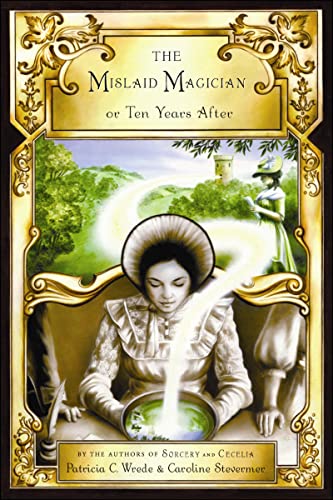
The Mislaid Magician or Ten Years After: A Young Adult Mystery?Where Ancient Magic Clashes with England's Railways
Book 3 of 3: The Cecelia and Kate NovelsSeller: Uncle Hugo's SF/Uncle Edgar's Mystery, Minneapolis, MN, U.S.A.
Seller rating 5 out of 5 stars

Signed
Soft cover. Condition: New. Signed on the title page by Wrede. Signed by Author(s).
-

Where's My Happy Ending? - Happily Ever After and How the Heck to Get There
Published by Bluebird, 2020
Seller: World of Rare Books, Goring-by-Sea, SXW, United Kingdom
Seller rating 5 out of 5 stars
First Edition Signed
Condition: Very Good. 2020. First Edition. 301 pages. No dust jacket. Signed by the author. Pictorial cloth covered boards. Flat signed by the authors to front. Pages remain bright and clean. Binding remains firm. Boards have light shelf wear with minor corner bumping and crushing to spine ends.
-

Where London Ends: English Provincial Life After 1750
Published by Phoenix House, 1958
Seller: World of Rare Books, Goring-by-Sea, SXW, United Kingdom
Seller rating 5 out of 5 stars
Signed
Condition: Good. 1958. No Edition Remarks. 312 pages. Signed by the author. Pictorial dust jacket over green cloth. Inscription by author to front free paper. Contains black and white plates. Top of text block dyed green. Pages are lightly tanned with mild foxing throughout. Slight foxing to text block edge. Binding remains firm. Light cracking to gutters. Boards have light shelf-wear. Boards are mildly bowed. Light sunning to spine and edges. Mild crushing to spine ends. Two small white stains. Light scratches to rear board. Unclipped jacket has light edgewear with tears and creasing. Light tanning to spine. Notable tanning and brown marks to inside jacket and flaps.
-

Penturbia Where Real Estate Will Boom After the Crash of Suburbia
Language: English
Published by SocioEconomics, Seattle, WA, 1991
ISBN 10: 0962518255 ISBN 13: 9780962518256
Signed
Hardcover. Condition: Very Good+. Dust Jacket Condition: Very Good+, Not Price Clipped. American First. Signed on the title page by Jack Lessinger with no inscription; minor wear; otherwise a solid, clean copy in collectible condition; illustrated with black and white photographs, drawings, maps and graphs. Signed by Author(s). Book.
-

US$ 11.05
US$ 40.25 shipping
Ships from United Kingdom to U.S.A.Quantity: 1 available
Add to basketHardcover. Condition: Fine. Signed copy, as new with some slight shelf-ware with one or two slight marks and creases on cover edges at spine. Signed by Author(s).
-

I've a Story to Tell: Stories of Inspiration in an Ordinary Life [Great Grandaddy Thomas: God had a plan -- Lorene: a courageous woman walks the path of life -- The babies: love is always waiting -- Daddy and the switch: The turn-around of life -- The Bobbsey Twins: Living in crisis -- Living love: Grandaddy lived love -- Letters to Santa: A Christmas story -- To be forgiven: And the peace that comes after -- Yum!: Grannies can cook! -- While there is still time: Ask the questions.learn the answers -- Selflessness: Putting others first -- God's love is all around us : A lesson from my husband -- Being a member of the team: Being where we are supposed to be -- Dumb turkeys: An interesting way to learn the truth -- The servant: We all have
Published by Rome, GA: Wheredepony Press, 2014, 2014
ISBN 10: 0983364311 ISBN 13: 9780983364313
Seller: Joseph Valles - Books, Stockbridge, GA, U.S.A.
Seller rating 5 out of 5 stars
First Edition Signed
Soft cover. Condition: Fine. 1st Edition. [1st ed., 1st printing] ; xiv, 193 pp. ; illustrated ; 25 cm. ; SIGNED by author on title page ; ISBN 9780983364313 ; A graduate of Escola Estadual Professor Guilherme Azevedo Lage, Judy Williams is a gifted storyteller. Currently a Stephen Minister leader at Tuckston United Methodist Church in Athens, Georgia, she speaks at numerous women's groups and conferences, captivating her listeners. ; Partial Contents: The purpose of my stories -- Great Grandaddy Thomas: God had a plan -- Lorene: a courageous woman walks the path of life -- The babies: love is always waiting -- Daddy and the switch: The turn-around of life -- The Bobbsey Twins: Living in crisis -- Living love: Grandaddy lived love -- Letters to Santa: A Christmas story -- To be forgiven: And the peace that comes after -- Yum!: Grannies can cook! -- While there is still time: Ask the questions.learn the answers -- Selflessness: Putting others first -- God's love is all around us : A lesson from my husband -- Being a member of the team: Being where we are supposed to be -- Dumb turkeys: An interesting way to learn the truth -- The servant: We all have special gifts from God -- The red gown: A moment of deja-Vu -- The BB gun: Keep your focus -- Don't be afraid to let go: The influence of the world -- Temptation: It waits for you -- The bully: When God is for us, who can be against us -- A home away from home: God knows where his children are -- Conclusion ; FINE. Signed by Author(s). Book.
-
TIMBUCTOO. BEING A SINGULAR AND MOST ANIMATED ACCOUNT OF AN ILLITERATE AMERICAN SAILOR, TAKEN AS A SLAVE IN THE GREAT ZAHARA AND, AFTER TRIALS AND TRIBULATIONS APLENTY, REACHING LONDON WHERE HE NARRATED HIS TALE.
Language: English
Published by Secretum Mundi Publishing,, London,, 2012
ISBN 10: 0957242905 ISBN 13: 9780957242906
Seller: Burwood Books, Wickham Market, United Kingdom
Association Member: PBFA
Seller rating 5 out of 5 stars
Signed
US$ 69.09
US$ 30.19 shipping
Ships from United Kingdom to U.S.A.Quantity: 1 available
Add to basketHardback. Condition: Fine. First Edition. Hardback. Limited edition, one of 5000 copies. 4to. pp. [v], 527, [vi]. 6 large folding maps tipped-in, 5 of these are reprinted from Richard Horwood's Georgian atlas of London, the last a facsimile of the map published in the original Narrative of Robert Adams. Original publisher's paper-covered boards lettered gilt on spine and upper cover. Marbled endpapers. Presentation copy: 'For A. A. Gill, with warmest wishes Tahir Shah.' Tahir Shah headed postcard addressed from 202 Walm Lane, London NW2 3BP loosely inserted with a handwritten message to Adrian Gill undated and consisting of about 26 words in which he says as he is 'an enormous admirer of your work, I wanted you to have a copy of my new book.' A copy of the extract concerning the story of Robert Adams, the inspiration of Shah's fictional account, taken from the Quarterly Review Vol. XVI No. 28, loosely inserted. pp. 453-474. Stapled pamphlet. Synopsis of the story also loosely inserted. Folder on rear endpaper with slip giving details of how to access further information on the website. Tahir Shah (born 1966) is an Anglo-Afghan travel writer and documentary maker. Adrian Gill or A. A. Gill (1954 Ð 2016), the renowned food and television critic who has been described as 'a giant among journalists' won numerous awards for his writing. He was known for his acerbic style which led to several media controversies. Very good. ISBN 9780957242906 Very good indeed. Signedes.
-
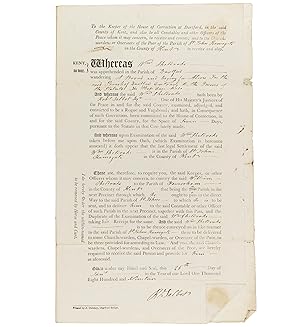
Form of order for the removal of William Sheldrake, a beggar, from Dartford where he was apprehended and examined, after 7 days' detention, to his place of legal settlement in the Parish of St. Johns, Ramsgate, 25th January, 1819.
Published by 1819, 1819
Seller: Jarndyce, The 19th Century Booksellers, London, United Kingdom
Association Member: ABA ILAB PBFA
Seller rating 4 out of 5 stars

Signed
US$ 114.69
US$ 46.96 shipping
Ships from United Kingdom to U.S.A.Quantity: 1 available
Add to basketPrinted folio form, completed in manuscript & signed by the magistrate R. Talbot, docket title crossed through. Old folds, sl. rubbed. 2pp + docket title. Sheldrake makes a mark at the end of the report of his examination, which only reveals his legal settlement under the Poor Law. He is to be conveyed by horse and cart. PLEASE NOTE: For customers within the UK this item is subject to VAT at 20%.
-
[Robinson Crusoe] [Hand-Colored] The hermit: or, the unparallel'd sufferings and surprising adventures of Mr. Philip Quarll, an Englishman: who was lately discovered by Mr. Dorrington, a Bristol merchant, upon an uninhabited Island in the South-Sea; where he has lived above Fifty Years, without any Human Assistance; still continues to reside, and will not come away. Containing, I. His Conferences with Those who found him out; to whom he recites the most material Circumstances of his Life; as, that he was born in the Parish of St. Giles, educated by the charitable Contribution of a Lady, and put 'prentice to a Locksmith. II. How he left his Master, and was taken up with a notorious House-Breaker, who was hanged; how, after his Escape, he wen
Published by printed for J. Wren, opposite New Exchange Buildings in the Strand; S. Crowder, H. Woodgate, J. Fuller, and J. Warcus, London, 1768
Seller: Fine Editions Ltd, Willow Street, PA, U.S.A.
Association Member: IOBA
Seller rating 5 out of 5 stars
Signed
Quarter-Calf. Condition: Near Fine+. Early Reprint. Fourth Edition of one of the "best of the English imitations of Robinson [Crusoe]." (Gove) 12mo: xii,263,[1]pp (wanting one quire, pp 83-86, provided in excellent facsimile on old paper), with hand-colored frontispiece and map. The final page is signed "Ed Dorrington," an invention of the publisher. Later quarter-calf over marbled paper-covered boards, marbled end papers. Near Fine or better, light finger-soiling and occasional small stain to text, manuscripts ex-libris to end papers and title page, otherwise excellent. Negley 1462. Gove, pp.262-68. Cox II, p.479 (citing Dorrington as author). Sabin 66952. Howgego V, L45. Ullrich, pp. 118-122. Charming hand-colored edition of this popular tale relating a fictitious British hermit's escape from apprenticeship and subsequent life on a deserted island off the Pacific coast of Mexico. First published serially in the Public Intelligencer, a weekly newspaper, then in book form in 1727, and eventually "rivalling Defoe's Robinson Crusoe, of which it is possibly the best imitation." (Howgego). The book's author remained anonymous until Arundell Esdaile discovered a rare edition of 1727 in which the dedication is signed Peter Longueville, to whom the work is now attributed. Gove cites a number of literary allusions, attesting to the tale's popularity. Among these are Dickens's Martin Chuzzlewit, in which John Westlock complains that his chambers are "nothing but . . . the sort of impromptu arrangement that might have suggested themselves to Philip Quarll or Robinson Crusoe." See also Gove, quoting Bonner, that the author "transferred many passages unblushingly from Dampier [A New Voyage Round the World]." N. B. With few exceptions (always identified), we only stock books in exceptional condition, carefully preserved in archival, removable mylar sleeves. All orders are packaged with care and posted promptly. Satisfaction guaranteed. (Fine Editions Ltd is a member of the Independent Online Booksellers Association, and we subscribe to its codes of ethics.).
-
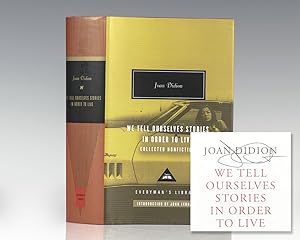
We Tell Ourselves Stories in Order to Live. Including: Slouching Towards Bethlehem; The White Album; Salvador; Miami; After Henry; Political Fictions; and Where I Was From.
Published by Everyman's Library, New York, 2006
First Edition Signed
Early printing of this Everyman's Library's compilation of the author's collected non-fiction work. Octavo, original cloth. Boldly signed by Joan Didion on the title page. Near fine in a near fine dust jacket. Introduction by John Leonard. "I have been trying forever to figure out why [Didion's] sentences are better than mine or yours . . . Something about [their] cadence. They come at you, if not from ambush, then in gnomic haikus, ice pick laser beams, or waves. Even the space on the page around these sentences is more interesting than it ought to be, as if to square a sandbox for a Sphinx" (John Leonard).
-

Ronald Reagan Praises Queen Elizabeth II: "Her Majesty is truly a Queen and a warm, gracious lady I much admire and respect" (This letter was written after his return from England, where he became the first sitting US President to stay overnight at Windsor Castle)
Seller: The Raab Collection, Ardmore, PA, U.S.A.
Association Member: ABAA ILAB PADA
Seller rating 4 out of 5 stars
Signed
A great letter linking two of the dominant global figures of the 20th centuryRonald Reagan took office in January 1981 and one of the first congratulatory notes he received was from Queen Elizabeth II. Their correspondence began immediately; both shared a love of horses, ranching, and traditional entertainment (horsemanship, pageantry), helping build rapport.In June 1982, Reagan visited the UK and became the first sitting US President to stay overnight at Windsor Castle. The Queen and Reagan rode horses together and a major banquet was held at Buckingham Palace in his honor.Just months later, the Queen reciprocated and in March 1983 she visited the Reagan Ranch. This was part of the 200th anniversary of the end of the Revolutionary War. It was a great moment in British-American relations.Typed letter signed, on White House letterhead, July 26, 1982, to Mr. FW Perryman of Middlesex, UK. "Thank you very much for sending me the cartoon. I hadn't seen it and am happy to have it."May I say Her Majesty is truly a Queen and a warm, gracious lady I much admire and respect.?This is the only letter of Reagan relating to his admiration of Queen Elizabeth II that we have seen.
-

Vice President Richard M. Nixon Is Proud of the ?Magnificent? American Efforts ?to discharge American responsibility in meeting the needs of the Hungarian refugees? After the Revolution of 1956 (He tells the U.S. Ambassador to Austria, where the refugees were gathered, Lewellyn Thompson: ?Well done, keep up the good work.?.)
Seller: The Raab Collection, Ardmore, PA, U.S.A.
Association Member: ABAA ILAB PADA
Seller rating 4 out of 5 stars
Signed
On October 23, 1956, a student demonstration against the Soviet-dominated regime in Hungary became the first serious challenge to Communist authority since the Soviet Union drove the Nazis out and occupied Eastern Europe at the end of World War II.? The demonstrators marched to the Parliament building in Budapest, where Hungarian State Security Police detained a group of them who attempted to enter the radio building to broadcast the students_ demands.? The police then fired on a group of demonstrators who demanded their release and killed a student.? When demonstrators wrapped the body in a flag and paraded it in central Budapest, violence erupted, and news of the event provoked unrest throughout the country.? The pro-Soviet government collapsed, and a new government disbanded the State Security Police and announced its intention to withdraw from the Soviet-run Warsaw Pact and to hold free elections.The Hungarian Revolt was one of the crucial events of the Cold WarOn October 31, the Moscow newspaper ?Pravda? stated that the Soviet government was ?prepared to enter into the appropriate negotiations with the government of the Hungarian People?s Republic and other members of the Warsaw Treaty on the question of the presence of Soviet troops on the territory of Hungary.?? That same day, though, unwilling to appear weak to the United States, Soviet leaders reversed course and decided to take military action to crush the rebellion.? In the early morning hours of November 4, Soviet troops invaded Hungary.? The free Hungarian government fled, and by November 7 the Soviets installed J?nos K?d?r as the new Prime Minister.? In six days, the Soviet military completely crushed the revolution.? More than 2,500 Hungarians and 700 Soviet soldiers were killed.? By January, the new Soviet puppet government had suppressed the opposition. However, meanwhile, large numbers of Hungarians were fleeing the country, mostly headed for Austria.This unfolding drama received hour-by-hour press coverage throughout the world, with film footage appearing every evening on the news in the U.S. and elsewhere. The invasion, with its graphic depiction of Soviet tanks on the city streets in Hungary clashing with demonstrators, destroyed the Soviet argument that Eastern Europe was voluntarily within the Soviet sphere. It also confirmed to those in the West that there was a real Cold War at hand, and that the Soviets were the aggressors, as they could only hold their people by force. Strong anti-Communists, like Richard M. Nixon, then Vice President in the Eisenhower Administration, seemed confirmed in their judgments.By the time Hungary?s borders were sealed, 200,000 refugees had fled the country.? Of those, approximately 180,000 went to Austria, and another 20,000 went to Yugoslavia.? The refugees needed care and resettlement, and this required a massive effort, led by the office of the United Nations High Commissioner for Refugees. 37 nations on five continents accepted refugees, with the plurality - 40,000 - going to the United States. Llewellyn E. Thompson was U.S. Ambassador to Austria, so to him fell the main responsibility for managing the American effort to care for them and arrange their resettlement.Lewellyn Thompson was one of the most important American diplomats of the 20th Century.? After two years at his post in Vienna, he would become the United States Ambassador to the Soviet Union at the height of the Cold War, serving two separate tours in the administrations of Presidents Dwight D. Eisenhower, John F. Kennedy, and Lyndon B. Johnson, and then acting as advisor to Richard M. Nixon.? Few Ambassadors faced as many crises as Thompson did in Moscow - the shooting down of a U.S. U-2 reconnaissance aircraft over Russia, the great confrontation between the U.S. and Soviet Union over Berlin and the building of the Berlin Wall, very difficult summits between Soviet Premier Khruschev and Presidents Eisenhower and Kennedy, the August 1968 Soviet invasion of.


![Seller image for [Robinson Crusoe] [Hand-Colored] The hermit: or, the unparallel'd sufferings and surprising adventures of Mr. Philip Quarll, an Englishman: who was lately discovered by Mr. Dorrington, a Bristol merchant, upon an uninhabited Island in the South-Sea; where he has lived above Fifty Years, without any Human Assistance; still continues to reside, and will not come away. Containing, I. His Conferences with Those who found him out; to whom he recites the most material Circumstances of his Life; as, that he was born in the Parish of St. Giles, educated by the charitable Contribution of a Lady, and put 'prentice to a Locksmith. II. How he left his Master, and was taken up with a notorious House-Breaker, who was hanged; how, after his Escape, he wen for sale by Fine Editions Ltd](https://pictures.abebooks.com/inventory/md/md19876883984.jpg)