

Order Total (1 Item Items):
Shipping Destination:

Forgeries (14 results)
Author:
forgeries
Refine with Advanced Search
Skip to main search results
Search filters
Product Type
- All Product Types
- Books (12)
- Magazines & Periodicals (1)
- Comics (No further results match this refinement)
- Sheet Music (No further results match this refinement)
- Art, Prints & Posters (No further results match this refinement)
- Photographs (No further results match this refinement)
- Maps (No further results match this refinement)
- Manuscripts & Paper Collectibles (1)
Condition Learn more
- New (No further results match this refinement)
- As New, Fine or Near Fine (6)
- Very Good or Good (5)
- Fair or Poor (No further results match this refinement)
- As Described (3)
Binding
Collectible Attributes
- First Edition (5)
- Signed (No further results match this refinement)
- Dust Jacket (No further results match this refinement)
- Seller-Supplied Images (6)
- Not Print on Demand (14)
Language (2)
Free Shipping
- Free Shipping to U.S.A. (No further results match this refinement)
Seller Location
Seller Rating
-

The Rescuers: The Remarkable People Who Saved World Heritage
Language: English
Published by Rowman & Littlefield Publishers, 2025
ISBN 10: 1538159791 ISBN 13: 9781538159798
Seller: Books From California, Simi Valley, CA, U.S.A.
Seller rating 4 out of 5 stars

hardcover. Condition: Very Good. Cover and edges may have some wear. Book has some light shelf wear and dirtiness from handling.
-

Encounter January 1975 / William Trevor "A Complicated Nature" (story) / Norman Cohn "Three Forgeries" / Jan Morris "Singapore"
Published by Encounter Ltd, 1975
Magazine / Periodical
US$ 11.05
US$ 14.75 shipping
Ships from United Kingdom to U.S.A.Quantity: 1 available
Add to basketSoft cover. Condition: Very Good. 97 pages. William Trevor "A Complicated Nature" (story) / Norman Cohn "Three Forgeries" / Jan Morris "Singapore".
-

Forgeries that were not Forged : Looking at artworks & antiques that were wrongly condemned as fakes. Pieces that experts, collectors, or dealers once dismissed, only for later scholarship to prove they were genuine after all. An original article from The Connoisseur, 1902.
Published by The Connoisseur, London, 1902
US$ 15.06
US$ 15.95 shipping
Ships from United Kingdom to U.S.A.Quantity: 2 available
Add to basketBooklet - Unbound Pages. Condition: Very Good. 4 pages. An authentic standalone article, extracted from a larger volume. Not a reprint or reproduction, but an original work in its own right. Supplied without title page or cover. Size: 24 x 29 cms. Category: The Connoisseur; Cosmo Books : 29 years on ABE, 47 years taking care of customers. A bookseller you can rely on.
-

The apprehending and trying of Robert Perreau, of Golden Square, Apothecary; Daniel Perreau, of Harley Street, and Margaret Caroline Rudd, for divers Forgeries, etc. An original article from the Annual Register for 1775.
Published by Annual Register, London, 1775
US$ 29.83
US$ 15.95 shipping
Ships from United Kingdom to U.S.A.Quantity: 1 available
Add to basketBooklet - Unbound Pages. Condition: Very Good. 12 pages. An authentic standalone article, extracted from a larger volume. Not a reprint or reproduction, but an original work in its own right. Preserved in a modern card cover, prepared for practicality - an unassuming but serviceable presentation that favours function over finery. Size: 13 x 20 cms. Category: Annual Register; Printed before 1800; Cosmo Books : 29 years on ABE, 47 years taking care of customers. A bookseller you can rely on.
-

Catalogue of the Celebrated Collection formed by Sir Maurice Pariser, of Manchester, of the notorious nineteenth century pamphlets, and other important Wiseiana.
Published by 8vo, pp.139 + frontispiece., Sotheby & Co., London, December 1967, 1967
US$ 41.43
US$ 20.98 shipping
Ships from United Kingdom to U.S.A.Quantity: 1 available
Add to basketCondition: Near Fine. Portrait frontispiece and illustrations in text. Green printed wrappers.A very good to fine copy with the prices realised loosely inserted as well as being annotated beside the text. A very good bright copy.
-
Thomas James Wise and Guildhall Library. Reprinted, with additions, from Guildhall Miscellany, 1962 and 1965.
Published by Crown 8vo, Title, 22 pages, Printed with the authority of the Library committee, 1970., 1970
First Edition
US$ 48.33
US$ 20.98 shipping
Ships from United Kingdom to U.S.A.Quantity: 1 available
Add to basketCondition: Near Fine. 1st Edition. Blue wrappers, a little faded at the spine. Near fine. On various occasions between 1893 and 1932 he presented books to the Library. In the list which follows only twelve of the items were acquired by purchase; all the others were given by Wise. In addition to some of the forgeries and his privately printed books, his donations included a number of 18th century books and two of the 17th century.
-
Catalogo de los sellos postales de la República Argentina y sus derivados.
Published by Buenos Aires, Tailhade & Co, January 1939., 1939
Seller: Hünersdorff Rare Books ABA ILAB, London, United Kingdom
Seller rating 3 out of 5 stars

US$ 89.76
US$ 30.17 shipping
Ships from United Kingdom to U.S.A.Quantity: 1 available
Add to basketHardcover. Condition: Very Good. Kneitschel, Victor. Catalogo de los sellos postales de la República Argentina y sus derivados. Buenos Aires, Tailhade & Co. January 1939. 8vo. 194 + [6]p. With numerous illustrations of stamps in the text (some full-page) and on 4 folding sheets in back-pocket. Orignal cloth with title lettering on front cover. Trade catalogue by an Argentine stamp dealer describing raritities and forgeries of historic Argentine stamps.
-
Between the Lines. Letters and Memoranda Interchanged by H. Buxton Forman and Thomas J. Wise. With A Foreword by Carl H. Pforzheimer and an Introductory Essay and Notes by Fannie E. Ratchford.
Published by First edition, 8vo, xii, 38, [1] pp, 26 plates, some folding, 24cm, Austin, Texas, University of Texas Press, 1945., 1945
First Edition
US$ 110.48
US$ 20.98 shipping
Ships from United Kingdom to U.S.A.Quantity: 1 available
Add to basketCondition: Near Fine. 1st Edition. Designed by Bruce Rogers and printed by A. Colish on Fabriano paper. 26 plates, some folding, some in red and black. Dark blue cloth stamped with the University of Texas seal, top edg gilt. Slipcase (a little damaged) and prospectus. Near fine copy. Carter & Pollard's 'An Enquiry into the Nature of Certain Nineteenth Century Pamphlets" had demonstrated the involvement of Thomas James Wise in the creation of forged or pirated works. However, they lacked evidence to establish the involvement of any co-forger. That finally appeared in Ratchford's 'Between the Lines', which published the now famous 'Pforzheimer document' - an exchange of correspondence between Wise and Harry Buxton Forman.
-
Various Extraordinary Books procured by Thomas J. Wise and now displayed on All Fools Day in observance of the centenary of his birth.
Published by 8vo, 18[2] pages, The Humanities Research Center, The University of Texas, 1 April 1959, 1959
First Edition
US$ 117.38
US$ 20.98 shipping
Ships from United Kingdom to U.S.A.Quantity: 1 available
Add to basketCondition: Near Fine. 1st Edition, Limited Edition. One of 300 copies on handmade paper stapled into decorative printed wrappers. Slightly yellowed at the spine. A very good to fine copy of this damning catalogue. Introduction by W.B. todd.
-

SKETCHES OF IMPOSTURE, DECEPTION, AND CREDULITY
Published by G. B. Zieber & Co, 1845
Seller: Arches Bookhouse, Portland, OR, U.S.A.
Seller rating 5 out of 5 stars

First Edition
Leather. Condition: FINE. First American Edition, an un-credited and likely un-royaltied printing of the 1837 Tegg edition (talk about frauds!). 283pp. 16mo, tan sheep with morrocco spine label stamped in gilt. Tips modestly rubbed, front hing leather cracked but cords still holding fast; Spine toned, age spotting to the text as usual, otherwise a clean, sound copy. Davenport's work was an inspiration and perhaps an uncredited source for much of the content in Mackay's much more famous work, Popular Delusions and the Madness of Crowds: 'Mackay may have derived inspiration, or even more, from a volume published four years prior by one Richard Davenport . which covered many of the same areas, although not in nearly as much detail' (William J. Bernstein intro. to the Grove-Atlantic edition of Mackay).
-
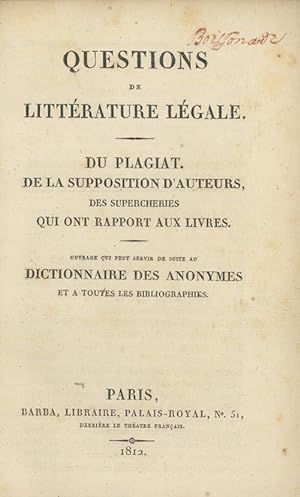
Questions de LittÈrature LÈgale. Du Plagiat. De La Supposition D'Auteurs, Des Supercheries qui ont Rapport aux Livres
Published by Paris: Barba, Libraire, 1812, 1812
Seller: Brick Row Book Shop, ABAA, San Francisco, CA, U.S.A.
Seller rating 5 out of 5 stars
First Edition
First edition. 8vo, later tan boards, red leather label, gilt rules and lettering. Half-title present. A scarce study of literary forgery by French author, antiquary and bibliophile Charles Nodier (1780-1844), who was also apparently well versed in the subject: "The French C19 saw Charles Nodier, whose Questions de LittÈrature LÈgale . . . is a minor classic of forgery criticism, repeatedly poise on the borderlines of fiction and fraud - another gamekeeper turned poacher." - Freeman, page 62. ? Contemporary signature on the title-page of Greek scholar and publisher Jean-FranÁois Boissonade (1774-1857). Boards darkened; some light foxing; very good copy. Freeman, Bibliotheca Fictivia, 1639.
-
SARTOR RESARTUS: THE LIFE & OPINIONS OF HERR TEUFELSDROECKH
Published by The Doves Press, London, 1907
Seller: Phillip J. Pirages Rare Books (ABAA), McMinnville, OR, U.S.A.
Seller rating 3 out of 5 stars
235 x 165 mm. (9 1/4 x 6 1/2"). 341 [1] pp. VERY ATTRACTIVE DARK BLUE CRUSHED MOROCCO IN THE STYLE OF THE DOVES BINDERY (counterfeit signature stamped and dated 1907 to the rear turn-in), covers simply framed by two plain gilt rules, raised bands, spine compartments with rose window designs formed by six open ovals accented with dots, encircled by two gilt rules, with low platforms and dots above and below, gilt titling, turn-ins gilt-ruled and with cornerpieces of open ovals, dots, and gouge work, all edges gilt and gauffered with two rows of tiny dots. Initials designed by Edward Johnston. Printed in red and black. Pastedown with the bookplate of Helen and Michael Oppenheimer. Tidcombe DP-13. For the binding: Tidcombe, p. 464. Spine a little sunned, just a trace of soiling to leather, the usual offsetting from the facing turn-ins on the front and rear free endpaper, a hint of yellowing to quire b, but still fine, the text otherwise pristine, and the binding unworn and lustrous. This is one of the 26 intriguing (and obviously uncommon) examples Tidcombe has identified as forged or imitation Doves bindings, a group of handsomely executed volumes that continue to be mysterious. Tidcombe differentiates between forgeries (those books that are stamp-signed with "C - S" and a date, as here) on the one hand and unsigned "copies of Doves bindings or bindings in the Doves style" on the other. But she treats them as one group "because they have several features in common." For example, signed or unsigned, all of the suspect bindings cover Doves Press books, all are bound in dark blue morocco, and all have a signature pallet with the letters "E" and "S" close together. Although Tidcombe suggests that the person responsible for the forged Doves bindings could possibly have been the former Doves Bindery finisher Charles McLeish, she does not settle on him or any other likely candidate. Whoever was behind them, the volumes in this puzzling group of bindings--like other forgeries and imitations of historically important cultural artifacts--are actively collected for their value as counterfeits. And as with other counterfeits, the present binding is a kind of implicit homage, in this case to the outstanding work done by Cobden-Sanderson at the Doves Bindery--our spurious binding would not have been worth undertaking, were the objects it mirrored not so universally recognized as worthy of imitation. The text here is an uncategorizable work reminiscent of satires by Swift and Sterne in its fictitious biography of Teufelsdroeckh (i.e., "devil's dung"), Professor of Things in General at the University of Weissnichtwo ("Know-not-where"). Day calls it "an intellectual and spiritual autobiography and a diatribe against current conditions in England" that advocates a reorganization of society and its institutions, so that "Brotherhood and the duty to work usefully will grip mankind's true leaders and assure a theocracy, a reborn humanity ruled by the divine spirit within." Our volume was formerly in the collection of fine private press books owned by the distinguished scholars Sir Michael Oppenheimer (1924-2020) and his wife Lady Helen Oppenheimer (1926-2022); he was an Oxford lecturer in politics and history, she an Anglican theologian whose groundbreaking work on ethics helped reform the church's position on remarriage of divorced persons. ONE OF 300 COPIES printed on paper (and 15 on vellum).
-
[ARABIC MANUSCRIPT] An early Arabic manuscript forgery in Ku!"c script, reminiscent of a letter purportedly sent by the Prophet to the ruler of Bahrain,
Seller: Konstantinopel ANTIQUARIAN BOOKSELLERS., ENSCHEDE, Netherlands
Seller rating 5 out of 5 stars
Manuscript / Paper Collectible
US$ 11,323.17
US$ 16.78 shipping
Ships from Netherlands to U.S.A.Quantity: 1 available
Add to basketSoft cover. Condition: Fine. ARABIC MANUSCRIPT] An early Arabic manuscript forgery in Ku!"c script, reminiscent of a letter purportedly sent by the Prophet to the ruler of Bahrain, currently preserved in the Topkapi Palace. Manuscript on vellum. oblong 21 by 14 cm and comprising nine bound leaves. Provenance: purchased in the 1920s in Egypt.Professor Ahmad Al-Jallad, a well-known scholar in the !"eld, told us that the text is written in Classical Arabic a language variant prevalent in the Arabian Peninsula during the 7th century and delves into the topic of alcohol usage, employing characters that mimic early Ku!"c Arabic. C-14 suggests a date back to the 17th century. Egypt has produced famous forgeries. In 1854, a French diplomat named François Alphonse Belin made a bombshell announcement: the discovery of an original letter sent by Muhammad to the governor of Egypt, complete with the Prophet's personal seal. This letter had been purportedly found in the library of a Coptic monastery in Egypt. Soon other letters were discovered and sold to the Ottoman sultans for large amounts of money. Four such letters are kept in the collection of sacred relics in the Topkapi Palace. Questions were not raised until 1904, when an article in the Egyptian journal al-Hilal argued that the letters script like ours betrayed a crude attempt to imitate early Islamic writing. But the history of forgeries goes much further back than the 19th century. It has also been suggested that they were made from the medieval period onwards. Christian (Coptic) and Jewish communities are known to have forged letters where Muhammad supposedly exempts the recipients from taxation. Our manuscript might be older (as the C-14 date suggests) than the 19th century. We do not even know if the knowledge was intended to deceive. Could it be a copy in a crude hand of an already existing early manuscript?However, according to Professor Gerd R. Puin, a leading expert in Arabic orthography and Koranic paleography, it is a forgery and a special one. He suggests a possible link to a letter attributed to the Prophet Muhammad, currently housed in the Topkapi Palace. According to Puin our MS displays the same distinctive paleographic errors as the one found in a letter attributed to the Prophet Muhammad, sent to the ruler of Bahrain, Munzir Bin Sawa. Gerd R. Puin'analysis of the letter of the Prophet can be found in his article titled "Das Siegel des Propheten" (The Seal of the Prophet), with speci)*c reference to Figure 11 in that article. Carbon-14 dating places its creation within several probable time frames, the most signi)*cant probabilities being between 1646 1681 and 1792 1803. Codex specialists have pointed out that the way it is bound looks old.
-
Réponse à la communication de M. Faugères.
Seller: Herman H. J. Lynge & Søn ILAB-ABF, Copenhagen, Denmark
Seller rating 4 out of 5 stars
(Paris, Gauthier-Villars), 1867. 4to. In: "Comptes Rendus Hebdomadaires des Séances de L'Academie des Sciences", Tome 65, No 10. Pp. (373-) 428. (Entire issue offered). Chasles' paper pp. 375-385. "Chasles was a collector of autographs and manuscripts, and this interest allied with his credulity to cause him serious embarrassment. From 1861 to 1869 he was the victim of one of the most clever and prolific of literary forgers, Denis Vrain-Lucas. Chasles bought thousands of manuscripts, including a correspondence between Isaac Newton, Blaise Pascal, and Robert Boyle which established that Pascal had anticipated Newton in the discovery of the law of universal gravitation. Chasles presented these letters to the Academy in 1867 and took an active part in the furor that ensued (1867-1869), vigorously defending the genuineness of the letters. In 1869 Vrain-Lucas was brought to trial and convicted. Chasles was forced to testify and had to admit to having purchased letters allegedly written by Galileo, Cleopatra, and Lazarus, all in French." (DSB).


