Order Total (1 Item Items):
Shipping Destination:

Koryusai (24 results)
Author:
koryusai
Refine with Advanced Search
Skip to main search results
Search filters
Product Type
- All Product Types
- Books (24)
- Magazines & Periodicals (No further results match this refinement)
- Comics (No further results match this refinement)
- Sheet Music (No further results match this refinement)
- Art, Prints & Posters (No further results match this refinement)
- Photographs (No further results match this refinement)
- Maps (No further results match this refinement)
- Manuscripts & Paper Collectibles (No further results match this refinement)
Condition Learn more
- New (1)
- As New, Fine or Near Fine (10)
- Very Good or Good (10)
- Fair or Poor (No further results match this refinement)
- As Described (3)
Binding
Collectible Attributes
- First Edition (No further results match this refinement)
- Signed (No further results match this refinement)
- Dust Jacket (No further results match this refinement)
- Seller-Supplied Images (14)
- Not Print on Demand (24)
Language (2)
Free Shipping
- Free Shipping to U.S.A. (No further results match this refinement)
Seller Location
Seller Rating
-

Koryusai: The Ronin and The Aesthete (fl. 1770-1788)
Language: English
Published by Ronin Gallery, 1980
Paperback. Condition: Very Good. Minor shelf wear, slight creasing to cover, stapled binding, pages clean and unmarked. Includes 84 prints on 40 pages, illustrated in black and white and color. From Wikipedia: "Kory?sai was born in 1735 and worked as a samurai in the service of the Tsuchiya clan. He became a masterless r?nin after the death of the head of the clan and moved to Edo (modern Tokyo) where he settled near Ry?goku Bridge in the Yagenbori area. He became a print designer there under the art name Haruhiro in 1769, at first making samurai-themed designs. The ukiyo-e print master Harunobu died in 1770, and about that time Kory?sai began making prints in a similar style of life in the pleasure districts.[1]Kory?sai was a prolific designer of individual prints and print series in the 1770s. The series Models for Fashion: New Designs as Fresh Young Leaves (Hinagata wakana no hatsumoy?, 1776?81) ran for 140 prints, the longest ukiyo-e print series of beauties known. He designed at least 350 hashira-e pillar prints, numerous kach?-e birds-and-flowers prints, a great number of shunga erotic prints, and others.[1]In 1782 Kory?sai applied for and received the Buddhist honour hokky? ("Bridge of the Law"), and thereafter used the title as part of his signature. His output slowed from this time, though he continued to design prints until his death in 1790.".
-

Paperback. Condition: Very Good. The book has some mild spine bends, light shelf wear mostly visible on the back. Contents are clean and unmarked. ; fl. 1770-1788.
-
![Seller image for Getting Rid of Mosquitoes. [Folding cardboard with art print of Japanese woodblock]. Signed Koryu ga . for sale by Borkert, Schwarz und Zerfaß GbR](https://pictures.abebooks.com/inventory/md/md31725284723.jpg)
Getting Rid of Mosquitoes. [Folding cardboard with art print of Japanese woodblock]. Signed Koryu ga .
Language: English
Published by w/o place w/o year.
Seller: Borkert, Schwarz und Zerfaß GbR, Berlin, Germany
Seller rating 5 out of 5 stars

Condition: Gut. Front cover with a small image of the art print, 1 side text, 1 side with art print fixed to one side, back side blank. Leaflet slightly bumped at the lower edge in the fold, art print very good. Text in Japanese and English. - Chuban Nishikie - (Important Art Object) Isoda Koryusai is said to have been an intimate friend of Harunobu, and in his early works used the studio name of Haruhiro. During the Meiwa era (1764-1771), he followed the Harunobu style closely, but after Harunobu's death he evolved his own style, in which the lyric feeling typical of Harunobu is gradually replaced by a more illustrative treatment of feminine customs and fashions. "Getting Rid of Mosquitoes" employs the comparatively harsh coloring often seen in Harunobu's latest works, and may have been printed early in the 1770's. Sprache: Englisch Gewicht in Gramm: 550 Leaflet 28,5*42 cm, Art print 20,7*27,7 cm.
-
![Seller image for Eight Parlor Scenes Based on Famous Birds The Eagle and Night Bells. [Folding cardboard with art print of Japanese woodblock]. Signed Koryusai ga. for sale by Borkert, Schwarz und Zerfaß GbR](https://pictures.abebooks.com/inventory/md/md31725284722.jpg)
Eight Parlor Scenes Based on Famous Birds The Eagle and Night Bells. [Folding cardboard with art print of Japanese woodblock]. Signed Koryusai ga.
Language: English
Published by w/o place w/o year.
Seller: Borkert, Schwarz und Zerfaß GbR, Berlin, Germany
Seller rating 5 out of 5 stars
Condition: Gut. Front cover with a small image of the art print, 1 side text, 1 side with art print fixed to one side, back side blank. Leaflet slightly bumped at the lower edge in the fold, art print very good. Text in Japanese and English. - Chuban Nishikie - (Important Art Object) A handsome youth who has just finished painting an eagle on a standing screen rests his brush on one knee, while appraising the results of his labors. The young girl, wearing a kimono patterned with seaweed and shells, and a wave-patterned obi, stands at his back, gazing intently at the painting of the fierce bird. Why this bird of prey was chosen to symbolize the sound of temple bells at night involves considerable interpretation. Perhaps Koryusai chose the eagle to parody a Chinese verse: Invisible through the obstructing clouds Is the shrine of Lord Brahma; The temple bells' peal Is wafted on the evening breeze. Or did the artist, remembering the "Night Bells at Mii" from the set "Eight Views of Lake Biwa" (or the song "Mountain of the Eagles" from the play Mii Temple), intend to evoke associations with the Holy Eagle Mountain of Buddhism? Sprache: Englisch Gewicht in Gramm: 550 Leaflet 28,5*42 cm, Art print 18,6*26 cm.
-
![Seller image for Eight Parlor Scenes Based on Famous Birds The Golden Pheasant and Evening Rain. [Folding cardboard with art print of Japanese woodblock]. Signed Koryusai ga. for sale by Borkert, Schwarz und Zerfaß GbR](https://pictures.abebooks.com/inventory/md/md31725291436.jpg)
Eight Parlor Scenes Based on Famous Birds The Golden Pheasant and Evening Rain. [Folding cardboard with art print of Japanese woodblock]. Signed Koryusai ga.
Language: English
Published by w/o place w/o year.
Seller: Borkert, Schwarz und Zerfaß GbR, Berlin, Germany
Seller rating 5 out of 5 stars
Condition: Gut. Front cover with a small image of the art print, 1 side text, 1 side with art print fixed to one side, back side blank. Leaflet slightly bumped at the lower edge in the fold, art print very good. Text in Japanese and English. - Chuban Nishikie - (Important Art Object) One is reminded of the kyoka, or comic verse, inscribed on Torii Kiyomasu's print "Evening Rain at Emonzaka" from his "Eight Views of the Yoshiwara": The rain at night But no voice of the samisen To wake the memories of love. The appearance of the young dandy, sleepy-eyed and indolent, with one hand on his chin, suggests that the couple are relaxing after the fulfillment of passion. The courtesan, attired in a white uchikake, or robe, patterned with boats and waves, has her left hand tucked inside her sleeve while holding a pipe in her right hand. Kneeling with her lover, she looks at the male golden pheasant in a bird cage on the porch. The pheasant, caged alone without a female at his side, seems to stare back reproachfully. The "golden pheasant" is the familiar name of a star. There is a superstition that when this pheasant star cries out to herald the dawn all the cocks in the world crow in imitation. The rain continues, and a few hours still remain before the cocks cry at the break of day, when the two lovers must part. Sprache: Englisch Gewicht in Gramm: 550 Leaflet 28,5*42 cm, Art print 19,3*25,5 cm.
-
![Seller image for Eight Parlor Scenes Based on Famous Birds The Parrot and Evening Snow. [Folding cardboard with art print of Japanese woodblock]. Signed Koryusai ga. for sale by Borkert, Schwarz und Zerfaß GbR](https://pictures.abebooks.com/inventory/md/md31725282828.jpg)
Eight Parlor Scenes Based on Famous Birds The Parrot and Evening Snow. [Folding cardboard with art print of Japanese woodblock]. Signed Koryusai ga.
Language: English
Published by w/o place w/o year.
Seller: Borkert, Schwarz und Zerfaß GbR, Berlin, Germany
Seller rating 5 out of 5 stars
Condition: Gut. Front cover with a small image of the art print, 1 side text, 1 side with art print fixed to one side, back side blank. Leaflet slightly bumped at the lower edge in the fold, art print very good. Text in Japanese and English. - Chuban Nishikie - (Important Art Object) This print parodies both the Chinese "Eight Views of Hsiao and Hsiang - Evening Snow on the River" and the Japanese counterpart, "Eight Views of Lake Biwa - Evening Snow at Mt. Hira." Koryusai has shown snow representationally as blanketing the garden. More symbolic is the suggestion of snow in the white feathers of the parrot on its perch. The girl, concealing her laughter at the parrot's mimicry, wears a kimono with a beautiful dyed pattern of narcissus and falling snowflakes, an additional reference to the original theme. A poem, "Evening Snow on the River," by Setsurei reads: The mountain tops are white Like white-capped waves. This verse may well have served as a source of inspiration to Koryusai for this parlor scene, since the branches of the pine in the garden, the parrot on its perch and even the patterned narcissus on the girl's sleeves and skirt hem are "capped with white." Sprache: Englisch Gewicht in Gramm: 550 Leaflet 28,5*42 cm, Art print 19,3*26 cm.
-
![Seller image for Eight Parlor Scenes Based on Famous Birds The Sparrow Hawk and Autumn Moon. [Folding cardboard with art print of Japanese woodblock]. Signed Koryusai ga. for sale by Borkert, Schwarz und Zerfaß GbR](https://pictures.abebooks.com/inventory/md/md31725292393.jpg)
Eight Parlor Scenes Based on Famous Birds The Sparrow Hawk and Autumn Moon. [Folding cardboard with art print of Japanese woodblock]. Signed Koryusai ga.
Language: English
Published by w/o place w/o year.
Seller: Borkert, Schwarz und Zerfaß GbR, Berlin, Germany
Seller rating 5 out of 5 stars
Condition: Gut. Front cover with a small image of the art print, 1 side text, 1 side with art print fixed to one side, back side blank. Leaflet slightly bumped at the lower edge in the fold, art print very good. Text in Japanese and English. - Chuban Nishikie - (Important Art Object) The sparrow hawk in this print is a young female. Larger than the male of the species, the females were often trained for the sport of hawking. The bird of prey, perched on the dandy's wrist, fiercely eyes a helpless sparrow below. A crouching girl holds the sparrow protectively to her breast, screening it from the hawk with her kimono sleeve. Thus Koryusai pairs the hunters and their trembling quarry in an interesting scene. The house stands on high ground, with an unobstructed view of the distances beyond the garden. The rays of the full moon pierce a veil of clouds to light up some distant rooftops, thus providing a romantic setting for this parody. The austere elegance of the classic "Autumn Moon at Lake Tung Ting" was often sung by Chinese poets: At evening, the Judas tree Is bathed in mists, The flute of the fisherman, unheard Torments the traveler. Suddenly the cold wind blows through the rushes. This austerity is only barely suggested in Koryusai's print by the painting of sails and water rushes which decorates the base of the far wall. Sprache: Englisch Gewicht in Gramm: 550 Leaflet 28,5*42 cm, Art print 19*25,6 cm.
-
![Seller image for Eight Parlor Scenes Based on Famous Birds Returning Cranes. [Folding cardboard with art print of Japanese woodblock]. Signed Koryusai ga. for sale by Borkert, Schwarz und Zerfaß GbR](https://pictures.abebooks.com/inventory/md/md31725297948.jpg)
Eight Parlor Scenes Based on Famous Birds Returning Cranes. [Folding cardboard with art print of Japanese woodblock]. Signed Koryusai ga.
Language: English
Published by w/o place w/o year.
Seller: Borkert, Schwarz und Zerfaß GbR, Berlin, Germany
Seller rating 5 out of 5 stars
Condition: Gut. Front cover with a small image of the art print, 1 side text, 1 side with art print fixed to one side, back side blank. Leaflet slightly bumped at the lower edge in the fold, art print very good. Text in Japanese and English. - Chuban Nishikie - (Important Art Object) The Chinese poet of the ode "Returning Sails on a Far-off Bay" spoke of "autumn, the domain of the heron and green mountains," thus comparing white sails extending across the water to a flock of white herons soaring on the wind. Koryusai painted his ukiyoe version of the "returning sails of herons" metaphorically, the white sails being suggested by the wings of cranes flying to their nests at dusk. On the paper sliding doors is a design of nets evocative of life beside the sea. The courtesan, in informal attire held together by a narrow obi, shades her eyes with one hand from the rays of the setting sun to watch two flying cranes at dusk. At the girl's feet, a man lies sprawled on the tatami floor, supported by one elbow, as he raises himself up to look at the cranes. There is a saying "my dwelling is on the banks of a river at sunset," but where is the abode of this young man? The cranes will return to their nest, but the young dandy shows no sign of setting out toward his. He passes the time by looking out at the ripples of the wind- borne clouds, reluctant to return without achieving the objective of his visit. Sprache: Englisch Gewicht in Gramm: 550 Leaflet 28,5*42 cm, Art print 19*25,8 cm.
-

Prints of Isoda Koryusai : Floating World Culture and Its Consumers in Eighteenth-Century Japan
Language: English
Published by University of Washington Press, 2002
ISBN 10: 0295983019 ISBN 13: 9780295983011
Condition: New.
-

Prints of Isoda Koryusai : Floating World Culture and Its Consumers in Eighteenth-Century Japan
Language: English
Published by University of Washington Press, 2002
ISBN 10: 0295983019 ISBN 13: 9780295983011
Condition: As New. Unread book in perfect condition.
-
Primary color edition Floating World Master Collection 6 Isoda Koryusai Tenkin color monochrome edition included
Published by Daihokaku shobo, 1931
Condition: Fine. Size: B5 size.
-
Condition: Fine. Size: 19.3x13.7x0.5cm. 36 pages Number of books: 1 book.
-
Condition: Fine. Size: 19.3x13.7x0.5cm. 36 pages Number of books: 1 book.
-
Condition: Fine. Number of books: 1 width.
-
Japanese Woodblock Print Masterpieces: Life, Landscape & Nature
Published by Charles E. Tuttle Company, 1959
Seller: Ivy Ridge Books/Scott Cranin, Fayetteville, NY, U.S.A.
Association Member: IOBA
Seller rating 5 out of 5 stars
Paperback. Condition: Very Good. Portfolio of six Japanese prints is 15x10.5 and has chipped corners and rubbed edges, the paper has wear. The six prints are protected with rice paper and in fine condition. All orders packed with care, most dust jackets protected by Brodart sleeve, independent bookseller since 2011.
-
Condition: Fine. The book is in fine condition.
-
Crowded Japanese Painting Volume 1 2 and 2 (3 volumes in total)
Published by Kobundo Masataro Funai N.A
Condition: Fine. Number of books: 3 books.
-
Condition: Fine. Number of books: 3 books.
-
Condition: Fine. Number of books: 1 book.
-
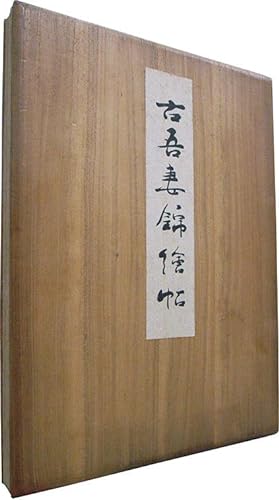
Koazuma Nishikie-cho
Published by Ca. early Taisho period [1910s], 1910
Seller: Kagerou Bunko (ABAJ, ILAB), Tokyo, Japan
Association Member: ILAB
Seller rating 2 out of 5 stars

Hardcover. Condition: Near fine. Kitagawa Utamaro ; Chobunsai Eishi ; Ippitsusai Buncho ; Isoda Koryusai ; Suzuki Harunobu ; Hiroshige ; Yamamoto Yoshinobu ; Shiba Kokan ; Torii Kiyonaga (illustrator). An album of delicately carved woodblock-print reproductions of classic ukiyo-e prints. The 24 colour tipped-in prints consist of six by Kitagawa Utamaro (including three triptychs), three by Chobunsai Eishi, one by Ippitsusai Buncho, two by Isoda Koryusai, six by Suzuki Harunobu, three by Hiroshige (all triptychs), one by Yamamoto Yoshinobu, one by Shiba Kokan, and one by Torii Kiyonaga. A charming album of woodblock-printed reproductions of ukiyo-e by some of Japanfs greatest artistic minds. Original accordion-style binding, with thick wooden upper and lower boards. Light foxing to textblock edges and original woodblock-printed title slip. Small ex-bookseller`s sticker to upper pastedown. Occasional very light foxing (mostly just to margins) and small marks, but in overall near fine condition. Comes with original book-envelope. 1 v. Binding measures 33.5 x 24.7 cm. Each woodblock print measures 29 x 22 cm. Text in Japanese. Used book.
-

Koryusai, Isoda. Vorbereitung des Mädchenfests Hina-Matsuri (Yamato nishiki-e)
Published by 1770-1780, 1770
Condition: guter Zustand. Koryusai, Isoda. Vorbereitung des Mädchenfests Hina-Matsuri (Yamato nishiki-e).1770-1780. Farbholzschnitt, auf Reispapier. Originale Künstlergrafik, von Isoda Koryusai. 27,8 x 21,2 cm (Darstellung / Druckbild), 29,2 x 22,0 cm (Blatt).Weitgehend originalrandiges Exemplar. Papier geringfügig gegilbt. In den oberen Ecken verso unscheinbare Montagespuren. Insgesamt guter Zustand.Isoda Koryusai (1735 - 1790). Eigentlich Isoda Masakatsu. Japanischer Maler und Holzschnitt-Künstler des Ukiyoe. Ursprünglich Samurai des Tsuchiya-Han entschied er sich für die Laufbahn eines Ukiyoe-Künstlers und wurde Schüler von Nishimura Shigenaga. Der Farbholzschnitt von Suzuki Harunobu war für ihn stilbildend, weshalb er auch zunächst als Haruhiro signierte. Ab 1770, mit dem Tod von Harunobu, nannte er sich Koryusai. Widmete sich bevorzugt der Darstellung von Genre-Szenen, wie z.B. in seiner bekannten Serie Hinagata wakana no hatsumoy (etwa: Junge Püppchen in ihrer Neujahrskleidung). 27,8 x 21,2 cm (Darstellung / Druckbild), 29,2 x 22,0 cm (Blatt). In der Darstellung rechts Signatur des Künstlers.
-
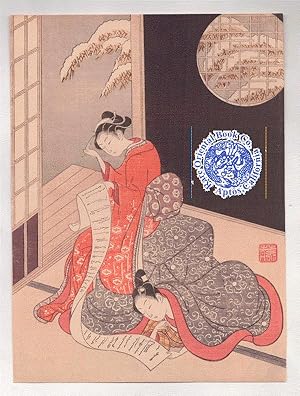
TWO BIJIN READING A LOVE LETTER. [Shows Two Primitive Japanese Beauties In Lavis
Seller: RARE ORIENTAL BOOK CO., ABAA, ILAB, Aptos, CA, U.S.A.
Seller rating 5 out of 5 stars
[Tokyo n.d. ca. 1900-1912]. Color woodblock print, sheet: 19.7 x 26.5 cm., Chuban, superb impression & registry, fine example no flaws, verso: "Made in Japan" stamp, else clean, seldom found reprint. * * FINE & RARE EXAMPLE * * . *** **** *** . . A BEAUTIFUL SCENE SHOWING TWO PRIMITIVE BIJIN . . . WEARING ELABORATE SILK KIMONO . . . READING A LONG SCROLL LOVE LETTER . * Koryusai, the early primitive master artist focused on drawing and painting Japanese beauties. This example shows his skill in conveying the emotional message of receiving and reading a love letter. . The season is winter, with snow outside on a tree limb. One Bijin [beauty] stands while reading a love letter, she scratches her hair with a Kanzashi [hair pin]. The other Bijin is cold and remains under a thick Futon [padded winter blanket], while reading the love letter. . *** Color photos are posted to our webstie. . *** CONDITION: The print is pristine, wit superb registry & impression, no flaws or issues. The verso [back] is very clean, with a lower right corner tiny stamp: "Made in Japan." . About as good as it can get. . This is a late Meiji period reprint of the 18t century original edition. . *.
-
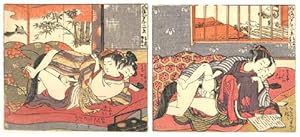
12,8 x 14,5 cm. 2 japanische Farbholzschnitte unter einem Passepartout montiert. Sehr gute Drucke in schönen Farben und bester Erhaltung. Ein Farbholzschnitt zeigt ein Paar beim Liebesakt unter einem offenen Fenster, der andere ein Liebespaar beim Akt vor einem Paravent mit Bambus- und Vogelmotiv. Koryûsai war Samurai und japanischer Maler. Seine Holzschnitte folgen dem Stil Suzuki Harunobus. Er war der erste, der das Oban-Format verwendete, das später zum Standardformat für japanische Farbholzschnitte werden sollte. --------------- Shunga. Koryusai, Isoda (active circa 1764-1781). Two shunga prints from the series Fûryû Edo jûnikei (Twelve Fashionable Views of Edo). 12.8 x 14.5 cm. 2 Japanese colour woodblock prints mounted under a passe-partout. Very good prints in beautiful colours and excellent condition. One colour woodcut shows a couple making love under an open window, the other shows a couple making love in front of a screen with a bamboo and bird motif. Koryûsai was a samurai and Japanese painter. His woodcuts follow the style of Suzuki Harunobu. He was the first to use the oban format, which later became the standard format for Japanese colour woodcuts.
-
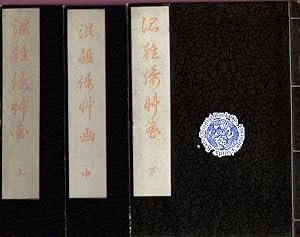
KONZATSU YAMATO SOHGA: MISCELLANEOUS SKETCHES
Seller: RARE ORIENTAL BOOK CO., ABAA, ILAB, Aptos, CA, U.S.A.
Seller rating 5 out of 5 stars
[Tokyo 1781, n.p.] 19th century Meiji reprint edition, 3 vol set, black stitched wrappers., 48 b.w. woodcuts, 16+16+16p., very clean copy, 18 x 25 cm. * SELDOM FOUND RARE EXAMPLE * . *** **** *** . .A SUPERB EXAMPLE OF KORYUSAI'S STUNNING TALENT & CREATIVITY . . . AN INNOVATOR IN EARLY JAPANESE WOODBLOCK BOOK PRINTING . * Depicting Japanese subjects i.e birds, flowers, figures and a myriad of typical native Japanese subjects. . Showing the master artist's skill and brushwork. . *** CONDITION: . a very clean, solid and firm example, with excellent registry & impression. Seldom found. aAbove average example. . *** Color photos are posted to our website. . *** REFERENCES: . BROWN, Louise N.: BLOCK PRINTING AND BOOK ILLUSTRATION IN JAPAN, [Japanese Woodblock Printed E-hon Books & Ukiyo-E Prints], see p.145-6. . *.